Topics
Transportation in Plants
- Transport System in Plants
- Complex Permanent Tissue: Xylem Structure and Function (Conducting Tissue)
- Complex Permanent Tissue: Phloem Structure and Function (Conducting Tissue)
- Differences Between Xylem and Phloem
- Diffusion
- Forces Contributing to Ascent of Sap
- Root Pressure
- Factors Affecting the Rate of Transpiration
Transport in Plants
Unit 1: Transport in Plants
Reproduction in Plants
Reproduction in Plants
- Sexual Reproduction in Plants
- Pollination
- Fertilisation in Flowering Plants
- Artificial Pollination
Unit 2 : Life Processes
Reproduction in Humans
Reproduction in Humans
Unit 3: Ecosystems
Ecosystem
- Forests: Our Lifeline
- Food Chain
- Food Web
- Energy Pyramid
- Risks to Ecosystem
- Need to Restore and Conserve the Ecosystems
Ecosystems
Unit 4: Human Body
Endocrine System and Adolescence
Human Body: Endocrine System
- Chemical Coordination
- Human Endocrine Glands and Harmones
- Concept of Adolescence
- Physical Changes
- Adolescence and the Related Psychological Changes
- Types of Hygiene: Personal Hygiene
- Stress Management
Unit 5: Health and Hygiene
Human Body: Circulatory System
Unit 6: Food Production
The Circulatory System
Nervous System
Human Body: Nervous System
- Control and Co-ordination in Human Being
- Nerve Fibres
- Major Division of the Nervous System
- Types of Reflexes
- Reflex Arc
Diseases and First Aid
Health and Hygiene
- Hygiene
- Categories of Disease
- Spread of Communicable Diseases
- Viral Diseases
- Vector Borne Diseases
- Principles of Prevention of Diseases
- First Aid and Emergency Action
- Tobacco Abuse
- Alcohol Abuse
Food Production
- Bacteria
- Useful Role of Bacteria in Industry
- Useful Role of Bacteria in Food Industry
- Useful Role of Bacteria in Medicine
- Useful Role of Bacteria in Agriculture
- Fungi
- Economic Importance of Fungi
- Crop and Its Types
- Horticulture
- Types of Farming in India > Organic Farming
- White Revolution
- Meat Providing Livestock
- Animal Husbandry (Livestock) > Poultry Farm Management
- Aquaculture
- Animal Husbandry (Livestock) > Pisciculture (Fish Farming)
- Animal Husbandry (Livestock) > Apiculture (Bee Farming)
Food Production
- Trophic Level
- Pyramid of Energy
Trophic Level:
A trophic level refers to the position an organism occupies in a food chain. It represents the step at which an organism obtains its food and energy. Energy flows from producers (plants) to consumers (herbivores, carnivores, and omnivores). The amount of energy and matter decreases as we move from lower to higher trophic levels. Only 10% of energy is transferred to the next trophic level. The remaining 90% is lost as heat or used for metabolic processes.
Each trophic level plays a crucial role in maintaining ecological balance. Producers support the food chain by providing the primary source of energy. Consumers and decomposers ensure energy and nutrients are cycled through the ecosystem.
Trophic Levels in the Pyramid
- Producers (Base Level): All producers, such as plants, form the foundation of the pyramid. They convert solar energy into chemical energy through photosynthesis.
- 1st Trophic Level (Herbivores): Herbivores are primary consumers that directly feed on plants (producers). For example: grasshoppers, rabbits, deer.
- 2nd Trophic Level (Carnivores): Carnivores are secondary consumers that feed on herbivores. For example: frogs, foxes, and owls.
- 3rd Trophic Level (Omnivores): Omnivores are organisms that feed on both plants and animals. For example: humans, bears.

Trophic levels
Pyramid of Energy:
Lindeman, in 1942, studied the food chain and energy flow through it. Charles Elton, a British scientist, first proposed the concept of the Ecological Pyramid in 1927 after his study of the Tundra Ecosystem of the Beer Islands in England. Hence, this pyramid is also called the Eltonian Pyramid.
The Pyramid of Energy is a graphical representation of the flow of energy at each trophic level in an ecosystem. Energy transfer in an ecosystem follows a hierarchical pattern, where energy is passed from one trophic level to the next, beginning with producers and ending with decomposers. At each trophic level, the amount of energy available decreases as it is used for life processes and lost as heat.
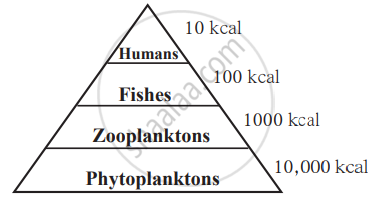
Pyramid of energy in an aquatic ecosystem
- The energy starts at the base with producers, such as phytoplankton, which store solar energy as food through photosynthesis.
- Primary consumers, such as zooplankton, feed on producers and transfer a portion of that energy to the next level.
- Secondary consumers, like fishes, feed on primary consumers, receiving less energy due to the inefficiency of energy transfer between trophic levels.
- Apex consumers, like humans, occupy the highest position in the energy pyramid and receive the least amount of energy in comparison to those at lower levels.
- After the death of apex consumers and other organisms, decomposers such as fungi and microorganisms break down their bodies into simpler compounds.
Decomposers release nutrients into the environment, making them available to plants, thus closing the nutrient cycle. Energy flow in an ecosystem is unidirectional, starting with the sun and flowing through the trophic levels, but it never returns to the sun. Decomposers also dissipate some of the remaining energy as heat during the decomposition process. This continuous circulation of energy and nutrients forms the basis of the food web, ensuring the sustainability of the ecosystem.
