Topics
Living World
- Concept of Living
- Taxonomical Aids
Systematics of Living Organisms
- Systematics of Living Organisms (Introduction)
- Systematics of Living Organisms (Introduction)
- Concept of Systematics
- Concept of Systematics
- Classification of Taxonomy
- Classification of Taxonomy
- Three Domains of Life
- Three Domains of Life
- Chemotaxonomy
- Chemotaxonomy
- Numerical Taxonomy
- Numerical Taxonomy
- Cladogram
- Cladogram
- Phylogeny
- Phylogeny
- DNA Barcoding
- DNA Barcoding
- Taxonomic Hierarchy of Living Organisms: Unit of Classification
- Taxonomic Hierarchy of Living Organisms: Unit of Classification
- Taxonomic Hierarchy
- Taxonomic Hierarchy
- Units of Classification
- Units of Classification
- Binomial Nomenclature
- General Features of Five Kingdoms
- General Features of Five Kingdoms
- Acellular Organisms
- Acellular Organisms
Kingdom Plantae
- Kingdom Plantae
- Salient Features of Major Plant Groups Under Cryptogams
- Salient Features of Major Plant Groups Under Phanerogams
- Plant Life Cycle and Alternation of Generations
Kingdom Animalia
- Criteria Used for Animal Classification
- Animal Body Plan
- History of Animal Classification
Cell Structure and Organization
- Cell: Structural and Functional Unit of Life
- Types of Cells
- Components of Eukaryotic Cell
Biomolecules
- Biomolecules in Living System
- Biomolecules in the Cell
- Biomolecules in the Cell > Carbohydrates
- Biomolecules in the Cell > Lipids
- Biomolecules in the Cell > Proteins
- Biomolecules in the Cell > Nucleic Acids
- Biomolecules in the Cell > Enzymes
- Nature of Enzyme Action
- Biomolecules in the Cell > Enzymes
- Biomolecules in the Cell > Enzymes
- Enzyme - Substrate Interactions
- Factors Affecting Enzyme Activity
- Metabolism
- Metabolic Pool
- Metabolism
Cell Division
Plant Tissues and Anatomy
- Tissues - “The Teams of Workers”
- Meristems or Meristematic Tissues
- Permanent Tissue
- Tissue System
- Secondary Growth in Plants
- Wood
- Cork Cambium and Secondary Growth
- Anatomy of Root, Stem and Leaf
Morphology of Flowering Plants
- Phanerogams > Division II- Angiosperms
- Evidences of organic evolution > Morphology
- Study of Some Important Families
Animal Tissue
Study of Animal Type : Cockroach
- Systematic Position
- External Morphology
- Criteria for New System of Classification > Body Cavity (Coelom)
- Digestive System of Cockroach
- Reproduction System
- Interactions with Mankind
Photosynthesis
- Concept of Photosynthesis
- Chloroplasts
- Nature of Light
- Mechanism of Photosynthesis
- Light Reaction
- Photophosphorylation
- Light-Independent Phase of Photosynthesis
- Photorespiration
- C4 Pathway Or Hatch-slack Pathway
- Cam - Crassulacean Acid Metabolism
- Factors Affecting Photosynthesis
Respiration and Energy Transfer
- Production of ATP
- Glycolysis
- Phases of Respiration: Pyruvate Oxidation (Link Reaction)
- Electron Transport System (Ets) and Oxidative Phosphorylation
- Tricarboxylic Acid Cycle (Citric Acid Cycle or Kreb’s Cycle)
- Phases of Respiration: Electron Transport Chain (Electron Transfer System)
- Fermentation
- Respiratory Balance Sheet
- Amphibolic Pathways
- Utility of Stepwise Oxidation
- Respiratory Quotient
Human Nutrition
- Nutrients and Nutrition
- Component of Food
- Human Digestive System
- The Mouth and Buccal Cavity
- The Salivary Glands
- The Teeth and Its Structure
- Human Digestive System
- The Food Pipe/Oesophagus
- The Stomach
- The Small Intestine
- The Large Intestine
- Human Digestive System
- Physiology of Digestion
- Absorption of Food
- Assimilation of Food
- Egestion of Food
- Nutritional and Digestive Tract Disorders
Excretion and Osmoregulation
- Excretion
- Modes of Excretion: Ammonotelism, Ureotelism, and Uricotelism
- Human Excretory System
- Kidney and Its Internal Structure
- Structure of a Kidney Tubule (Nephrons)
- Function of the Kidney - “Production of Urine”
- Concentration of Urine
- Composition of Urine
- The Excretory Organs
- Common Disorders of the Urinary System
Skeleton and Movement
- Movements and Locomotion
- Location and Structure of Skeletal Muscles
- Working of Skeletal Muscles
- Mechanism of Muscle Contraction
- Physiology of Muscle Relaxation
- Relaxation of Muscle Fibres
- Skeletal System
- Group of Skeleton
- Types of Joints
- Disorders Related to Muscles
- Disorders Related to Bones
Kingdom Plantae:
Kingdom Plantae consists of autotrophic organisms with eukaryotic cells surrounded by cell walls. Plants are unique in their ability to perform photosynthesis using chlorophyll, enabling them to produce their own food from sunlight. As the primary producers in the food chain, plants serve as the fundamental source of energy and nourishment for nearly all other living organisms, playing a vital role in sustaining life on Earth.
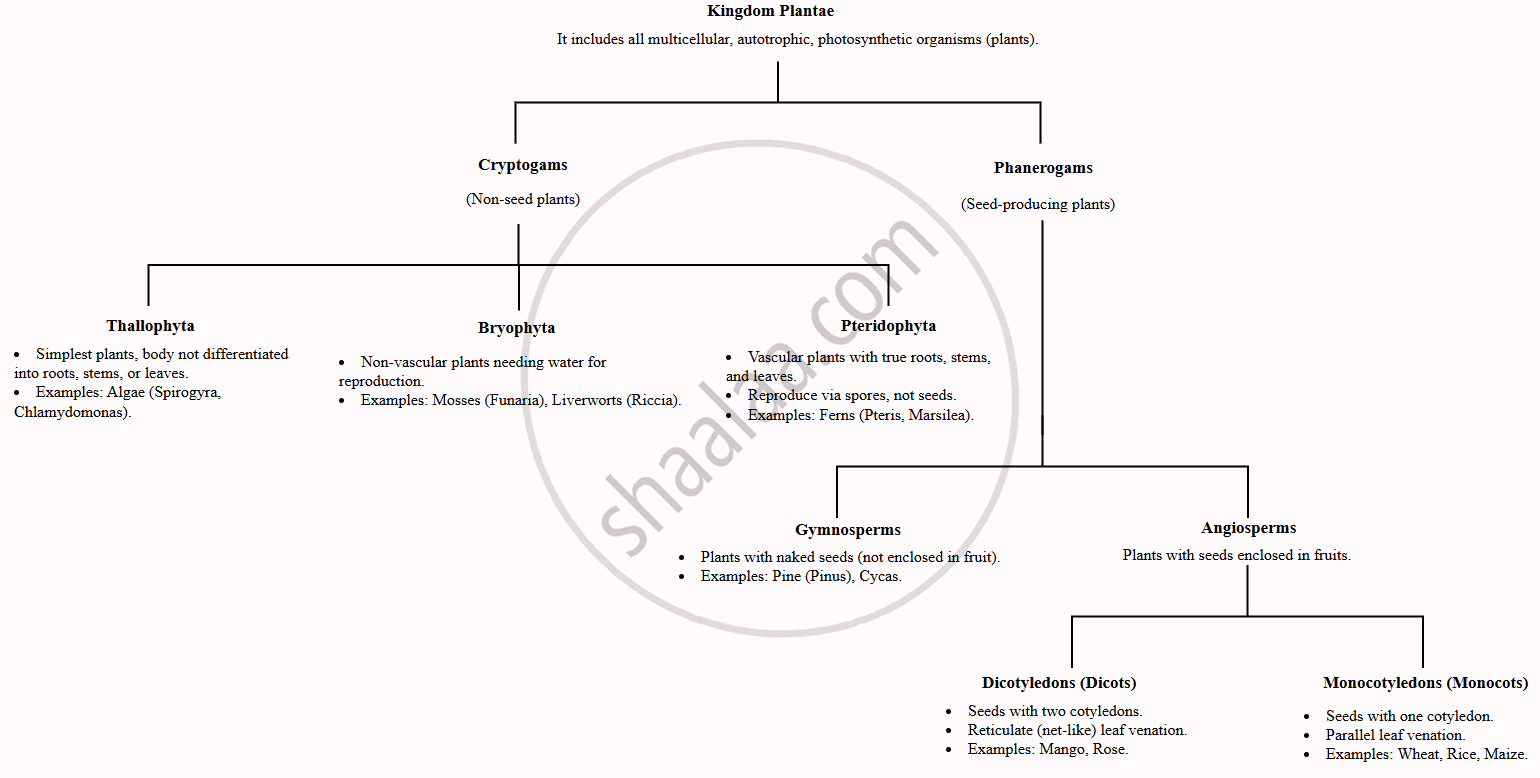
Key Points: Kingdom Plantae
1. Meaning- All eukaryotic, chlorophyll-containing organisms; cell wall made of cellulose; mostly autotrophic; some are insectivorous (e.g. Venus fly trap, Bladderwort) or parasitic (e.g. Cuscuta).
2. Members - Includes algae, bryophytes, pteridophytes, gymnosperms and angiosperms.
3. Alternation of generations - Life cycle has two phases - diploid sporophyte and haploid gametophyte - which alternate with each other.
4. Plant groups at a glance:
- Algae - Simple, aquatic, no true roots/stems/leaves. e.g. Seaweed, Green algae
- Bryophytes - Non-vascular, moist environments. e.g. Mosses, Liverworts
- Pteridophytes - Vascular, no seeds, reproduce by spores. e.g. Ferns
- Gymnosperms - Naked seeds in cones, no flowers/fruits. e.g. Pine, Fir
- Angiosperms - Seeds enclosed in fruits, the most diverse group. e.g. Rose, Lily
5. Key features - Have prominent chloroplasts for photosynthesis; membrane-bound organelles; the most diverse group among all kingdoms.
