Advertisements
Online Mock Tests
Chapters
2: Chemical Bonding
3: Acids, Bases and Salts
4: Analytical Chemistry
5: Mole concept and Stoichiometry
▶ 6: Electrolysis
7: Metallurgy
8: Study of Compounds A. Hydrogen Chloride
9: Study of Compounds B. Ammonia
10: Study of Compounds C. Nitric Acid
11: Study of Compounds D. Sulphuric Acid
12: Organic Chemistry
13: Practical Work

Advertisements
Solutions for Chapter 6: Electrolysis
Below listed, you can find solutions for Chapter 6 of CISCE S.P. Singh for Concise Chemistry [English] Class 10 ICSE.
S.P. Singh solutions for Concise Chemistry [English] Class 10 ICSE 6 Electrolysis lntext Questions [Pages 114 - 120]
Fill in the blanks.
Powdered sodium chloride (common salt) does not conduct an electric current, but it does so when ______ or when ______.
Molten lead bromide conducts electricity. It is called an ______. It is composed of lead ______ and bromide ______. The lead ions are ______ charged and are called ______. The bromide ______ are ______ charged and are called ______.
Substances which conduct electricity in the solid state are generally ______.
The electron releasing tendency of zinc is ______ than that of copper.
A solution of HCl gas in water conducts electricity because ______, but a solution of HCl gas in toluene does not conduct an electric current because ______.
Pure water consists entirely of ______.
ions
molecules
We can expect that pure water ______ normally conducts electricity.
will
will not
Electrolysis is the passage of ______ through a liquid or a solution accompanied by a ______ change.
electricity
electrons
physical
chemical
When the current is turned on, electrons flow from ______ (anode/cathode) to ______ (anode/cathode). The cathode becomes the ______ (negative/positive) electrode by which electrons ______ (enter/leave) the electrolyte.
Define the following term:
Electrolysis
Define the following term:
Non-electrolyte
Define the following term:
Cation
Define the following term:
anion
Define the following term:
Weak electrolytes
What is the difference between:
Modern explanation and Arrhenius explanation for the theory of electrolysis.
What is the difference between:
Electrolytic dissociation and ionisation.
What is the difference between:
A cation and an anion.
What is the difference between:
Electrolytic dissociation and thermal dissociation.
What is the difference between:
Strong electrolyte and weak electrolyte.
Name a salt which is a weak electrolyte.
Name a base which is a weak electrolyte.
Name an inert electrode.
Name an active electrode.
Name a positively charged non-metallic ion.
Name the electrode at which reduction occurs.
Name a non-metallic element which is a conductor of electricity.
Electrolysis is a redox process. Explain.
Classify the following substances under three headings:
- strong electrolytes
- weak electrolytes
- non-electrolytes
Acetic acid, ammonium chloride, ammonium hydroxide, carbon tetrachloride, dilute hydrochloric acid, sodium acetate, dilute sulphuric acid.
Explain why Cu, though a good conductor of electricity is a non electrolyte?
Explain why solid sodium chloride does not allow electricity to pass through?
Complete and state whether the reaction is oxidation or reduction.
\[\ce{Cl- - e- ->}\] .........
Complete and state whether the reaction is oxidation or reduction.
\[\ce{Al -}\] .......... \[\ce{-> Al^{3+}}\]
Complete and state whether the reaction is oxidation or reduction.
\[\ce{Pb^{2+} +}\] .......... \[\ce{-> Pb}\]
Complete and state whether the reaction is oxidation or reduction.
\[\ce{Sn^{4+} +}\] .......... \[\ce{-> Sn^{2+}}\]
Name two substances in the following case:
Contain only molecules.
Name two substances in the following case:
Contain only ions.
Name two substances in the following case:
Contain ions as well as molecules.
Select the ion in the following case, that would get selectively discharged from the aqueous mixture of the ions listed below:
\[\ce{SO^2-_4, NO^-_3 {and} OH-}\]
Select the ion in the following case, that would get selectively discharged from the aqueous mixture of the ions listed below:
Pb2+, Ag+ and Cu2+
Among Zn and Cu, which would occur more readily in nature as metal and which as an ion?
Why cannot we store AgNO3 solution in copper vessel?
Out of Cu and Ag, which is more active?
How would you change a metal like Cu into its ions?
How would you change Cu2+ ion to Cu?
A solution of caustic soda (NaOH) in water or when fused, conducts an electric current. what is the similarity in these two cases?
During electrolysis of an aqueous solution of sulphuric acid between platinum electrodes, two types of anions migrate towards the anode but only one of them is discharged:
- Name the two anions.
- Name the main product of the discharge of anion at the anode and write the anode reaction.
- Name the product at the cathode and write the reaction.
- Do you notice any change in colour. State why?
- Why this electrolysis, is considered as an example of catalysis?
Copper sulphate solution is electrolysed using a platinum cathode and carbon anode.
Study the diagram given alongside and answer the following questions:

- Give the names of the electrodes A and B.
- Which electrode is the oxidising electrode?
Explain the following:
A solution of cane sugar does not conduct electricity, but a solution of sodium chloride is a good conductor.
Explain the following:
Hydrochloric acid is a good conductor of electricity.
Explain the following:
During the electrolysis of an aqueous solution of NaCI, hydrogen ion is reduced at the cathode and not the sodium ion though both Na+ and H+ ions are present in the solution.
Explain the following:
On electrolysis of dilute copper (II) sulphate solution, copper is deposited at the cathode but no hydrogen gas evolves there. Explain why?
Explain the following:
When a dilute aqueous solution of sodium chloride is electrolysed between platinum electrodes, hydrogen gas is evolved at the cathode but metallic sodium is not deposited. Why?
Explain the following:
Zinc can produce hydrogen on reacting with acids but copper cannot.
To carry out the so-called "electrolysis of water", sulphuric acid is added to water. How does the addition of sulphuric acid produce a conducting solution?
AB2 is a hard crystalline solid having high melting and boiling points. It conducts electricity in aqueous and molten states.
- AB2 conducts electricity due to the presence of free ______ (ions/molecules/electrons).
- During electrolysis of AB2 in aqueous state, it is observed that cathode becomes thick and anode thin. The anode material will be ______ (graphite/metal A).
Give reason for the following:
The blue colour of aqueous copper sulphate fades when it is electrolysed using platinum electrodes.
Give reason for the following:
Lead bromide undergoes electrolytic dissociation in the molten state but is a non-electrolyte in the solid state.
Give reason for the following:
Aluminium is extracted from its oxide by electrolytic reduction and not by convectional reducing agents.
Give reason for the following:
The ratio of hydrogen and oxygen formed at the cathode and anode is 2 : 1 by volume.
Give reason for the following:
In the electrolysis of acidified water, dilute sulphuric acid is preferred to dilute nitric acid for acidification.
Give reason for the following:
Ammonia is unionised in the gaseous state but in the aqueous solution, it is a weak electrolyte.
Give reasons for the following:
A direct current instead of alternating current should be used in electrolysis.
S.P. Singh solutions for Concise Chemistry [English] Class 10 ICSE 6 Electrolysis EXERCISE-6 [Pages 124 - 127]
MULTIPLE CHOICE TYPE: (Choose the correct answer from the options given below).
During the electrolysis of molten lead bromide, which of the following takes place?
Bromine is released at the cathode.
Lead is deposited at the anode.
Bromine ions gain electrons.
Lead is deposited at the cathode.
The aqueous solution of the compound which contains both ions and molecules is ______.
H2SO4
HCl
HNO3
CH3COOH
A compound which during electrolysis in its molten state, liberates a reddish brown gas at the anode.
Sodium chloride
Copper [II] oxide
Copper [II] sulphate
Lead [II] bromide
Identify the weak electrolyte from the following:
Sodium chloride solution
Dilute hydrochloric acid
Dilute sulphuric acid
Aqueous acetic acid
An aqueous electrolyte consists of the ions mentioned in the list. The ion which could be discharged most readily during electrolysis.
\[\ce{Fe^{2+}}\]
\[\ce{Cu^{2+}}\]
\[\ce{H^+}\]
Pb2+
An electrolyte which completely dissociates into ions is ______.
Alcohol
Carbonic acid
Sucrose
Sodium hydroxide
During silver plating of an article using potassium argentocyanide as an electrolyte, the anode material should be.
Cu
Ag
Pt
Fe
Which of these will act as a non-electrolyte?
Liquid carbon tetrachloride
Acetic acid
Sodium hydroxide aqueous solution acid
Potassium chloride aqueous solution
The observation seen when fused lead bromide is electrolysed is ______.
A silver grey deposit at anode and a reddish brown deposit at cathode.
A silver grey deposit at cathode and a reddish brown deposit at anode.
A silver grey deposit at cathode and reddish brown fumes at anode.
Silver grey fumes at anode and reddish brown fumes at cathode.
During electroplating an article with silver, the electrolyte used is ______.
Silver nitrate solultion
Silver cyanide solution
Sodium argentocyanide solution
Nickel sulphate solution
The metallic electrode which does not take part in an electrolytic reaction.
Cu
Ag
Pt
Ni
The ion which is discharged at the anode during the electrolysis of copper sulphate solution using platinum electrodes as anode and cathode.
\[\ce{Cu^{2+}}\]
\[\ce{OH^{-}}\]
\[\ce{SO^{2-}4}\]
\[\ce{H^+}\]
When dilute sodium chloride is electrolysed using graphite electrodes, the cation which is discharged at the cathode most readily.
\[\ce{Na^{1+}}\]
\[\ce{OH^{1-}}\]
\[\ce{H^{1+}}\]
\[\ce{Cl^{1-}}\]
Cathode is a reducing electrode because ______.
it has less number of electrons.
it has deficiency of electrons.
cations gain electrons from cathode.
anions lose electrons to cathode.
Which statement about conduction of electricity is correct?
Electricity is conducted in aqueous solution by electrons.
Electricity is conducted in a metal wire by ions.
Electricity is conducted in a molten electrolyte by electrons.
Electricity is conducted in an acid solution by ions.
The oxidation reaction among the following is:
\[\ce{Fe^{3+} + 3e- -> Fe}\]
\[\ce{Fe^{2+} - 1e- -> Fe^{3+}}\]
\[\ce{Cl2 + 2e- -> 2Cl-}\]
\[\ce{Cu^{2+} + 2e- -> Cu}\]
During electrolysis, what happens to metallic ions and at which electrode do they get discharged?
P Reduction of metallic ions, cathode
Q Oxidation of metallic ions, anode
R Oxidation of metallic ions, cathode
Only P
Only Q
both P and Q
Both Q and R
The following questions are Assertion-Reason based questions. Choose the answer based on the codes given below.
Assertion (A): Electrolysis establishes a relationship between electrical energy and chemical energy.
Reason (R): Substances like metals, carbon (graphite) are conductors while salts like NaCl, KCl are electrolytes.
Both A and R are true and R is the correct explanation of A.
Both A and R are true but R is not the correct explanation of A.
A is true but R is false.
A is false but R is true.
Assertion (A): Benzene acts as non-electrolyte.
Reason (R): Benzene does not have free ions.
Both A and R are true and R is the correct explanation of A.
Both A and R are true but R is not the correct explanation of A.
A is true but R is false.
A is false but R is true.
Assertion (A): Metals and alloys conduct electricity with the help of electrons.
Reason (R): Non-metals do not have free electrons.
Both A and R are true and R is the correct explanation of A.
Both A and R are true but R is not the correct explanation of A.
A is true but R is false.
A is false but R is true.
Assertion (A): Weak electrolytes do not allow any electricity to flow through them.
Reason (R): Substances which are composed of only molecules do not allow any current to flow through them.
Both A and R are true and R is the correct explanation of A.
Both A and R are true but R is not the correct explanation of A.
A is true but R is false.
A is false but R is true.
Assertion (A): NaCl is an example of an electrolyte.
Reason (R): NaCl conducts electricity in aqueous or molten state.
Both A and R are true and R is the correct explanation of A.
Both A and R are true but R is not the correct explanation of A.
A is true but R is false.
A is false but R is true.
Assertion (A): An electrolyte can be acid, base or salt.
Reason (R): An electrolyte is a substance which can conduct electricity in aqueous or molten state.
Both A and R are true and R is the correct explanation of A.
Both A and R are true but R is not the correct explanation of A.
A is true but R is false.
A is false but R is true.
Assertion (A): Oxidation occurs at the anode.
Reason (R): Electrons are gained at the anode.
Both A and R are true and R is the correct explanation of A.
Both A and R are true but R is not the correct explanation of A.
A is true but R is false.
A is false but R is true.
Assertion (A): Polar covalent compounds can form ions when dissolved in water.
Reason (R): Electrovalent compounds show dissociation.
Both A and R are true and R is the correct explanation of A.
Both A and R are true but R is not the correct explanation of A.
A is true but R is false.
A is false but R is true.
Assertion (A): A block of pure silver metal is used as anode during silver plating.
Reason (R): Silver ions are deposited as metal at the anode.
Both A and R are true and R is the correct explanation of A.
Both A and R are true but R is not the correct explanation of A.
A is true but R is false.
A is false but R is true.
VERY SHORT ANSWER TYPE: (Choose the correct word to fill in the blanks).
Cations are formed by ______ of electrons and anions are formed by ______ of electrons.
loss
gain
Match the following in column A with the correct answer from the choices given in column B:
| Column A | Column B |
| 1. Ammonium hydroxide solution | (i) Contains only ions |
| 2. Dilute hydrochloric acid | (ii) Contains only molecules |
| 3. Carbon tetrachloride | (iii) Contains ions and molecules |
Choose A, B, C or D to match the descriptions (i) to (v) below . Some alphabets may be repeated.
(A) Non-electrolyte, (B) Strong electrolyte, (C) Weak electrolyte, (D) Metallic conductor
(i) Molten ionic compound
(ii) Carbon tetrachloride
(iii) An aluminium wire
(iv) A solution containing solvent molecules, solute molecules and ions formed by the dissociation of solute molecules
(v) A sugar solution with sugar molecules and water molecules.
Name the kind of particles present in sodium hydroxide solution.
Name the kind of particles present in carbonic acid.
Name the kind of particles present in the sugar solution.
What kind of particles will be found in a liquid compound which is a non-electrolyte?
If HX is a weak acid, what particles will be present in its dilute solution apart from those of water?
What ions must be present in a solution used for electroplating a particular metal?
A strip of copper is placed in four different colourless salt solutions. They are KNO3, AgNO3, Zn(NO3)2 and Ca(NO3)2. Which one of the solutions will finally turn blue?
Here is an electrode reaction:
\[\ce{Cu -> Cu^{2+} + 2e^-}\]
At which electrode (anode or cathode) would such a reaction take place? Is this an example of oxidation?
Give one word or phrase for the following:
Electrolytic deposition of a superior metal on a baser metal.
Identify:
A gas which does not conduct electricity in the liquid state but conducts electricity when dissolved in water.
Aqueous solution of nickel sulphate contains \[\ce{Ni^{+2}}\] and \[\ce{SO^{-2}_{4}}\] ions.
- Which ion moves towards the cathode?
- What is the product at the anode?
Give reason for the following:
Carbon tetrachloride is a liquid but does not conduct electricity.
Give reason for the following:
Potassium is not extracted by electrolysis of its aqueous salt solution.
Give reasons as to why - the electrolysis of acidulated water is considered to be an example of catalysis.
Give appropriate scientific reasons for the following statement:
During electrolysis of molten lead bromide, graphite anode is preferred to other electrodes.
Give reason for the following:
Electrolysis of molten lead bromide is considered to be a reaction in which oxidation and reduction go side by side, i.e., a redox reaction.
Give reasons why sodium chloride will conduct electricity only in the fused or aqueous solution state.
Give reasons why in the electroplating of an article with silver, the electrolyte sodium argentocynide solution is preferred over silver nitrate solution.
Give reasons why although copper is a good conductor of electricity, it is a non-electrolyte.
Write two applications of electrolysis in which the anode diminishes in mass.
A solution contains magnesium ions (Mg+2), iron (II) ions (Fe+2) and copper ions (Cu+2). On passing an electric current through this solution, which ions will be the first to be discharged at the cathode? Write the equation for the cathode reaction.
During electroplating of an article with nickel, name the electrolyte.
During electroplating of an article with nickel, name the cathode.
During electroplating of an article with nickel, name the anode.
During electroplating of an article with nickel, give the reaction of the electrolysis at the cathode.
During electroplating of an article with nickel, give the reaction of the electrolysis at the anode.
Three different electrolytic cells, A, B and C are connected in separate circuits. Electrolytic cell A contains a sodium chloride solution. When the circuit is completed, a bulb in the circuit glows brightly. Electrolytic cell B contains an acetic acid solution and in this case, the bulb in the circuit glows dimly. The electrolytic cell C contains a sugar solution and the bulb does not glow. Give a reason for each of these observations.
Differentiate between the electrical conductivity of copper sulphate solution and copper metal.
State one observation when electricity is passed through molten lead bromide.
State your observation at the cathode, when acidified aqueous copper sulphate solution is electrolysed with copper electrodes.
State one relevant observation for the following:
At the anode when aqueous copper sulphate solution is electrolysed using copper electrodes.
Which electrode—anode or cathode—is the oxidising electrode? Why?
M2O is the oxide of a metal ‘M’ which is above hydrogen in the activity series. M2O when dissolved in water forms the corresponding hydroxide which is a good conductor of electricity.
- State the reaction taking place at the cathode
- Name the product at the anode.
Choosing only words from the following list, write down the appropriate words to fill in the blanks (a) to (e) below:
anions, anode, cathode, cations, electrode, electrolyte, nickel, voltameter.
The electroplating of an article with nickel requires an (a) ______ which must be a solution containing (b) ______ ions. The article to be plated is placed as the (c) ______ of the cell in which the plating is carried out. The (d) ______ of the cell is made from pure nickel. The ions that are attracted to the negative electrode and discharged are called (e) ______.
When a molten ionic compound is electrolysed, the metal is always formed at ______ and the non-metal is formed at ______.
Electrolysis of acidulated water is an example of ______.
Reduction
Oxidation
Redox reaction
Synthesis
LONG ANSWER TYPE:
Element X is a metal with a valency 2. Element Y is a non-metal with a valency 3.
Write equations to show how X and Y form ions?
Element X is a metal with a valency 2. Element Y is a non-metal with a valency 3.
If Y is a diatomic gas, write the equation for the direct combination of X and Y to form a compound.
Element X is a metal with a valency 2. Element Y is a non-metal with a valency 3.
If the compound formed between X and Y is melted and an electric current passed through the molten compound, the element X will be obtained at the ______ and Y at the ______ of the electrolytic cell. (Provide the missing words).
Draw a labelled diagram to show how iron is electroplated with copper.
Which solution is preferred as electrolyte, CuSO4 or FeSO4?
Describe what happens to the iron object and the copper rod.
A metal article is to be electroplated with silver. The electrolyte selected is sodium argentocyanide.
- What kind of salt is sodium argentocyanide?
- Why is it preferred to silver nitrate as an electrolyte?
- State one condition to ensure that the deposit is smooth, firm and long lasting.
- Write the reaction taking place at the cathode.
- Write the reaction taking place at the anode.
During the electrolysis of copper (II) sulphate solution using platinum as cathode and carbon as anode:
- What do you observe at the cathode and at the anode?
- What change is noticed in the electrolyte?
- Write the reactions at the cathode and at the anode.
(a) Copy and complete the following table, which refers to two practical applications of electrolysis.
| Anode | Electrolyte | Cathode | |
| (i) Silver plating of a spoon | A solution of potassium argentocyanide | ||
| (ii) Purification of copper | |||
| (iii) Extraction of sodium |
(b) Write the equation taking place at the anode for Q. (a).
The following sketch represents the electroplating of an Iron cup with Nickel metal.
Study the diagram and answer the following questions:

- During electroplating, the iron cup is placed at the cathode. Why?
- Name the ion that must be present in the electrolyte.
- State one condition that is necessary to ensure that the deposit is smooth, firm and even.
- Write the reaction taking place at the cathode.
- What change would you observe at the anode?
Copper sulphate solution is electrolyzed using copper electrodes. Study the diagram given alongside and answer the questions that follow.
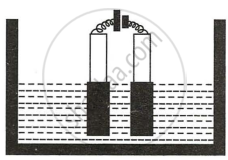
- Which electrode to your left or right is known as the oxidizing electrode and why?
- Write the equation representing the reaction that occurs.
- State two appropriate observations for the above electrolysis reactions.
Electroplating steel objects with silver involves a three-step process.
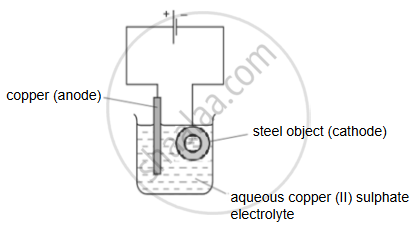
Step 1: A coating of copper is applied to the object.
Step 2: A coating of nickel is applied to the object.
Step 3: The coating of silver is applied to the object.
(a) A diagram of the apparatus used for step 1 is shown.
- The chemical process taking place on the surface of the object is \[\ce{Cu^2+_{ (aq)} + 2e- ->Cu_{(s)}}\].
What is the observation seen on the surface of the object? - Explain why the concentration of copper ions in the electrolyte remains constant throughout step 1.
(b) Give two changes which would be needed in order to coat nickel onto the object in step 2.
(c) Write down the reaction taking place at the positive electrode during step 3.
Solutions for 6: Electrolysis
S.P. Singh solutions for Concise Chemistry [English] Class 10 ICSE chapter 6 - Electrolysis
Shaalaa.com has the CISCE Mathematics Concise Chemistry [English] Class 10 ICSE CISCE solutions in a manner that help students grasp basic concepts better and faster. The detailed, step-by-step solutions will help you understand the concepts better and clarify any confusion. S.P. Singh solutions for Mathematics Concise Chemistry [English] Class 10 ICSE CISCE 6 (Electrolysis) include all questions with answers and detailed explanations. This will clear students' doubts about questions and improve their application skills while preparing for board exams.
Further, we at Shaalaa.com provide such solutions so students can prepare for written exams. S.P. Singh textbook solutions can be a core help for self-study and provide excellent self-help guidance for students.
Concepts covered in Concise Chemistry [English] Class 10 ICSE chapter 6 Electrolysis are Preferential or Selective Discharge of Ions at Electrodes, Examples of Electrolysis, Cations vs Anions, Conduction in Compounds, Characteristics of Electrolysis, Electrolytic Dissociation, Applications of Electrolysis > Electroplating, Oxidation, Theory of Electrolytic Dissociation, Electrochemical Series (Electromotive Series), Electrolysis and Conductivity of Substances, Metallic Conductors and Electrolytic Conductors, Strong Electrolytes vs Weak Electrolytes, Acids, Bases and Salts as Electrolytes, Anode vs Cathode, Chemical Properties of Carbon Compounds > Reduction, Ionisation, Comparison of Ionisation and Dissociation, Applications of Electrolysis > Electrolytic Refining of Metals, Applications of Electrolysis > Electrometallurgy, Preferential or Selective Discharge of Ions at Electrodes, Examples of Electrolysis, Cations vs Anions, Conduction in Compounds, Characteristics of Electrolysis, Electrolytic Dissociation, Applications of Electrolysis > Electroplating, Oxidation, Theory of Electrolytic Dissociation, Electrochemical Series (Electromotive Series), Electrolysis and Conductivity of Substances, Metallic Conductors and Electrolytic Conductors, Strong Electrolytes vs Weak Electrolytes, Acids, Bases and Salts as Electrolytes, Anode vs Cathode, Chemical Properties of Carbon Compounds > Reduction, Ionisation, Comparison of Ionisation and Dissociation, Applications of Electrolysis > Electrolytic Refining of Metals, Applications of Electrolysis > Electrometallurgy, Preferential or Selective Discharge of Ions at Electrodes, Examples of Electrolysis, Cations vs Anions, Conduction in Compounds, Characteristics of Electrolysis, Electrolytic Dissociation, Applications of Electrolysis > Electroplating, Oxidation, Theory of Electrolytic Dissociation, Electrochemical Series (Electromotive Series), Electrolysis and Conductivity of Substances, Metallic Conductors and Electrolytic Conductors, Strong Electrolytes vs Weak Electrolytes, Acids, Bases and Salts as Electrolytes, Anode vs Cathode, Chemical Properties of Carbon Compounds > Reduction, Ionisation, Comparison of Ionisation and Dissociation, Applications of Electrolysis > Electrolytic Refining of Metals, Applications of Electrolysis > Electrometallurgy.
Using S.P. Singh Concise Chemistry [English] Class 10 ICSE solutions Electrolysis exercise by students is an easy way to prepare for the exams, as they involve solutions arranged chapter-wise and also page-wise. The questions involved in S.P. Singh Solutions are essential questions that can be asked in the final exam. Maximum CISCE Concise Chemistry [English] Class 10 ICSE students prefer S.P. Singh Textbook Solutions to score more in exams.
Get the free view of Chapter 6, Electrolysis Concise Chemistry [English] Class 10 ICSE additional questions for Mathematics Concise Chemistry [English] Class 10 ICSE CISCE, and you can use Shaalaa.com to keep it handy for your exam preparation.
