Advertisements
Chapters
II: Section 2: Textual Passages
III: Section 3: Poetry
▶ IV: Section 4: Non - Textual Passage
V: Section 5: Writing Skill
VI: Section 6: Creative Writing

Advertisements
Solutions for Chapter IV: Section 4: Non - Textual Passage
Below listed, you can find solutions for Chapter IV of Maharashtra State Board SCERT Maharashtra for English Standard 10 Maharashtra State Board.
SCERT Maharashtra solutions for English Standard 10 Maharashtra State Board IV Section 4: Non - Textual Passage ACTIVITY - SET 1 [Pages 21 - 22]
Read the following passage and do the activities:
A1. Complete the following: [2]
- Neeraj Chopra topped the qualifying ______.
- “My goal was always ______.”
- Indian Javelin thrower Jaiveer Choudhary recognised his potential ______.
- He shot to fame after winning the gold medal at ______.
|
Heading into the Tokyo Olympics, Neeraj Chopra was, at best, a dark horse in the men’s javelin competition which featured a strong field consisting of overwhelming favourite Johannes Vetter, reigning world champion Anderson Peters, London 2012 gold medallist Keshorn Walcott, among others. Come the main event, though, the Indian stepped up in a major way. Neeraj Chopra topped the qualifying round with an 86.65 m throw, finishing above Vetter’s 85.64 m. The challenge from Vetter to Neeraj Chopra in the final never materialised; The German struggled and failed to make it into the final eight, as Chopra led the field from start to finish. While his first throw measuring 87.03 m put him on the perch, Neeraj Chopra consolidated his spot with an 87.58 m second attempt - a throw that eventually proved enough to win him the historic gold medal. “My goal was always the Tokyo Olympics. I put in the hard work and trusted the process since every single effort counts when it comes to success at the highest level,” Neeraj Chopra said after his win. The win was the culmination of a remarkable, yet short, journey which began with a 13-year-old obese kid taking up sports to lose weight and gain confidence. Neeraj Chopra soon took to javelin throw after watching the sport at the Shivaji Stadium in Panipat. With the ability to throw over 40 m with no training, his talent for the discipline was obvious. Indian javelin thrower Jaiveer Choudhary recognised his potential and took Neeraj Chopra under his wings. With proper coaching, there was no turning back for the Haryana lad. Neeraj Chopra dominated the national scene at the youth level and won multiple international accolades. He shot to fame after winning the gold medal at the 2016 IAAF World U20 Championships in Bydgoszcz, Poland. His winning throw of 86.48m at Poland still stands as the under-20 javelin throw record and made him the first Indian track and field athlete to become a world champion at any level and hold a world record. With the qualifying cut off for Rio 2016 men’s javelin throw set at 83.00 m, the attempt would also have qualified Neeraj Chopra for his maiden Olympics but unfortunately, it came a week after the qualification window had shut. Before that, injuries had hampered Neeraj Chopra’s Rio qualification campaign. |
A2. How did Neeraj Chopra win the historic gold medal at the Tokyo Olympics? [2]
A3. Form noun forms of: [2]
- Reigning
- Dominated
- Qualifying
- Recognized
A4. Do as directed: [2]
- The win was the culmination of a remarkable, yet short, journey which began with a 13-year-old obese kid taking up sports to lose weight and gain confidence.
(Use not only......but also) - Injuries had hampered Neeraj Chopra’s Rio Qualification campaign
(Add a question tag)
A5. Do you think only hard work leads to success? Why? [2]
Write a summary of the following passage and suggest a suitable title for it.
|
Heading into the Tokyo Olympics, Neeraj Chopra was, at best, a dark horse in the men’s javelin competition which featured a strong field consisting of overwhelming favourite Johannes Vetter, reigning world champion Anderson Peters, London 2012 gold medallist Keshorn Walcott, among others. Come the main event, though, the Indian stepped up in a major way. Neeraj Chopra topped the qualifying round with an 86.65 m throw, finishing above Vetter’s 85.64 m. The challenge from Vetter to Neeraj Chopra in the final never materialised; The German struggled and failed to make it into the final eight, as Chopra led the field from start to finish. While his first throw measuring 87.03 m put him on the perch, Neeraj Chopra consolidated his spot with an 87.58 m second attempt - a throw that eventually proved enough to win him the historic gold medal. “My goal was always the Tokyo Olympics. I put in the hard work and trusted the process since every single effort counts when it comes to success at the highest level,” Neeraj Chopra said after his win. The win was the culmination of a remarkable, yet short, journey which began with a 13-year-old obese kid taking up sports to lose weight and gain confidence. Neeraj Chopra soon took to javelin throw after watching the sport at the Shivaji Stadium in Panipat. With the ability to throw over 40 m with no training, his talent for the discipline was obvious. Indian javelin thrower Jaiveer Choudhary recognised his potential and took Neeraj Chopra under his wings. With proper coaching, there was no turning back for the Haryana lad. Neeraj Chopra dominated the national scene at the youth level and won multiple international accolades. He shot to fame after winning the gold medal at the 2016 IAAF World U20 Championships in Bydgoszcz, Poland. His winning throw of 86.48 m at Poland still stands as the under-20 javelin throw record and made him the first Indian track and field athlete to become a world champion at any level and hold a world record. With the qualifying cut off for Rio 2016 men’s javelin throw set at 83.00 m, the attempt would also have qualified Neeraj Chopra for his maiden Olympics but unfortunately, it came a week after the qualification window had shut. Before that, injuries had hampered Neeraj Chopra’s Rio qualification campaign. |
SCERT Maharashtra solutions for English Standard 10 Maharashtra State Board IV Section 4: Non - Textual Passage ACTIVITY - SET 2 [Pages 23 - 24]
Read the following passage and do the activities:
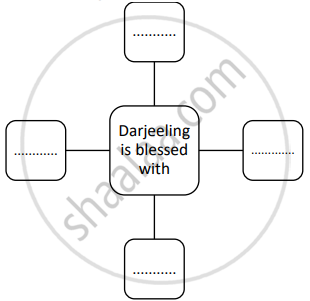
A1. Complete the web diagram: [2]
|
Darjeeling is a town in India’s West Bengal state, located in the Himalayan foothills at an elevation of 6,700 ft (2,042.2 m). It is famed for its tea and the “Toy Train” a UNESCO Heritage Site. It is one of the few hill stations that are connected with the plains with a steam locomotive. The town is set against the backdrop of the snow-capped southern Himalayan mountains. Mt. Kanchenjunga happens to be the third highest mountain in the world. Darjeeling is globally famous for the tea produces, it is one of the oldest and most celebrated tea growing regions of the world. Darjeeling tea is internationally recognized and ranks among the most popular of the black teas. It is globally recognized as the ‘Champagne’ of teas. The region is blessed with a year-long cold climate, fresh mountain air, pine trees and natural flora and fauna which is not found elsewhere. The resultant is, Darjeeling produces some of the most prized aromatic teas. Harvest seasons in Darjeeling are distributed over a span of nine months with three major tea flushes (spring, summer, and autumn) and two minor ‘in-between’ flushes. Every flush produces unique varieties of tea, and no two flushes produce the same kind. The famous Darjeeling ‘muscatel tea’ is one such kind. No other part of the world is known to produce this variety of tea. |
A2. How long does Darjeeling Harvest season last? [2]
A3. Write the synonyms of the following words from the above passage: [2]
- Inherited traditions
- Joined
- Animals
- Different
A4. Do as Directed: [2]
- Mt. Kanchenjunga happens to be the third highest mountain in the world.
(Change the voice) - Darjeeling produces some of the most prized aromatic teas.
(Rewrite as Negative sentence)
A5. What kind of difficulties do people in mountainous region face? [2]
Write a summary of the following passage and suggest a suitable title for it.
|
Darjeeling is a town in India’s West Bengal state, located in the Himalayan foothills at an elevation of 6,700 ft (2,042.2 m). It is famed for its tea and the “Toy Train” a UNESCO Heritage Site. It is one of the few hill stations that are connected with the plains with a steam locomotive. The town is set against the backdrop of the snow-capped southern Himalayan mountains. Mt. Kanchenjunga happens to be the third highest mountain in the world. Darjeeling is globally famous for the tea produces, it is one of the oldest and most celebrated tea growing regions of the world. Darjeeling tea is internationally recognized and ranks among the most popular of the black teas. It is globally recognized as the ‘Champagne’ of teas. The region is blessed with a year-long cold climate, fresh mountain air, pine trees and natural flora and fauna which is not found elsewhere. The resultant is, Darjeeling produces some of the most prized aromatic teas. Harvest seasons in Darjeeling are distributed over a span of nine months with three major tea flushes (spring, summer, and autumn) and two minor ‘in-between’ flushes. Every flush produces unique varieties of tea, and no two flushes produce the same kind. The famous Darjeeling ‘muscatel tea’ is one such kind. No other part of the world is known to produce this variety of tea. |
SCERT Maharashtra solutions for English Standard 10 Maharashtra State Board IV Section 4: Non - Textual Passage ACTIVITY - SET 3 [Pages 24 - 26]
Read the following passage and do the activities:
A1. Match the levels of education of Column A with institutions given in Column B: [2]
| A | B |
| Schooling | IIT Bombay |
| Graduation | Tamil Medium Government school |
| Master’s in engineering | ST. Hindu college |
| PhD | IISc |
|
The humble son of a farmer from Sarakkalvilai village in Tamil Nadu’s Kanyakumari district, Dr. K.Sivan as Indian Space Research Organization (ISRO) chairman was leading the Chandrayaan-2 mission to Moon. Sivan studied at a Tamil medium government school. After graduating from ST Hindu College in Nagercoil, Sivan completed aeronautical engineering from Madras Institute of Technology (MIT) in 1980 and completed a Master’s in engineering from IISc in 1982. In 2006, he received a PhD in aerospace engineering from IIT Bombay. Sivan is the first graduate in his family. His brother and two sisters were unable to complete higher education due to their poverty. “When I was in college, I used to help my father in the field. That was the reason he got me admitted in a college near our house,” Sivan told TOI. “Only when I had completed my BSc (Mathematics) with 100% marks, his mind changed.” Sivan said he had spent his childhood days without a shoe or sandal. “I continued wearing vesti (dhoti) till college. I wore pants for the first time when I entered MIT.” He joined Isro in 1982 and worked on almost all rocket programmes. Before taking charge as Isro chairman in January 2018, he was the director of Vikram Sarabhai Space Centre (VSSC), which develops rockets. He is known as ISRO’s ‘Rocket Man’ |
A2. Complete the following sentences: [2]
- Dr. Sivan is known as ______.
- Dr. Sivan in his B SC scored 100% in ______.
- Dr. Sivan was the director of ______.
- Dr. Sivan is the first person from his family to ______.
A3. Find out the antonyms of the following words from the passage: [2]
- far
- able
- proud
- Prosperity
A4. Do as directed: [2]
- Sivan is the first graduate in his family.
(Rewrite as a negative sentence) - His brother and two sisters were unable to complete higher education due to their poverty.
(Rewrite the following sentence using an appropriate Modal Auxiliary)
A5. What inspiration can we draw from Dr. Sivan’s success? [2]
Write a summary of the following passage and suggest a suitable title for it.
|
The humble son of a farmer from Sarakkalvilai village in Tamil Nadu’s Kanyakumari district, Dr. K.Sivan as Indian Space Research Organization (ISRO) chairman was leading the Chandrayaan-2 mission to Moon. Sivan studied at a Tamil medium government school. After graduating from ST Hindu College in Nagercoil, Sivan completed aeronautical engineering from Madras Institute of Technology (MIT) in 1980 and completed a Master’s in engineering from IISc in 1982. In 2006, he received a PhD in aerospace engineering from IIT Bombay. Sivan is the first graduate in his family. His brother and two sisters were unable to complete higher education due to their poverty. “When I was in college, I used to help my father in the field. That was the reason he got me admitted in a college near our house,” Sivan told TOI. “Only when I had completed my BSc (Mathematics) with 100% marks, his mind changed.” Sivan said he had spent his childhood days without a shoe or sandal. “I continued wearing vesti (dhoti) till college. I wore pants for the first time when I entered MIT.” He joined Isro in 1982 and worked on almost all rocket programmes. Before taking charge as Isro chairman in January 2018, he was the director of Vikram Sarabhai Space Centre (VSSC), which develops rockets. He is known as ISRO’s ‘Rocket Man’ |
Solutions for IV: Section 4: Non - Textual Passage
SCERT Maharashtra solutions for English Standard 10 Maharashtra State Board chapter IV - Section 4: Non - Textual Passage
Shaalaa.com has the Maharashtra State Board Mathematics English Standard 10 Maharashtra State Board Maharashtra State Board solutions in a manner that help students grasp basic concepts better and faster. The detailed, step-by-step solutions will help you understand the concepts better and clarify any confusion. SCERT Maharashtra solutions for Mathematics English Standard 10 Maharashtra State Board Maharashtra State Board IV (Section 4: Non - Textual Passage) include all questions with answers and detailed explanations. This will clear students' doubts about questions and improve their application skills while preparing for board exams.
Further, we at Shaalaa.com provide such solutions so students can prepare for written exams. SCERT Maharashtra textbook solutions can be a core help for self-study and provide excellent self-help guidance for students.
Concepts covered in English Standard 10 Maharashtra State Board chapter IV Section 4: Non - Textual Passage are Grammar, The Alphabet, Parts of Speech, Noun, Pronoun, Root Word, Prefix-suffix, Compound Words, Word Building, Punctuation, Speech, Pronunciation, Figures of Speech, Idioms and Phrases, Syllables, Tense, English Translation, Rhyme Scheme, Modal Auxiliary, Use ‘Not Only but Also’, Use ‘As Soon As’, ‘either ... or’ and ‘No Sooner ... Than’, Rhyming Words, Wh-questions, Add a Question Tag, Change the Voice, Make a Sentence, Use of Though, Although, Even Though and but, Spotting Errors, Verb, Adjective, Adverb, Preposition, Conjunction, Interjection, Determiners, Articles - A, An, The, Degrees of Comparison, Make a Sentence, Types of Sentences, Types of Sentences, Subject and Predicate, Direct-Indirect Speech, Clauses, Vocabulary, Synonyms, Antonyms, Homonyms, Homophones, Homographs, Register, Writing Skills, Speech Writing, Story Writing, Summary Writing, Dialogue Writing, Interview Questions, Report Writing, Note Making, Letter Writing, Notice Writing, View and Counterview, Tourist Leaflet, Article Writing, Information Transfer, Expansion of Ideas, Narration, Paragraph Writing, Reading Skills, Unseen Passage Comprehension, Unseen Poem Comprehension.
Using SCERT Maharashtra English Standard 10 Maharashtra State Board solutions Section 4: Non - Textual Passage exercise by students is an easy way to prepare for the exams, as they involve solutions arranged chapter-wise and also page-wise. The questions involved in SCERT Maharashtra Solutions are essential questions that can be asked in the final exam. Maximum Maharashtra State Board English Standard 10 Maharashtra State Board students prefer SCERT Maharashtra Textbook Solutions to score more in exams.
Get the free view of Chapter IV, Section 4: Non - Textual Passage English Standard 10 Maharashtra State Board additional questions for Mathematics English Standard 10 Maharashtra State Board Maharashtra State Board, and you can use Shaalaa.com to keep it handy for your exam preparation.
