Advertisements
Chapters
▶ II: Section 2: Textual Passages
III: Section 3: Poetry
IV: Section 4: Non - Textual Passage
V: Section 5: Writing Skill
VI: Section 6: Creative Writing

Advertisements
Solutions for Chapter II: Section 2: Textual Passages
Below listed, you can find solutions for Chapter II of Maharashtra State Board SCERT Maharashtra for English Standard 10 Maharashtra State Board.
SCERT Maharashtra solutions for English Standard 10 Maharashtra State Board II Section 2: Textual Passages ACTIVITY - SET 1 [Pages 6 - 8]
Read the following passage and do the activities:
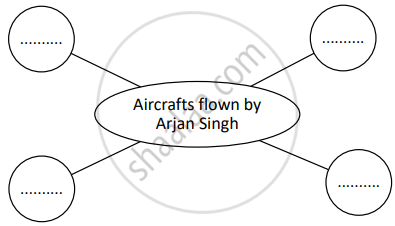
A1. Complete the following web: [2]
|
On August 1, 1964, in the rank of Air Marshal, the Marshal of the Air Force Arjan Singh took over reins of IAF, at a time when it was still rebuilding itself and was gearing up to meet new challenges. Singh was the first Air Chief to keep his flying currency till his CAS rank. Having flown over 60 different types of aircraft from pre-World War II era biplanes to the more contemporary Gnats and Vampires, he has also flown in transport aircraft like the Super Constellation. In 1965, when Pakistan launched its Operation Grand Slam, with an armoured thrust targeted at the vital town of Akhnoor, Singh led IAF through the war with courage, determination and professional skill. He inspired IAF to victory, despite the constraints imposed on the full-scale use of Air Force combat power. Singh was awarded Padma Vibhushan for his astute leadership of the Air Force during the war. Subsequently, in recognition of the Air Force’s contribution during the war, the rank of the CAS was upgraded and Arjan Singh became the first Air Chief Marshal of the Indian Air Force. He remained a flyer to the end of his tenure in IAF, visiting forward bases and units and flying with the squadrons. He retired in August 1969, there upon accepting Ambassadorship to Switzerland. He was Lieutenant Governor of Delhi from December 1989 to December 1990. |
A2. Answer the following questions: [2]
- Why was Singh awarded Padma Vibhushan?
- What posts did Arjan Singh hold after his retirement from IAF?
A3. Complete the crossword with the help of clues given: [2]
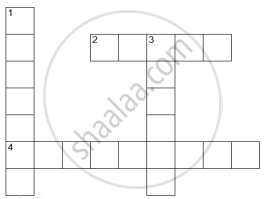
ACROSS
2. ESSENTIAL
4. VERB FORM OF COURAGE
DOWN
1. VERB FORM OF POWER
3. TERM, DURATION
A4. Do as directed: [2]
- Arjan Singh became the first Air Chief Marshal of the Indian Air Force.
(Rewrite as a negative sentence) - Singh led the IAF.
(Begin the sentence with - The IAF.....)
A5. Would you like to join the armed forces? Justify your answer. [2]
Read the following passage and do the activities:
B1. State whether the following statements are true or false. [2]
- Dr. Kalam’s own life was nourished by multiple faiths.
- Dr. Kalam saw simplicity and divinity in his father.
- Dr. Kalam was the Prime Minister of India.
- Dr. Kalam’s father was a great Vedic scholar.
|
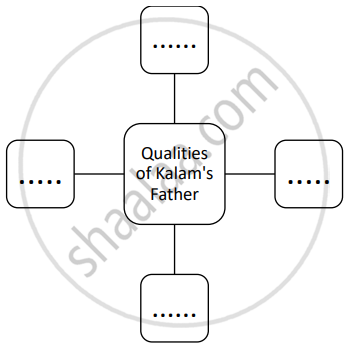
Dr. Kalam was a great scientist - this is indisputable. But he was also convinced that fact and faith can, together, create a better planet. He once told me, ‘Science and faith must coexist for the human good. Science provides focus - focus helps us solve questions, discover the truth and conceive inventions. Faith provides perspective - perspective helps us see how our creations and discoveries go on to impact a combination vital for the success of societies. Science accelerates progress and faith curbs it within reasonable limitations. If the two function true to their roles, they will work together for the betterment of humanity.’ Dr. Kalam’s own life was nourished by multiple faiths. His father, a boatman, also served as an imam at their local mosque, and his two best friends were from two different religions - one was a Hindu and the other was a Christian. Pakshi Lakshmana Shastrigal was the head priest of the famous Rameswara temple and a Vedic scholar, and the Reverend Father Bodal had built the first church on Rameswara Island. Dr. Kalam recalled how ‘All three of them, in the unique attire of their religion, used to sit and discuss the community’s problems and find solutions. Throughout the nation and the world, the need to have a frank dialogue among cultures, religions and civilizations is felt now more than ever.” When asked where he got his humility from Dr. Kalam would always attribute it to his father. In him, he saw how simplicity and divinity could go together. Even though his father was a boatman and Dr. Kalam went on to become the President of India, they shared the same values in life. Both believed that if one leads a spiritual life then that spirituality can lift them out of any kind of confusion misery or failure. |
B2. Complete the web chart. [2]
B3. Complete the crossword with the help of clues given: [2]
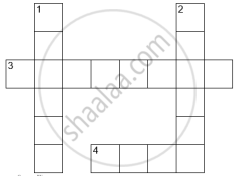
ACROSS
3 NOUN FORM OF DIVINE
4 HOMOPHONE OF ROLL
DOWN
1 ONE AND ONLY
2 DRESS
B4. Do As directed: [2]
- Dr. Kalam was a great scientist - this is indisputable.
(Make it a complex sentence using ‘that’) - Dr. Kalam’s own life was nourished by multiple faiths.
(Begin the sentence with Multiple faiths.....)
B5. Why do science and faith have to go hand in hand? [2]
SCERT Maharashtra solutions for English Standard 10 Maharashtra State Board II Section 2: Textual Passages ACTIVITY - SET 2 [Pages 10 - 11]
Read the following passage and do the activities:
A1. Arrange the following in the correct order as it appears in the passage. [2]
- The door opened and Jim stepped in.
- She turned white for just a moment.
- He simply stared at her fixedly.
- He needed a new overcoat.
| Jim was never late. Della doubled the fab chain in her hand and sat on the corner of the table near the door that he always entered. Then she heard his step on the stair away down on the first flight, and she turned white for just a moment. She had a habit for saying a little silent prayer about the simplest everyday things, and now she whispered: “Please God, make him think I am still pretty.” The door opened and Jim stepped in and closed it. He looked thin and very serious. Poor fellow, he was only twenty-two-and to be burdened with a family! He needed a new overcoat and he was without gloves. Jim stopped inside the door, as immovable as a setter at the scent of quail. His eyes were fixed upon Della, and there was an expression in them that she could not read, and it terrified her. It was not anger, nor surprise, nor disapproval, nor horror, nor any of the sentiments that she had been prepared for. He simply stared at her fixedly with that peculiar expression on his face. |
A2.
- What was Della’s greatest fear as she waited for Jim’s arrival? [1]
- Why did Jim look thin and serious? [1]
A3.
- Pick out the word from the passage that refers to the following: [1]
- Emotions and feelings.
- Strange and Unique.
- Write the Noun form of the following words: [1]
- Silence
- Simply
A4. Do as directed: [2]
- “Please God, make him think I am still pretty”, she whispered.
(Rewrite into Indirect Speech) - Della doubled the fab chain in her hand and sat on the corner of the table.
(Rewrite the following sentence as a Simple sentence)
A5. What kind of gifts do you like to exchange with your friends and family members? [2]
Read the following passage and do the activities:
B1. Arrange the following sentences according to their occurrence in the passage. [2]
- Arjan Singh was appointed as the Vice - Chief of the Air Staff.
- Arjan Singh led a fly-past over Red Fort.
- Arjan Singh completed his second tenure as AOC.
- Arjan Singh was appointed Deputy Chief of Air Staff.
|
For his role in successfully leading the squadron in combat, he was awarded the Distinguished Flying Cross (DFC) in 1944. On August 15, 1947, he achieved the unique honour of leading a fly-past of over a hundred IAF aircraft over the Red Fort in Delhi. After his promotion to the rank of Wing Commander, he attended the Royal Staff College at the UK. Immediately after Indian independence, he commanded Ambala in the rank of Group Captain. In 1949, he was promoted to the rank of Air Commodore and took over as Air Officer Commanding (AOC) of an operational command, which later came to be known as Western Air Command. Singh had the distinction of having the longest tenure as AOC of an operational base, initially from 1949-1952 and then again from 1957-1961. After his promotion to the rank of Air Vice Marshal, he was appointed as the AOC-in-C of an operational command. Towards the end of the 1962 war, he was appointed as the Deputy Chief of the Air Staff and he became the Vice Chief of the Air Staff in 1963. He was the overall commander of the joint air training exercise “Shiksha” held between IAF, RAF (Royal Air Force) and RAAF (Royal Australian Air Force). |
B2. How did independent India recognize and honour the Arjan Singh? [2]
B3. Match the column A with column B. [2]
| i. Tenure | at the beginning. |
| ii. Commanded | To complete something by hard work. |
| iii. Initially | Term of holding an office. |
| iv. Achieved | to give an authoritative order. |
B4. Do as directed. [2]
- Rewrite the sentence with ‘not only.....but also’
He was promoted to the rank of Air Commodore and took over as Air Officer. - Add a question tag.
Arjan Singh achieved the unique honour of leading a fly–past.
B5. What are the ways through which we can serve the nation in its defence? [2]
SCERT Maharashtra solutions for English Standard 10 Maharashtra State Board II Section 2: Textual Passages ACTIVITY - SET 3 [Pages 13 - 14]
Read the following passage and do the activities:
A1. Complete the following web. [2]
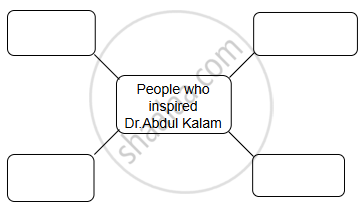
|
Dr. Kalam sat contemplating deeply. He recollected the tenet of goodness of action from Pramukh Swamiji. Then, perhaps swimming in silence to the shores of Mahapragyaji, he gathered the sands of conscience to be our guide, our best friend. Deeper down in the space-time of memory, he must have heard Professor Brahma Prakash’s words about the need of living a pure and ethical life, and Father Pereira’s and Dr. Sarabhai’s lesson of selflessness in service. Eventually his thoughts would have settled on Swami Sivananda of Rishikesh, in whom he saw great tranquility, and finally they must have come full circle with the memory of the life of simplicity of his father, who always espoused the value of giving back. At long last, he spoke. ‘It is the very spirit of What Can I Give.’ He elaborated, ‘Mahaswamiji lives with the beliefs and ethos of our mission. He gives and gives education to famished minds, food to famished bodies. In giving so much, he becomes strong. His munificence fuels his strength. That is what keeps him standing tall and active in life. The essence of a happy life and a peaceful society lies in one sentence - What can I give?’ |
A2. What thoughts came in Dr. Kalam’s mind when he was contemplating? [2]
A3. List four adjectives from the passage. [2]
- ............
- ............
- ............
- ............
A4. Do as directed. [2]
- He gives education to the famished minds
(Pick out the verb and state its tense) - What can I give?
(Change the voice)
A5. Do you like to help the poor, orphans and the downtrodden? Justify your answer. [2]
Read the following passage and do the activities:
B1. State whether the following statements are true or false. [2]
- Jim had purchased his gold watch when his income was good.
- Queen Sheba was living in a flat across the airshaft of Della.
- Della’s hair made itself almost a garment for her.
- Jim valued his watch more than treasures King Solomon had.
|
Now, there were two possessions of the James Dillingham Young in which they both took a mighty pride. One was Jim’s gold watch that had been his father’s and his grandfather’s. The other was Della’s hair. Had the queen of Sheba lived in the flat across the airshaft, Della would have let her hair hang out the window someday to dry just to depreciate Her Majesty’s jewels and gifts. Had King Solomon been the janitor, with all his treasures piled up in the basement, Jim would have pulled out his watch every time he passed, just to see him pluck at his beard from envy. So now Della’s beautiful hair fell about her rippling and shining like a cascade of brown waters. It reached below her knee and made itself almost a garment for her. And then she did it up again nervously and quickly. Once she faltered for a minute and stood still while a tear or two splashed on the worn red carpet. On went her old brown jacket; on went her old brown hat. With a whirl of skirts and with the brilliant sparkle still in her eyes, she fluttered out the door and down the stairs to the street. |
B2. What do you think the reason why a tear or two splash from Della on the carpet? [2]
B3. Give noun form for the following words. [2]
- Depreciate
- Nervous
- Brilliant
- Accurate
B4. Do as directed.
- She faltered for a minute. [1]
(Rewrite as interrogative sentence) - It reached below her knee and made itself a garment for her. [1]
(Rewrite as a simple sentence)
B5. Do you like to exchange gifts on special occasions? What things are you taking care of while selecting a gift? [2]
Solutions for II: Section 2: Textual Passages
SCERT Maharashtra solutions for English Standard 10 Maharashtra State Board chapter II - Section 2: Textual Passages
Shaalaa.com has the Maharashtra State Board Mathematics English Standard 10 Maharashtra State Board Maharashtra State Board solutions in a manner that help students grasp basic concepts better and faster. The detailed, step-by-step solutions will help you understand the concepts better and clarify any confusion. SCERT Maharashtra solutions for Mathematics English Standard 10 Maharashtra State Board Maharashtra State Board II (Section 2: Textual Passages) include all questions with answers and detailed explanations. This will clear students' doubts about questions and improve their application skills while preparing for board exams.
Further, we at Shaalaa.com provide such solutions so students can prepare for written exams. SCERT Maharashtra textbook solutions can be a core help for self-study and provide excellent self-help guidance for students.
Concepts covered in English Standard 10 Maharashtra State Board chapter II Section 2: Textual Passages are The Thief’s Story, On Wings of Courage, Joan of Arc, The Alchemy of Nature, Grammar, The Alphabet, Parts of Speech, Noun, Pronoun, Root Word, Prefix-suffix, Compound Words, Word Building, Punctuation, Speech, Pronunciation, Figures of Speech, Idioms and Phrases, Syllables, Tense, English Translation, Rhyme Scheme, Modal Auxiliary, Use ‘Not Only but Also’, Use ‘As Soon As’, ‘either ... or’ and ‘No Sooner ... Than’, Rhyming Words, Wh-questions, Add a Question Tag, Change the Voice, Make a Sentence, Use of Though, Although, Even Though and but, Spotting Errors, Verb, Adjective, Adverb, Preposition, Conjunction, Interjection, Determiners, Articles - A, An, The, Degrees of Comparison, Make a Sentence, Types of Sentences, Types of Sentences, Subject and Predicate, Direct-Indirect Speech, Clauses, Vocabulary, Synonyms, Antonyms, Homonyms, Homophones, Homographs, Register, Writing Skills, Speech Writing, Story Writing, Summary Writing, Dialogue Writing, Interview Questions, Report Writing, Note Making, Letter Writing, Notice Writing, View and Counterview, Tourist Leaflet, Article Writing, Information Transfer, Expansion of Ideas, Narration, Paragraph Writing, The Thief’s Story, On Wings of Courage, Joan of Arc, The Alchemy of Nature.
Using SCERT Maharashtra English Standard 10 Maharashtra State Board solutions Section 2: Textual Passages exercise by students is an easy way to prepare for the exams, as they involve solutions arranged chapter-wise and also page-wise. The questions involved in SCERT Maharashtra Solutions are essential questions that can be asked in the final exam. Maximum Maharashtra State Board English Standard 10 Maharashtra State Board students prefer SCERT Maharashtra Textbook Solutions to score more in exams.
Get the free view of Chapter II, Section 2: Textual Passages English Standard 10 Maharashtra State Board additional questions for Mathematics English Standard 10 Maharashtra State Board Maharashtra State Board, and you can use Shaalaa.com to keep it handy for your exam preparation.
