Advertisements
Chapters
2: Population
3: Migration
4: Urbanization
5: Natural and Man-made Disasters with Case Studies
6: Disaster Management
7: Asia: Location, Extent, Political and Physical Features
8: Asia: Climate and Natural Vegetation
9: India: Location, Extent, Political and Physical Features
▶ 10: India: Climate, Natural Vegetation, Forests and Wildlife
11: Human Resources in India
![Oxford University Press solutions for Voyage Geography [English] Class 8 chapter 10 - India: Climate, Natural Vegetation, Forests and Wildlife - Shaalaa.com](/images/voyage-geography-english-class-8_6:8252e9b8eb0c48bba3b0177d4ba41329.jpg "Oxford University Press solutions for Voyage Geography [English] Class 8 chapter 10 - India: Climate, Natural Vegetation, Forests and Wildlife")
Advertisements
Solutions for Chapter 10: India: Climate, Natural Vegetation, Forests and Wildlife
Below listed, you can find solutions for Chapter 10 of CISCE Oxford University Press for Voyage Geography [English] Class 8.
Oxford University Press solutions for Voyage Geography [English] Class 8 10 India: Climate, Natural Vegetation, Forests and Wildlife Fill in the blanks
Fill in the blank:
The state that first receives the monsoon rains: ___________
Fill in the blank:
A place that receives the heaviest rainfall in India and the world:: ___________
Fill in the blank:
Depression that causes winter rainfall in north-west India : ___________
Fill in the blanks:
In mixed deciduous forests: _________ and ________trees are found.
Oxford University Press solutions for Voyage Geography [English] Class 8 10 India: Climate, Natural Vegetation, Forests and Wildlife True or False
Write true or false. Correct the false statement:
Babool and kikar trees are mainly found in Rajasthan, Gujarat, and on the leeward side of the Western Ghats.
Write true or false. Correct the false statement:
Increase in height is responsible for the changing vegetation in the Himalayas.
True
False
Write true or false. Correct the false statement:
Thorn forests occupy the largest area in India
True
False
Write true or false. Correct the false statement:
Hogla is mainly found in the tidal forests.
True
False
Oxford University Press solutions for Voyage Geography [English] Class 8 10 India: Climate, Natural Vegetation, Forests and Wildlife Give geographical reasons for each
Give geographical reasons for the following :
South India is warmer than north India.
Give geographical reasons for the following :
The south-west monsoon is divided into two branches
Oxford University Press solutions for Voyage Geography [English] Class 8 10 India: Climate, Natural Vegetation, Forests and Wildlife Answer the questions in brief
Answer the following question in brief
What type of climate does the Indian subcontinent have?
Answer the following question in brief
State two ways in which the Himalayas act as a climate barrier.
Answer the following question in brief
Why does India have a tropical monsoon climate?
Answer the following question in brief
Name two states of north India that receive rainfall in winter.
Answer the following question in brief
What is the cause of winter rainfall in these states?
Where would you find the following in India:
Asiatic lion
Where would you find the following in India:
Royal Bengal tiger
Where would you find the following in India:
one-horned rhinoceros
Where would you find the following in India:
Red panda
Mention any three national parks in India.
Mention any five biosphere reserves in India.
Oxford University Press solutions for Voyage Geography [English] Class 8 10 India: Climate, Natural Vegetation, Forests and Wildlife Answer the questions in one or two paragraphs
Describe the seasons experienced in India and also state the months and their duration.
Which winds bring rainfall to the Western Ghats?
Why is the Deccan Plateau relatively dry during the rainy season?
Why do Punjab and Rajasthan get very little rainfall during the monsoons?
Explain the importance of monsoon.
List the different types of vegetation found in India. Describe any two.
How are the tropical evergreen forests different from the tropical deciduous forests?
Where are the tidal forests found in India? What are the characteristics of these forests? Name a few trees found in. these forests.
Give an account of the biosphere reserves in India.
Oxford University Press solutions for Voyage Geography [English] Class 8 10 India: Climate, Natural Vegetation, Forests and Wildlife Map work
On an outline map of India, do as directed :
Mark with red arrows the paths of the Arabian Sea branch and the Bay of Bengal branch of the south-west monsoon.
On an outline map of India, do as directed :
Shade in yellow the rain shadow regions of the Western Ghats.
On an outline map of India, do as directed :
Colour with light green the areas of India that receive moderate rainfall between 100-200 cm annually.
On an outline map of India, do as directed :
Mark the Kaziranga and Kanha national parks, and the Nokrek biosphere reserve
Oxford University Press solutions for Voyage Geography [English] Class 8 10 India: Climate, Natural Vegetation, Forests and Wildlife Picture Study
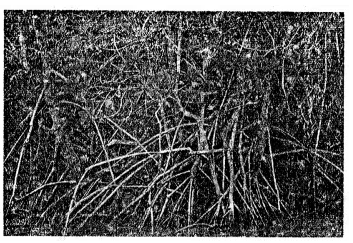
- Identify the type of forest shown in the photograph.
- Write two characteristics of this type of forest.
- Identify the type of forest shown in the photograph.
- Write two characteristics of this type of forest.
Oxford University Press solutions for Voyage Geography [English] Class 8 10 India: Climate, Natural Vegetation, Forests and Wildlife Extra Questions
Which latitude divides India into two nearly equal parts?
What are monsoons?
What are the factors affecting the climate of India?
Why do places at higher altitudes and the coastal regions have moderate temperatures in summers ?
Name the hottest place in India.
Name the coldest place in India.
Name :
The wettest place in India.
What do you mean by western disturbances?
How are evergreen and deciduous trees different?
What do you mean by mangrove?
What is a loo?
Name the showers that help in the ripening of mangoes in Kerala?
Why are storms in Assam and West Bengal called Kalbaisakhi?
Which is the first and the last state to receive monsoon in India?
Name few festivals of India which celebrate the arrival of monsoons, changes in seasons and the harvest season.
What do you understand by retreating monsoons?
Why does Tamil Nadu receive rainfall in winter?
Name two areas in India which receive winter rainfall.
On what factors does rainfall at a place depend on?
Write short notes on :
Thorn and Desert forest
Write short notes on :
Mountain or Alpine forest
Write short notes on :
Afforestation or Vana Mahotsava
Name few important species of wildlife found in India.
List some direct and indirect advantages from forests.
Define with example:
Sanctuary
Define with example:
National Park
Define with example:
Biosphere reserve.
Fill in the blanks:
The areas away from the coast experience _________ of temperature while those near the coast have _________climate throughout the year.
Fill in the blank:
The southern part of India is _______ all year round.
Fill in the blank:
Agriculture, forestry and fishing are directly influenced by the amount of _________.
Temperature ______ with increase in height above sea level.
Fill in the blank:
The _________ protect our country from the cold winds of Central Asia.
Fill in the blank:
The highest temperatures are recorded in the _________ regions of north-west India.
Fill in the blank:
The winter rainfall is very important for the cultivation of _________ crops such as wheat.
Fill in the blank:
The __________ branch of south-west monsoon winds causes heavy rainfall to Western Ghats.
Fill in the blank:
The ________ branch of south-west monsoon brings heavy rainfall to the north-east India Ganga plains and north-west India.
Fill in the blank:
There are about ___________ species of plants and animals in India.
Fill in the blank:
Mangrove forests are a very important part of the ________ ecosystem.
Fill in the blanks:
_________ is the national animal and __________ is the national bird of India.
Fill in the blank:
The total forest area in India was at __________ percent in 2015.
Fill in the blanks:
There are ________ wildlife sanctuaries and ________ national parks in India.
Fill in the blank:
India receives most of its rainfall from the __________ monsoons from June to October.
Fill in the blank:
The __________ monsoons cause rainfall on the Coromandel Coast during winter months.
Fill in the blank:
The _____________ cause rainfall in the north-west India in winters.
Oxford University Press solutions for Voyage Geography [English] Class 8 10 India: Climate, Natural Vegetation, Forests and Wildlife Map Skills
Mark some important biosphere reserves, bird sanctuaries and national parks of India?
On an outline map of India, show the path of the northeast monsoons with arrows.
On an outline map of India, show the annual distribution of rainfall.
Solutions for 10: India: Climate, Natural Vegetation, Forests and Wildlife
Oxford University Press solutions for Voyage Geography [English] Class 8 chapter 10 - India: Climate, Natural Vegetation, Forests and Wildlife
Shaalaa.com has the CISCE Mathematics Voyage Geography [English] Class 8 CISCE solutions in a manner that help students grasp basic concepts better and faster. The detailed, step-by-step solutions will help you understand the concepts better and clarify any confusion. Oxford University Press solutions for Mathematics Voyage Geography [English] Class 8 CISCE 10 (India: Climate, Natural Vegetation, Forests and Wildlife) include all questions with answers and detailed explanations. This will clear students' doubts about questions and improve their application skills while preparing for board exams.
Further, we at Shaalaa.com provide such solutions so students can prepare for written exams. Oxford University Press textbook solutions can be a core help for self-study and provide excellent self-help guidance for students.
Concepts covered in Voyage Geography [English] Class 8 chapter 10 India: Climate, Natural Vegetation, Forests and Wildlife are Political Divisions of India, Conservation of Forest and Wildlife in India, Climate and Natural Vegetation, Indian - Location, Size and Extent.
Using Oxford University Press Voyage Geography [English] Class 8 solutions India: Climate, Natural Vegetation, Forests and Wildlife exercise by students is an easy way to prepare for the exams, as they involve solutions arranged chapter-wise and also page-wise. The questions involved in Oxford University Press Solutions are essential questions that can be asked in the final exam. Maximum CISCE Voyage Geography [English] Class 8 students prefer Oxford University Press Textbook Solutions to score more in exams.
Get the free view of Chapter 10, India: Climate, Natural Vegetation, Forests and Wildlife Voyage Geography [English] Class 8 additional questions for Mathematics Voyage Geography [English] Class 8 CISCE, and you can use Shaalaa.com to keep it handy for your exam preparation.
