Advertisements
Advertisements
Question
List the different types of vegetation found in India. Describe any two.
Advertisements
Solution
he different types of vegetation found in India are :
Based on the variation of rainfall
- Tropical evergreen forests
- Tropical deciduous forests
- Thorn and desert forests
Based on the variation of relief
- Tidal or mangrove forests
- Mountain or Alpine forests
Tropical evergreen rain forests: These forests are found in areas that receive an annual rainfall of over 300 cm and are very humid. The temperature varies between 25° and 27° C or above. The windward side of the Western Ghats in western Maharashtra, Kerala, Karnataka, hills of north-eastern India and the Andaman and Nicobar Islands have these forests. The forests have broad-leaved hardwood trees. These are dense evergreen forests with trees up to 60 m tall. The trees form distinct layers. Thick undergrowth makes commercial exploitation difficult Shisham, ebony, rosewood, telsar, tun or red cedar, teak gurjans, mahogany, and bamboo are the common species of trees growing here.
Monsoon deciduous forests: These forests are found in areas that receive an annual rainfall between 100 and 200 cm, have distinct dry and wet seasons, and a low range of temperature. These forests are found in large parts of India- from the eastern slopes of the Western Ghats up to the Shivalik Range in the north, north-eastern region, and the Deccan Plateau. The trees shed their leaves during the dry season to conserve water. The trees do not grow very close to each other, are not very tall, and have long roots. The trees growing here are of great economic importance like teak, sal, mahua, Khair, sandalwood, jack fruit, semal, myrobalan, and banyan.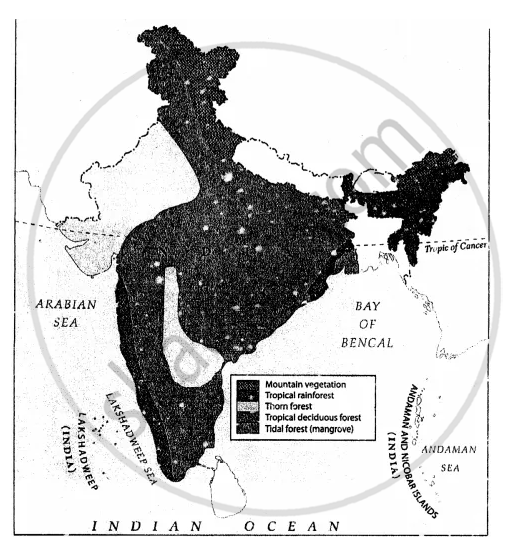
APPEARS IN
RELATED QUESTIONS
Why do Punjab and Rajasthan get very little rainfall during the monsoons?
How are the tropical evergreen forests different from the tropical deciduous forests?
Give an account of the biosphere reserves in India.
On an outline map of India, do as directed :
Colour with light green the areas of India that receive moderate rainfall between 100-200 cm annually.
Which latitude divides India into two nearly equal parts?
Name the hottest place in India.
What is a loo?
Why does Tamil Nadu receive rainfall in winter?
Fill in the blank:
The winter rainfall is very important for the cultivation of _________ crops such as wheat.
Fill in the blank:
The _____________ cause rainfall in the north-west India in winters.
