Advertisements
Online Mock Tests
Chapters
![NCERT solutions for Political Science Politics in India Since Independence [English] Class 12 chapter 1 - challenges of nation Building - Shaalaa.com](/images/political-science-politics-in-india-since-independence-english-class-12_6:6ebe260af61b4bd7af6108945e3d6be6.jpg "NCERT solutions for Political Science Politics in India Since Independence [English] Class 12 chapter 1 - challenges of nation Building")
Advertisements
Solutions for Chapter 1: challenges of nation Building
Below listed, you can find solutions for Chapter 1 of CBSE NCERT for Political Science Politics in India Since Independence [English] Class 12.
NCERT solutions for Political Science Politics in India Since Independence [English] Class 12 1 challenges of nation Building Intext Questions [Pages 14 - 23]
Let's re-search
Shweta noticed that her Nana (maternal grandfather) would get very quiet whenever anyone mentioned Pakistan. One day she decided to ask him about it. Her Nana told her about how he moved from Lahore to Ludhiana during Partition. Both his parents were killed. Even he would not have survived, but a neighbouring Muslim family gave him shelter and kept him in hiding for several days. They helped him find some relatives and that is how he managed to cross the border and start a new life. Similarly, there are many examples of Hindu families and others who helped, sheltered, and saved the lives of Muslim families during the times of crisis and violence caused by Partition. It shows the importance of compassion and solidarity on religious grounds in both communities.
Have you heard a similar story? Ask your grandparents or anyone of that generation about their memories of Independence Day, about the celebration, about the trauma of Partition, about the expectations they had from independence.
Write down at least two of these stories.
Can’t we end the Partition of India and Pakistan the way they did in Germany? I want to have breakfast in Amritsar and lunch in Lahore!
Isn’t it better that we now learn to live and respect each other as independent nations?
I wonder what happened to all those hundreds of kings, queens, princes and princesses. How did they live their lives after becoming just ordinary citizens?
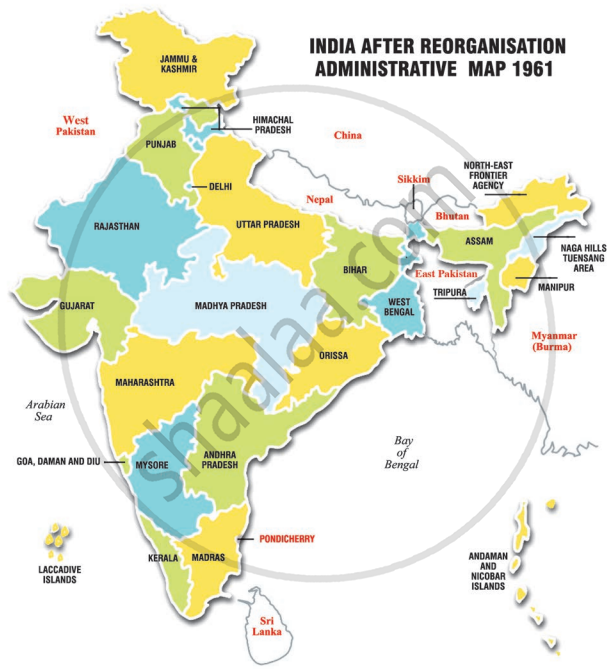
Note: This illustration is not a map drawn to scale and should not be taken to be an authentic depiction of India's external boundaries.
Read the map and answer the following questions:
- Name the original state from which the following states were carved out:
- Gujarat
- Haryana
- Meghalaya
- Chhattisgarh
- Name two states that were affected by the Partition of the country.
- Name two states today that were once a Union Territory.
The US has one-fourth of our population but 50 states. Why can’t India have more than 100 states?
NCERT solutions for Political Science Politics in India Since Independence [English] Class 12 1 challenges of nation Building Exercise [Pages 24 - 25]
Which among the following statements about the partition is incorrect?
(a) Partition of India was the outcome of the “two-nation theory”.
(b) Punjab and Bengal were the two provinces divided on the basis of religion.
(c) East Pakistan and West Pakistan were not contiguous.
(d) The scheme of Partition included a plan for transfer of population across the border.
Match the principles with the instances :
| (a) Mapping of boundaries on religious ground | (i) Pakistan and Bangladesh |
| (b) Mapping of boundaries on grounds of different languages | (ii) India and Pakistan |
| (c) Demarcating boundaries within a country by geographical zones | (iii) Jharkhand and Chhattisgarh |
| (d) Demarcating boundaries within a country on administrative and political grounds | (iv) Himachal Pradesh and Uttarakhand |
Take a current political map of India (showing outlines of states) and mark the location of the following Princely States.
- Junagadh
- Manipur
- Mysore
- Gwalior.
Here are two opinions :-
Bismay: “The merger with the Indian State was an extension of democracy to the people of the Princely States."
Inderpreet: “I am not so sure, there was force being used. Democracy comes by creating consensus.”
What is your opinion in the light of accession of Princely States and the responses of the people in these parts?
Read the following very different statements made in August 1947 :
“Today you have worn on your heads a crown of thorns. The seat of power is a nasty thing. You have to remain ever wakeful on that seat… you have to be more humble and forbearing… now there will be no end to your being tested. ”-M.K, Gandhi
“....India will awake to a life of freedom…. we step out from, the old to the new…. we end, today a period of ill fortune and India discovers herself again. The achievement we celebrate today is but a step, an opening of opportunity …” -Jawaharlal Nehru
Spell out the agenda of nation building that flows from these two statements. Which one appeals more to you and why?
What are the reasons being used by Nehru for keeping India secular? Do you think these reasons were only ethical and sentimental? Or were there some prudential reasons as well?
Bring out two major differences between the challenge of nation building for eastern and western regions of the country at the time of Independence.
What was the task of the States Reorganisation Commission? What was its most salient recommendation?
It is said that the nation is to large extent an “imagined community” held together by common beliefs, history, political aspirations and imaginations. Identify the features that make India a nation.
Read the following passage and answer the questions below :-
“In the history of nation-building only the Soviet experiment bears comparison with the Indian. There too, a sense of unity had to be forged between many diverse ethnic groups, religious, linguistic communities and social classes. The scale - geographic as well as demographic - was comparably massive. The raw material the state had to work with was equally unpropitious: a people divided by faith and driven by debt and disease.” —Ramachandra Guha
(a) List the commonalities that the author mentions between India and Soviet Union and give one example for each of these from India.
(b) The author does not talk about dissimilarities between the two experiments. Can you mention two dissimilarities?
(c) In retrospect which of these two experiments worked better and why?
LET US DO IT TOGETHER
Read a novel/story on Partition by an Indian and a Pakistani/Bangladeshi writer. What are the commonalities of the experience across the border?
Collect all the stories from the ‘Let’s Research’ suggestion in this chapter. Prepare a wallpaper that highlights the common experiences and has stories on the unique experiences.
Solutions for 1: challenges of nation Building
NCERT solutions for Political Science Politics in India Since Independence [English] Class 12 chapter 1 - challenges of nation Building
Shaalaa.com has the CBSE Mathematics Political Science Politics in India Since Independence [English] Class 12 CBSE solutions in a manner that help students grasp basic concepts better and faster. The detailed, step-by-step solutions will help you understand the concepts better and clarify any confusion. NCERT solutions for Mathematics Political Science Politics in India Since Independence [English] Class 12 CBSE 1 (challenges of nation Building) include all questions with answers and detailed explanations. This will clear students' doubts about questions and improve their application skills while preparing for board exams.
Further, we at Shaalaa.com provide such solutions so students can prepare for written exams. NCERT textbook solutions can be a core help for self-study and provide excellent self-help guidance for students.
Concepts covered in Political Science Politics in India Since Independence [English] Class 12 chapter 1 challenges of nation Building are Legacy of Partition - Challenge of 'Refugee' Resettlement, the Kashmir Problem, Organisation and Reorganization of States, Political Conflicts Overlanguage, Nehru's Approach to Nation-building, Challenges for the New Nation, Partition: Displacement and Rehabilitation, Integration of Princely States, Overview of Challenges of Nation-building, Legacy of Partition - Challenge of 'Refugee' Resettlement, the Kashmir Problem, Organisation and Reorganization of States, Political Conflicts Overlanguage, Nehru's Approach to Nation-building, Challenges for the New Nation, Partition: Displacement and Rehabilitation, Integration of Princely States, Overview of Challenges of Nation-building.
Using NCERT Political Science Politics in India Since Independence [English] Class 12 solutions challenges of nation Building exercise by students is an easy way to prepare for the exams, as they involve solutions arranged chapter-wise and also page-wise. The questions involved in NCERT Solutions are essential questions that can be asked in the final exam. Maximum CBSE Political Science Politics in India Since Independence [English] Class 12 students prefer NCERT Textbook Solutions to score more in exams.
Get the free view of Chapter 1, challenges of nation Building Political Science Politics in India Since Independence [English] Class 12 additional questions for Mathematics Political Science Politics in India Since Independence [English] Class 12 CBSE, and you can use Shaalaa.com to keep it handy for your exam preparation.
