Advertisements
Online Mock Tests
Chapters
2: Contemporary Centres of Power
3: Contemporary South Asia
4: International Organisations
5: Security in the Contemporary World
▶ 6: Environment and Natural Resources
7: Globalisation
Advertisements
Solutions for Chapter 6: Environment and Natural Resources
Below listed, you can find solutions for Chapter 6 of CBSE NCERT for Political Science Contemporary World Politics [English] Class 12.
NCERT solutions for Political Science Contemporary World Politics [English] Class 12 6 Environment and Natural Resources Intext Question [Pages 82 - 97]
Politics in forests, politics in water, politics in atmosphere! What is not political then?
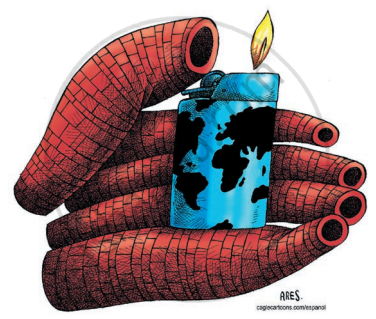
Why do you think the fingers are designed like chimneys and the world made into a lighter?
LET'S DO IT
Collect news clippings on reports linking environment and politics in your own locality.

Are there different perspectives from which the rich and the poor countries agree to protect the Earth?
LET'S DO IT
Find out more about the Kyoto Protocol. Which major countries did not sign it? And why?
That’s a cool principle! A bit like the reservation policy in our country, isn't it?
I heard about some rivers being sold in Latin America. How can common property be sold?
I get it! First they destroyed the earth, now it is our turn to do the same! Is that our stand?
LET'S DO IT
Let’s find out about ‘Chipko Movement’.
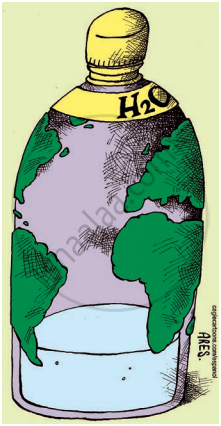
The larger part of the Earth is water than the land and yet the cartoonist decides to show larger image of the land than water. How does the image show the scarcity of water?
How are water conflicts different from the many water conflicts within our own country?
Why don’t we hear much about the indigenous people and their movements? Is the media biased against them?

Spoonful of Ecology
Do you agree with this perspective where a man from an urban (developed!) area becomes greedy for nature?
STEPS
- Each student is asked to list any ten items they consume/use every day. (The list could include - pen/paper/eraser/computer/water etc.)
- Ask students to calculate the amount of natural resources being used to make these items. (For finished products like pen/pencil/computer etc., students will calculate the amount of resources and for items like water they could calculate the amount of electricity used for purifying and pumping along with gallons of water). Each would calculate and arrive at an approximate figure.
Ideas for the Teacher
- Collect the approximate figures from each student and sum up all to arrive at total resources consumed by the students of that particular class. (Teacher is to act as a facilitator and allow students to do the calculations.)
- Project this figure to other classes of the same school, then to schools across the country. The country figure could be used to measure the amount of resources being used by schools in other countries too. (The teacher is to have background information about the resources being used by students in a few select countries. While selecting countries, teacher should ensure that the selected countries belong to the developed/developing countries category).
- Ask students to imagine the amount of resources we are consuming and also to estimate future consumption.
NCERT solutions for Political Science Contemporary World Politics [English] Class 12 6 Environment and Natural Resources Exercises [Page 98]
Which among the following best explains the reason for growing concerns about the environment?
The developed countries are concerned about protecting nature.
Protection of the environment is vital for indigenous people and natural habitats.
The environmental degradation caused by human activities has become pervasive and has reached a dangerous level.
None of the above.
Mark correct or wrong against the following statement about the Earth Summit:
It was attended by 170 countries, thousands of NGOs and many MNCs.
Correct
Wrong
Mark correct or wrong against the following statement about the Earth Summit:
The Summit was held under aegis of the UN.
Correct
Wrong
Mark correct or wrong against the following statement about the Earth Summit:
For the first time, global environmental issues were firmly consolidated at the political level.
Correct
Wrong
Mark correct or wrong against the following statement about the Earth Summit:
It was a summit meeting.
Correct
Wrong
Which among the following are TRUE about the global commons?
The Earth’s atmosphere, Antarctica, the ocean floor, and outer space are considered part of the Global Commons.
The Global Commons are outside sovereign jurisdiction.
The question of managing the Global Commons has reflected the North-South divide.
The countries of the North are more concerned about the protection of the global Commons than the countries of the South.
What were the outcomes of the Rio-Summit?
What is meant by the global commons? How are they exploited and polluted?
What is meant by ‘Common but differentiated responsibilities’? How could we implement the idea?
Why have issues related to global environmental protection become the priority concern of states since the 1990s?
Compromise and accommodation are the two essential policies required by states to save Planet Earth. Substantiate the statement in the light of the ongoing negotiations between the North and South on environmental issues.
The most serious challenge before the states is pursuing economic development without causing further damage to the global environment. How could we achieve this? Explain with a few examples.
Solutions for 6: Environment and Natural Resources
NCERT solutions for Political Science Contemporary World Politics [English] Class 12 chapter 6 - Environment and Natural Resources
Shaalaa.com has the CBSE Mathematics Political Science Contemporary World Politics [English] Class 12 CBSE solutions in a manner that help students grasp basic concepts better and faster. The detailed, step-by-step solutions will help you understand the concepts better and clarify any confusion. NCERT solutions for Mathematics Political Science Contemporary World Politics [English] Class 12 CBSE 6 (Environment and Natural Resources) include all questions with answers and detailed explanations. This will clear students' doubts about questions and improve their application skills while preparing for board exams.
Further, we at Shaalaa.com provide such solutions so students can prepare for written exams. NCERT textbook solutions can be a core help for self-study and provide excellent self-help guidance for students.
Concepts covered in Political Science Contemporary World Politics [English] Class 12 chapter 6 Environment and Natural Resources are Common Property Resources, Environment Movements: One Or Many?, India's Stand on Environmental Issues, Rights of Indigenous People, Environmental Concerns in Global Politics, Introduction to Environment and Natural Resources, The Protection of Global Commons, Common but Differentiated Responsibilities, Resource Geopolitics, The Indigenous Peoples and Their Rights, Overview of Environment and Natural Resources, Common Property Resources, Environment Movements: One Or Many?, India's Stand on Environmental Issues, Rights of Indigenous People, Environmental Concerns in Global Politics, Introduction to Environment and Natural Resources, The Protection of Global Commons, Common but Differentiated Responsibilities, Resource Geopolitics, The Indigenous Peoples and Their Rights, Overview of Environment and Natural Resources.
Using NCERT Political Science Contemporary World Politics [English] Class 12 solutions Environment and Natural Resources exercise by students is an easy way to prepare for the exams, as they involve solutions arranged chapter-wise and also page-wise. The questions involved in NCERT Solutions are essential questions that can be asked in the final exam. Maximum CBSE Political Science Contemporary World Politics [English] Class 12 students prefer NCERT Textbook Solutions to score more in exams.
Get the free view of Chapter 6, Environment and Natural Resources Political Science Contemporary World Politics [English] Class 12 additional questions for Mathematics Political Science Contemporary World Politics [English] Class 12 CBSE, and you can use Shaalaa.com to keep it handy for your exam preparation.
