Advertisements
Online Mock Tests
Chapters
![NCERT solutions for Political Science Contemporary World Politics [English] Class 12 chapter 3 - Contemporary South Asia - Shaalaa.com](/images/political-science-contemporary-world-politics-english-class-12_6:81271a49b2e74b1dbf3542a3e8a6ee7a.jpg "NCERT solutions for Political Science Contemporary World Politics [English] Class 12 chapter 3 - Contemporary South Asia")
Advertisements
Solutions for Chapter 3: Contemporary South Asia
Below listed, you can find solutions for Chapter 3 of CBSE NCERT for Political Science Contemporary World Politics [English] Class 12.
NCERT solutions for Political Science Contemporary World Politics [English] Class 12 3 Contemporary South Asia Intext Questions [Pages 30 - 42]
LET'S DO IT
Identify some features common to all the South Asian countries but different from countries in West Asia or Southeast Asia.
Is there a fixed definition of South Asian regions? Who decides that?
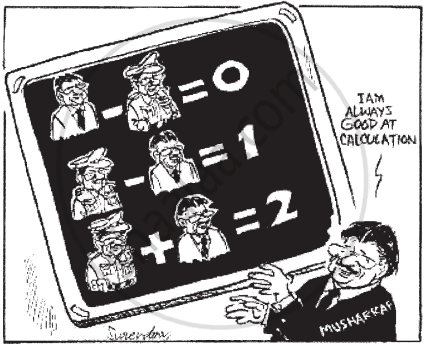
Surendra, The Hindu
This cartoon comments on the dual role of Pakistan’s ruler Pervez Musharraf as the President of the country and as the army General. Read the equations carefully and write down the message of this cartoon.
If Germany can be reunited, why can’t the people of India and Pakistan at least travel more easily to each other’s country?
LET'S DO IT
Let’s know more about Bangladesh’s Grameen Bank. Can we make use of the idea to reduce poverty in India?
Discussion on Kashmir sounds like a property dispute between the rulers of India and Pakistan! What do the Kashmiris feel about it?
Why is it that every one of our neighbours has a problem with India? Is there something wrong with our foreign policy? Or is it just our size?
LET'S DO IT TOGETHER
STEPS
- Divide the classroom into eight groups (as many as the number of countries). The number of students in each group may vary, reflecting the size of the countries of South Asia.
- Name each group after a country and hand over a brief country profile to respective groups. Besides the basic information, include a short note on the contentious issues/disputes among the South Asian countries. The issues could be those discussed in this chapter or an issue of relevance but not discussed in the chapter.
- Allow students to select an issue of their choice. The dispute could be bilateral or multilateral (the issue could be related to India, given the geographic peculiarity of the region).
- Assign each group to find out what initiatives the governments involved have taken and the reasons for their failures in resolving the disputes.
- Students should assume the role of representing their respective countries and share their findings.
Ideas for the Teacher
- Pair up the countries sharing the common issue/dispute. It could be two groups in the case of a bilateral issue or more in case of a multilateral issue (examples of bilateral issues include the Jammu and Kashmir dispute between India and Pakistan, the migrant problem between India and Bangladesh; multilateral issues include the creation of a free trade zone or tackling terrorism).
- Groups should negotiate on the proposals and counter-proposals within a time limit. The teacher is to take note of the outcome of the negotiations. The focus should be on the areas of agreement and disagreement.
- Link the outcome of the negotiations with the prevailing situation among the countries of South Asia. Talk about the difficulties involved in negotiating on a political issue based on the observation made. Conclude by discussing the importance of accommodating each other's interest for the sake of peaceful coexistence.
If the chapter on US was called ‘US Hegemony’, why is this chapter not called ‘Indian Hegemony’?
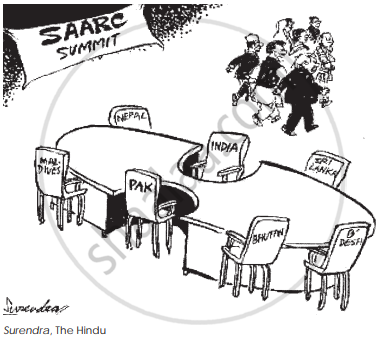
What does this cartoon tell you about the role of India and Pakistan in the process of regional cooperation in South Asia?
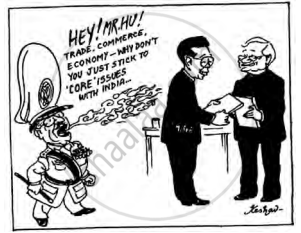
Keshav, The Hindu
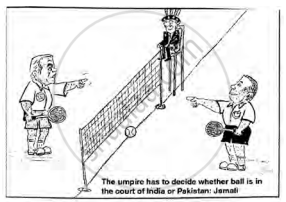
Pakistan Tribune
The two cartoons, one from India and the other from Pakistan, interpret the role of two key players who are also interested in the region. Do you notice any commonality between their perspectives?
Every association seems to have emerged for trade! Is trade more important than people-to-people relations?
NCERT solutions for Political Science Contemporary World Politics [English] Class 12 3 Contemporary South Asia Exercises [Pages 43 - 44]
Identify the country:
The struggle among pro-monarchy, pro-democracy groups and extremists created an atmosphere of political instability.
Identify the country:
A landlocked country with multi¬party competition.
Identify the country:
The first country to liberalise its economy in the South Asian region.
Identify the country:
In the conflict between the military and pro-democracy groups, the military has prevailed over democracy.
Identify the country:
Centrally located and shares borders with most of the South Asian Countries.
Identify the country:
Earlier the island had the Sultan as the head of state. Now, it’s a republic.
Identify the country:
Small savings and credit cooperatives in the rural areas have helped in reducing poverty.
Identify the country:
A landlocked country with a monarchy.
Which among the following statements about South Asia is wrong?
All the countries in South Asia are democratic.
Bangladesh and India have signed an agreement on river-water sharing.
SAFTA was signed at the 12th SAARC Summit in Islamabad.
The US and China play an influential role in South Asian politics.
What are some of the commonalities and differences between Bangladesh and Pakistan in their democratic experiences?
List three challenges to democracy in Nepal.
Name the principal players in the ethnic conflict in Sri Lanka. How do you assess the prospects of the resolution of this conflict?
Mention some of the recent agreements between India and Pakistan. Can we be sure that the two countries are well on their way to a friendly relationship?
Mention two areas each of cooperation and disagreement between India and Bangladesh.
How are the external powers influencing bilateral relations in South Asia? Take any one example to illustrate your point.
Write a short note on the role and the limitations of SAARC as a forum for facilitating economic cooperation among the South Asian countries.
India’s neighbours often think that the Indian government tries to dominate and interfere in the domestic affairs of the smaller countries of the region. Is this a correct impression?
Solutions for 3: Contemporary South Asia
NCERT solutions for Political Science Contemporary World Politics [English] Class 12 chapter 3 - Contemporary South Asia
Shaalaa.com has the CBSE Mathematics Political Science Contemporary World Politics [English] Class 12 CBSE solutions in a manner that help students grasp basic concepts better and faster. The detailed, step-by-step solutions will help you understand the concepts better and clarify any confusion. NCERT solutions for Mathematics Political Science Contemporary World Politics [English] Class 12 CBSE 3 (Contemporary South Asia) include all questions with answers and detailed explanations. This will clear students' doubts about questions and improve their application skills while preparing for board exams.
Further, we at Shaalaa.com provide such solutions so students can prepare for written exams. NCERT textbook solutions can be a core help for self-study and provide excellent self-help guidance for students.
Concepts covered in Political Science Contemporary World Politics [English] Class 12 chapter 3 Contemporary South Asia are The Military and Democracy in Pakistan, Ethnic Conflict and Democracy in Sri Lanka, India's Relations with Its Neighbours, Impact of Economic Globalization on the Region, What is South Asia?, Monarchy and Democracy in Nepal, India-Pakistan Conflicts, Peace and Cooperation, Overview of Contemporary South Asia, Introduction to Contemporary South Asia, Democracy in Bangladesh, Conflicts and Efforts for Peace in South Asia, The Military and Democracy in Pakistan, Ethnic Conflict and Democracy in Sri Lanka, India's Relations with Its Neighbours, Impact of Economic Globalization on the Region, What is South Asia?, Monarchy and Democracy in Nepal, India-Pakistan Conflicts, Peace and Cooperation, Overview of Contemporary South Asia, Introduction to Contemporary South Asia, Democracy in Bangladesh, Conflicts and Efforts for Peace in South Asia.
Using NCERT Political Science Contemporary World Politics [English] Class 12 solutions Contemporary South Asia exercise by students is an easy way to prepare for the exams, as they involve solutions arranged chapter-wise and also page-wise. The questions involved in NCERT Solutions are essential questions that can be asked in the final exam. Maximum CBSE Political Science Contemporary World Politics [English] Class 12 students prefer NCERT Textbook Solutions to score more in exams.
Get the free view of Chapter 3, Contemporary South Asia Political Science Contemporary World Politics [English] Class 12 additional questions for Mathematics Political Science Contemporary World Politics [English] Class 12 CBSE, and you can use Shaalaa.com to keep it handy for your exam preparation.
