NCERT solutions for Maths Mela [English] Class 5 chapter 7 - Shapes and Patterns [Latest edition]
Chapters
2: Fractions
3: Angles as Turns
4: We the Travellers-2
5: Far and Near
6: The Dairy Farm
▶ 7: Shapes and Patterns
8: Weight and Capacity
Chapter 9: Coconut Farm
Chapter 10: Symmetrical Designs
Chapter 11: Grandmother’s Quilt
Chapter 12: Racing Seconds
Chapter 13: Animal Jumps
Chapter 14: Maps and Locations
Chapter 15: Data Through Pictures
Advertisements
Advertisements
Solutions for Chapter 7: Shapes and Patterns
Below listed, you can find solutions for Chapter 7 of CBSE NCERT for Maths Mela [English] Class 5.
Advertisements
NCERT solutions for Maths Mela [English] Class 5 7 Shapes and Patterns Intext Question [Pages 93 - 103]
Let Us Try
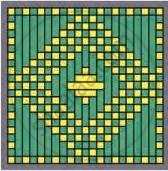
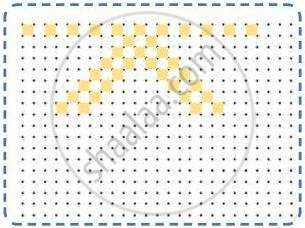
Draw the following pattern on a grid paper. Part of it is done for you. Now, complete the rest of the grid to get the full design.
Find Out
Can regular triangles fit together at a point without any gap? How many of them fit together? (A sample triangle is given at the end of the book). Do you see that regular triangles fit around a point as shown here?
Can squares (a regular 4-sided shape) fit together around a point without any gap or overlap? Try it out using cutouts of squares (a sample square is given at the end of the book). How many squares did you need?
Can five squares fit together around a point without any gaps or overlaps? Why or why not?
Can regular hexagons (6-sided shapes with equal sides) fit together around a point without any gaps or overlaps? Try and see (a sample hexagon is given at the end of the book). How many fit together at a point?

Here is a tessellating pattern with more than one shape. What shapes have been used in this pattern? ______, ______.
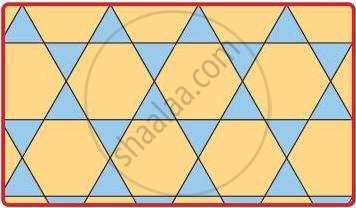
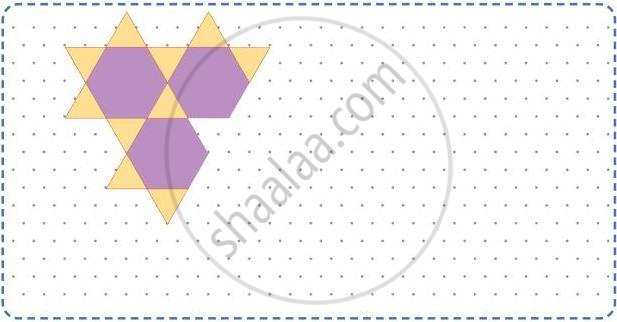
Continue the pattern given below and colour it appropriately.
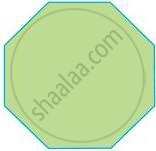
Do regular octagons fit together without any gaps or overlaps? Try drawing the same and check.
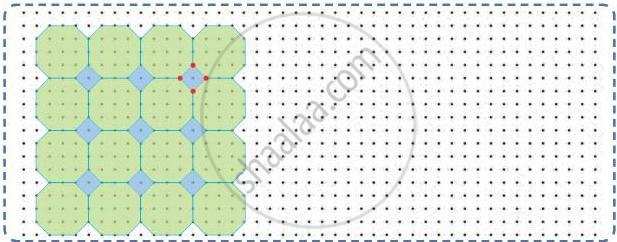
Look at the pattern given below. What shapes are coming together at the marked points? Are the same set of shapes coming together at these points? Continue the pattern and colour it appropriately.
Here is a tiling pattern made using two different shapes—squares and triangles. Are the triangles equilateral? Why or why not?
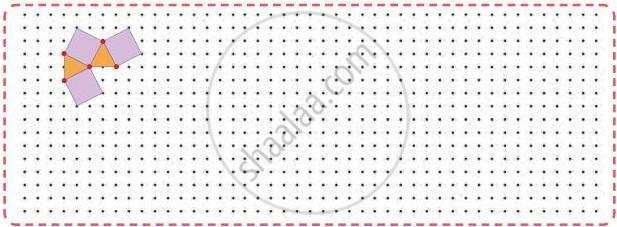
What shapes are coming together at the marked points? Are the same set of shapes coming together at these points? Continue the pattern and colour it appropriately.
Is it possible to make a triangle where all three sides are equal (equilateral triangle)?
Is it possible to make a triangle where all three sides are unequal?
Try This
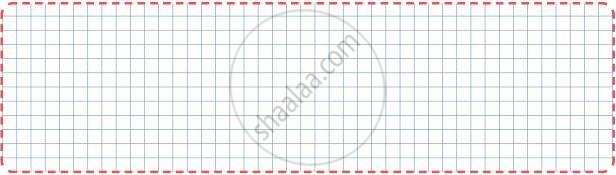
In the grid given below, draw two different kites and parallelograms each.
Which of these shapes can be made with all 4 pieces? Try and find out.
- Square
- Rectangle
- Triangle
- Pentagon (5-sided)
- Hexagon (6-sided)
- Octagon (8-sided)
Tangram
Look at the tangram set given at the end of your textbook. Cut out all the shapes. Name them.
- How are they same or different from each other?
- What do you notice about the angles of each of the shapes?
- What do you notice about the sides of each of the shapes?
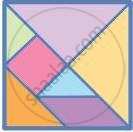
Now, use some or all of the pieces of your tangram set to make the following shapes. There may be more than one way to do it.
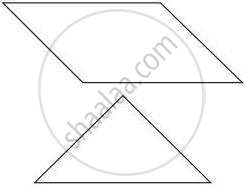
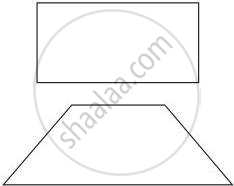
Which Shape Am I?
Match the statements with appropriate shapes. Do some of them describe more than one shape?
| Statement | Shape | |
|---|---|---|
| 1. | All my angles are right angles, but all my sides are not equal. |  (Square)  (Rectangle)  (Rhombus)  (Parallelogram) |
| 2. | All my sides are equal, but all my angles are not. | |
| 3. | My opposite angles are equal, but my sides do not make a right angle. | |
| 4. | Two pairs of sides are equal, but they do not make a right angle. | |
| 5. | All my sides make right angles with each other and are equal. | |
| 6. | My opposite angles are equal and so are my sides. | |
| 7. | My opposite angles are equal and my sides make right angles. |
Kites
What shapes do you see in the kite?
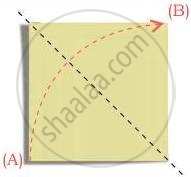
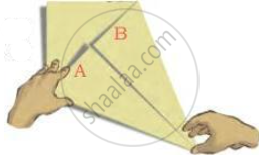
Play with Circles
Do you remember a circle?
- Draw a circle with a compass and mark its centre.
- Draw its diameter. Mark the endpoints of the diameter.
- Draw another diameter of the circle and mark the endpoints.
- Now join the four points.
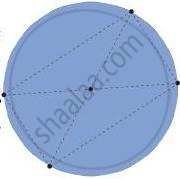
- What shape is formed? Check the sides of the quadrilateral and the angles obtained.
- Try with a different pair of diameters. What do you notice about the shape that is formed?
- Is it possible to create a 4-sided shape other than a rectangle through this process?
Circle Designs
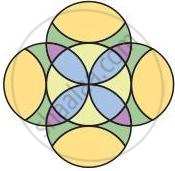
Can you think of a way to make a design exactly like the image given here? Try to make it.
Cube Connections
Here are three views of a cube. Can you draw them on the net in the correct order?
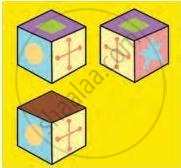
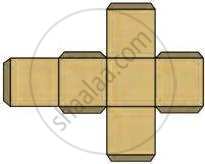
Here are some big solid cube frames. How many small cubes have been removed from each cube?
(a)


(b)


(c)
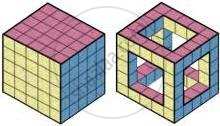
Nisha has glued 27 small cubes together to make a large solid cube. She paints the large cube red. How many of the original small cubes have—

- three faces painted red? _______
- two faces painted red? _______
- one face painted red? _______
- no faces painted red? _______
Puzzle
Tanu arranged 7 shapes in a line. She used 2 squares, 2 triangles, 1 circle, 1 hexagon, and 1 rectangle. Find her arrangement using the following clues:
- The square is between the circle and the rectangle.
- The rectangle is between the square and the triangle.
- The two triangles are next to the square.
- The hexagon is to the right of the triangle.
- The circle is to the left of the square.
Icosahedron and Dodecahedron
What do Icosahedron and Dodecahedron names mean? Once you count their faces, you will know.
What shapes do you see in an icosahedron and a dodecahedron?
Do all the faces look the same in an icosahedron and a dodecahedron?
How many faces meet at a vertex (point) in an icosahedron and a dodecahedron?
Do the same number of faces meet at each vertex in an icosahedron and a dodecahedron?
How many edges do you see in an icosahedron and a dodecahedron?
How did you count icosahedron and dodecahedron such that you do not miss out any edge or count an edge twice?
Can you think of any other solid shapes that have faces that look the same as icosahedron and dodecahedron?
Solutions for 7: Shapes and Patterns
NCERT solutions for Maths Mela [English] Class 5 chapter 7 - Shapes and Patterns
Shaalaa.com has the CBSE Mathematics Maths Mela [English] Class 5 CBSE solutions in a manner that help students grasp basic concepts better and faster. The detailed, step-by-step solutions will help you understand the concepts better and clarify any confusion. NCERT solutions for Mathematics Maths Mela [English] Class 5 CBSE 7 (Shapes and Patterns) include all questions with answers and detailed explanations. This will clear students' doubts about questions and improve their application skills while preparing for board exams.
Further, we at Shaalaa.com provide such solutions so students can prepare for written exams. NCERT textbook solutions can be a core help for self-study and provide excellent self-help guidance for students.
Concepts covered in Maths Mela [English] Class 5 chapter 7 Shapes and Patterns are .
Using NCERT Maths Mela [English] Class 5 solutions Shapes and Patterns exercise by students is an easy way to prepare for the exams, as they involve solutions arranged chapter-wise and also page-wise. The questions involved in NCERT Solutions are essential questions that can be asked in the final exam. Maximum CBSE Maths Mela [English] Class 5 students prefer NCERT Textbook Solutions to score more in exams.
Get the free view of Chapter 7, Shapes and Patterns Maths Mela [English] Class 5 additional questions for Mathematics Maths Mela [English] Class 5 CBSE, and you can use Shaalaa.com to keep it handy for your exam preparation.
