Look at the tangram set given at the end of your textbook. Cut out all the shapes. Name them. (a) How are they same or different from each other? (b) What do you notice about the angles of each
Advertisements
Question
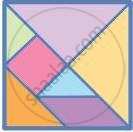
Look at the tangram set given at the end of your textbook. Cut out all the shapes. Name them.
- How are they same or different from each other?
- What do you notice about the angles of each of the shapes?
- What do you notice about the sides of each of the shapes?
Activity
Advertisements
Solution
Names of the tangram shapes (standard 7-piece tangram set):
- 2 large right-angled isosceles triangles
- 1 medium right-angled isosceles triangle
- 2 small right-angled isosceles triangles
- 1 square
- 1 parallelogram
Basis of Difference Triangles Square Parallelogram Number of sides 3 4 4 Side lengths Two sides equal in each triangle (isosceles) All 4 sides equal Opposite sides equal Size Large, medium and small triangles Same size as the small triangle's hypotenuse-based unit Same size as the small triangle's hypotenuse-based unit Angles One right angle (90°) in each triangle All angles are 90° Two acute angles and two obtuse angles Same/different Same type of triangle, different sizes Different shape Different shape Summary: All pieces are polygons made of straight sides, but they differ in number of sides, size and angles.
-
- Each triangle has one angle of 90° and two angles of 45°.
- The square has four angles of 90° each.
- The parallelogram has two angles of 45° and two angles of 135°.
- All angles are formed by straight sides, so every shape is a polygon with straight-line sides.
-
- Each triangle has two equal sides (isosceles) and one longer hypotenuse.
- The square has all four sides equal.
- The parallelogram has opposite sides equal and parallel.
- The sides of the triangles and parallelogram match in length, so the pieces fit together edge to edge.
shaalaa.com
Is there an error in this question or solution?
