NCERT solutions for Maths Mela [English] Class 5 chapter 5 - Far and Near [Latest edition]
Chapters
2: Fractions
3: Angles as Turns
4: We the Travellers-2
▶ 5: Far and Near
6: The Dairy Farm
7: Shapes and Patterns
8: Weight and Capacity
Chapter 9: Coconut Farm
Chapter 10: Symmetrical Designs
Chapter 11: Grandmother’s Quilt
Chapter 12: Racing Seconds
Chapter 13: Animal Jumps
Chapter 14: Maps and Locations
Chapter 15: Data Through Pictures
Advertisements
Advertisements
Solutions for Chapter 5: Far and Near
Below listed, you can find solutions for Chapter 5 of CBSE NCERT for Maths Mela [English] Class 5.
Advertisements
NCERT solutions for Maths Mela [English] Class 5 5 Far and Near Intext Question [Pages 57 - 69]
Let Us Find
Identify the appropriate units for measuring each of the following.
| Quantity | Unit of measurement Metre (m) or centimetre (cm) |
|---|---|
| Height of India Gate | 42 |
| Length of a handkerchief | 40 |
| Depth of a well | 50 |
| Length of a mobile phone | 13 |
| Length of an elephant’s trunk | 2 |
| Distance between two buttons on a shirt |
5 |
Let Us Compare
Ritika is comparing the lengths of different rods. Compare them using <, =, > signs.
- 456 cm ____ 5 m
- 55 cm + 200 cm ____ 200 cm + 54 cm
- 6 m 5 cm ____ 6 m 50 cm
- 2 m 150 cm ____ 3 m 50 cm
- 238 cm ____ 138 cm + 1 m
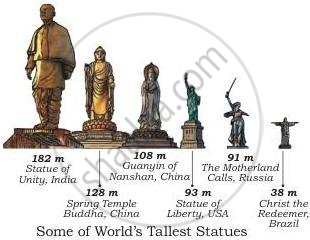
World’s tallest statue
- What is the difference between the height of the tallest statue in the world and the Statue of Liberty?
- Identify the statues whose heights have the least difference.
- Identify the statues whose heights have the largest difference.
- The height of which statue will be equal to the height of the Statue of Unity, if it is doubled?
Let Us Do
Measure 100 m and 200 m on your school playground, or any other place in and around your school, using a Long Tape. Mark these points and draw a straight line. Walk on the lines and count the number of steps. Use this relationship between the number of steps taken and distance walked to find distances around you for at least 3 locations. Wherever possible, walk and find the number of steps. Otherwise, find the distance and estimate the number of steps.
- Identify and write the locations that are the nearest and the farthest from your home.
Nearest location ____________.
Farthest location ____________. - Write the distances obtained above in increasing order.
______, ______, ______, ______. - Name a location that is equal to or more than 1,000 m from your home.
Let Us Explore
When we walk 1,000 m, we say we have walked 1 km.
1,000 m = 1 km
Kilo stands for thousand. This unit is used to measure long distances.
| Length of rope | Number of ropes needed to make 1 km |
|---|---|
| 1,000 m | 1 |
| 100 m | |
| 10 m | |
| 200 m | |
| 500 m | |
| 250 m |
Kilometre Race
Sheena and Jennifer are helping to organise a 3-km race. Help them with the arrangements for the race.
- Water stations are to be arranged after every 500 m. How many water stations must be set up? At what positions from the starting point will these water stations be placed?
- Children need to stand at an interval of 300 m to direct the runners. How many children are needed? At what positions from the starting point will the children be standing?
- Red and blue flags are to be placed alternately at every 50 m. How many red and blue flags are needed till the finish line?
Let Us Do
Longest Train Journey
The longest train journey in India is by The Vivek Express which runs from Dibrugarh in Assam to Kanniyakumari in Tamil Nadu. Look at the stations on the route shown in the table below and answer the questions.
| Station number | Name of the station | Distance from Dibrugarh |
|---|---|---|
| 9 | Dimapur | 306 km |
| 14 | Guwahati | 556 km |
| 22 | Jalpaiguri Road | 983 km |
| 34 | Bhubaneswar | 2,007 km |
| 40 | Visakhapatnam | 2,450 km |
| 45 | Vijayawada JN | 2,800 km |
| 55 | Coimbatore JN | 3,675 km |
| 65 | Kanniyakumari | 4,187 km |
- The total length of the route from Dibrugarh to Kanniyakumari is ________ km.
- The distance between Vijayawada and Jalpaiguri road is ________.
- Distance between Vijayawada and Visakhapatnam is ________.
- Which two stations are farther apart—Guwahati and Dimapur or Bhubaneswar and Jalpaiguri Road?
- What is the distance between Guwahati and Coimbatore JN?
Let Us Measure
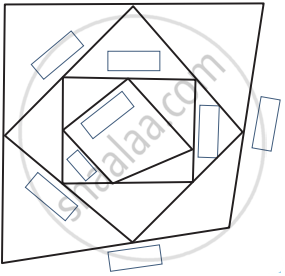
Measure the lines in the design and write their measurements in cm and mm.
Let Us Do
Soak some seeds of whole moong or black or white chana overnight. Next morning, take them out and wrap them in a moist cloth to sprout them. Over the next 4 days, take out one seed each day and measure the length of sprout. For ease of measurement, you can either place the seed on a paper and mark the length of the sprout, or use a thread to find its length.
| Number of days | Length of the sprout (in mm) |
|---|---|
| Day 1 | |
| Day 2 | |
| Day 3 | |
| Day 4 |
Let Us Draw
Draw lines of the following lengths in your notebook using a scale.
- 5 cm 5 mm
- 3 cm 6 mm
- 8 cm 3 mm
- 36 mm
- 67 mm
How did you draw lines of lengths 36 mm and 67 mm? Share your thoughts in class.
Let Us Do
Fill in the blanks appropriately in the double number lines given below.
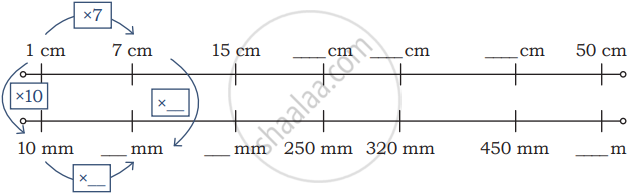
Fill in the blanks appropriately in the double number lines given below.
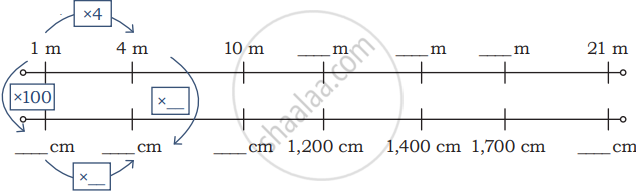
Fill in the blanks appropriately in the double number lines given below.
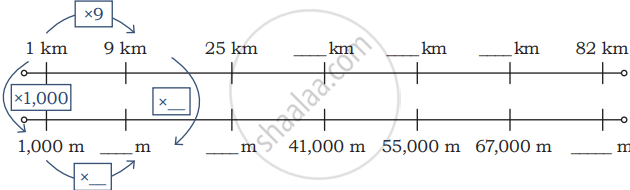
Use your understanding to fill in the blanks appropriately.
4 cm 5 mm = ______ mm
Use your understanding to fill in the blanks appropriately.
89 mm = ______ cm ______ mm
Use your understanding to fill in the blanks appropriately.
234 cm = ______ mm
Use your understanding to fill in the blanks appropriately.
514 mm = ______ cm ______ mm
Use your understanding to fill in the blanks appropriately.
6 m 34 cm = ______ cm
Use your understanding to fill in the blanks appropriately.
20 m 12 cm = ______ cm
Use your understanding to fill in the blanks appropriately.
397 m = ______ cm
Use your understanding to fill in the blanks appropriately.
5,792 cm = ______ m ______ cm
Use your understanding to fill in the blanks appropriately.
9,108 cm = ______ m ______ cm
Use your understanding to fill in the blanks appropriately.
34 km = ______ m
Use your understanding to fill in the blanks appropriately.
6,870 m = ______ km ______ m
Use your understanding to fill in the blanks appropriately.
10,552 m = ______ km ______ m
Use your understanding to fill in the blanks appropriately.
29 km 30 m = ______ m
Use your understanding to fill in the blanks appropriately.
32 km 359 m = ______ m
Let Us Do
Rani has two red-coloured ribbon rolls, one of length 3 m 75 cm and another 2 m 25 cm long. How much ribbon does she have?
The distance from Bhopal to Sanchi is 48 km 700 m. Bhadbhada Ghat waterfall is on the way, and 17 km 900 m away from Bhopal. How far is Sanchi from the waterfall?
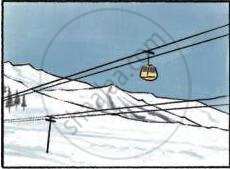
Gulmarg Gondola in Gulmarg, Kashmir is the second longest and second highest cable car in the world. It is divided into two sections. The first section covers 2 km 300 m and the second section covers 2 km 650 m. What is the total distance covered by the cable car?
Circle the bigger length and find the difference.
- 11 mm and 1 cm Difference - ______
- 26 mm and 2 cm Difference - ______
- 20 cm and 201 mm Difference - ______
- 1,020 mm and 1m Difference - ______
- 2 m and 245 cm Difference - ______
- 5,678 m and 6 km Difference - ______
- 6 km 1,480m and 7 km 479m Difference - ______
Multiplying and Dividing Lengths
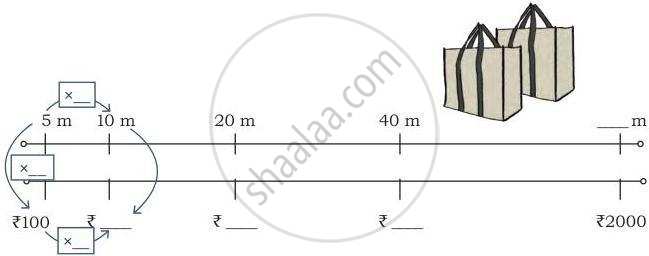
A shop sells cloth for making bags at ₹100 for 5 m. How much money is needed to buy a 1 m cloth?
If 5 m cloth costs ₹100, then a 1 m cloth costs 100 ÷ 5 = ₹20.
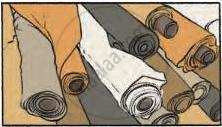
Now, use the double number line to find the cost of the cloth or the length of cloth that we can buy at a particular cost.
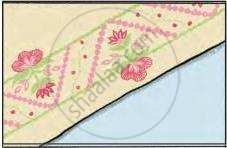
Anita is making an embroidery on the border of a sari. She needs a 1 m long thread to embroider a 50 cm sari. How much thread would she need for a 5 m sari border?
A 1 m long thread costs ₹50. How much money will be needed to buy the thread?
A road 12 km 600 m long is being laid in a town. The workers lay an equal length of road each day, and complete the work in 6 days. How much road-laying work is done on each day?
Let Us Estimate
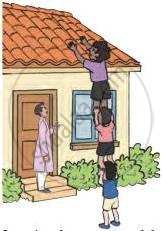
Height of a single-storeyed house
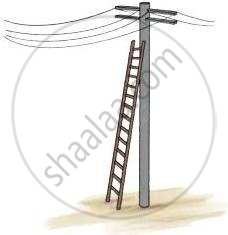
Height of an electric pole
Estimate the following. Share your reasoning in class.
- The height of the tallest building in your neighbourhood. What did you use as a reference to estimate the height?
- The height of the tallest tree in your neighbourhood. What did you use as a reference?
- The depth of a well or swimming pool in your neighbourhood. How did you find out?
Measure Your Height
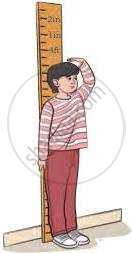
Stand against a wall and mark your height. Measure the distance between the floor and the marked point in feet and inches.
Similarly, other students in the class can also measure their heights.
Find out who is the tallest student in your class. What is his or her height in feet and inches?
Try This
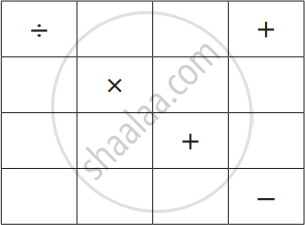
Put appropriate operation sign (+, -, ×, ÷) such that each row and column and each 4 × 4 box should not repeat the sign.
Solutions for 5: Far and Near
NCERT solutions for Maths Mela [English] Class 5 chapter 5 - Far and Near
Shaalaa.com has the CBSE Mathematics Maths Mela [English] Class 5 CBSE solutions in a manner that help students grasp basic concepts better and faster. The detailed, step-by-step solutions will help you understand the concepts better and clarify any confusion. NCERT solutions for Mathematics Maths Mela [English] Class 5 CBSE 5 (Far and Near) include all questions with answers and detailed explanations. This will clear students' doubts about questions and improve their application skills while preparing for board exams.
Further, we at Shaalaa.com provide such solutions so students can prepare for written exams. NCERT textbook solutions can be a core help for self-study and provide excellent self-help guidance for students.
Concepts covered in Maths Mela [English] Class 5 chapter 5 Far and Near are .
Using NCERT Maths Mela [English] Class 5 solutions Far and Near exercise by students is an easy way to prepare for the exams, as they involve solutions arranged chapter-wise and also page-wise. The questions involved in NCERT Solutions are essential questions that can be asked in the final exam. Maximum CBSE Maths Mela [English] Class 5 students prefer NCERT Textbook Solutions to score more in exams.
Get the free view of Chapter 5, Far and Near Maths Mela [English] Class 5 additional questions for Mathematics Maths Mela [English] Class 5 CBSE, and you can use Shaalaa.com to keep it handy for your exam preparation.
