Advertisements
Chapters
A: The Perfect Play
B: Games and Glory
C: Adventure Sports
D: The Superhumans
Unit - 2 : Arts and Aesthetics
A: Performing Arts
B: Blind Opera
C: Outsider Art
D: An Accomplished Filmmaker
E: Reviewing a Film
Unit - 3 : Inventors and Inventions
A: Trailblazers
B: Robots
C: Machine
D: Humans Against Virus
Unit - 4 : Exploring New Avenues
A: Healing
B: Crafts
C: Warriors
Unit - 5 : Speaking and Listening Practice
A: A Review
B: Language Functions
Chapter C: In my Office
▶ D: Sounds of English - Review
E: Listening - Review
Advertisements
Solutions for Chapter D: Sounds of English - Review
Below listed, you can find solutions for Chapter D of CBSE CBSE for English Language Skills Class 12.
CBSE solutions for English Language Skills Class 12 D Sounds of English - Review Section - D [Pages 122 - 128]
Given below are the phonetic symbols along with the words which represents that sound.
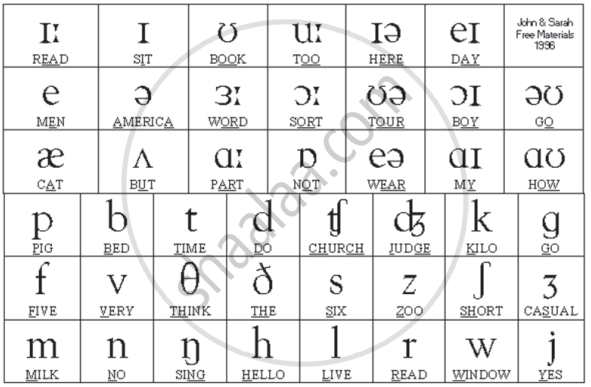
Read all these words aloud and circle the letter that corresponds to the phonetic symbol.
Study the phonetic symbol for each consonant sound carefully, and underline the word which DOES NOT represent the corresponding sound.
| Consonant sound | Odd one out |
|---|---|
| /p/ | pen, copy, happen, ciphon |
| /b/ | back, bomb, baby, job |
| /t/ | tea, tight, listen, button |
| /d/ | day, ladder, odd |
| /k/ | key, clock, Wednesday, school |
| /g/ | get, giggle, might, ghost |
| /tʃ/ | church, match, nation, nature |
| /dʒ/ | judge, age, plague, soldier, |
| /f/ | fat, coffee, though, photo |
| /v/ | view, heavy, move |
| /θ/ | thing, author, matter, path |
| /ð/ | this, other, should, smooth |
| /s/ | soon, cease, kites, sister |
| /z/ | zero, music, measure, buzz |
| /ʃ/ | ship, cycle, sure, national |
| /ʒ/ | pleasure, vision, leisure, ledger |
| /h/ | hot, whole, thought, ahead |
| /m/ | more, hammer, mnemonic, sum |
| /n/ | nice, know, funny, column |
| /ŋ/ | ring, anger, thanks, sung |
| /l/ | light, valley, talk, feel |
| /r/ | right, wrong, sorry, poor |
| /j/ | yet, use, beauty, jade |
| /w/ | wet, one, suit, queen |
(a) Given below is a box full of words. Read each word aloud, and then find pairs of words that are pronounced in the same way, but have a different meaning and different spellings
| sea | gate | too | bow | knot | see |
| blue | sent | fare | cue | pear | fair |
| there | by | gait | their | not | blew |
| bye | already | tye | stationery | whole | practise |
| deer | tie | die | two | bough | sent |
| queue | pair | practice | already | stationary | hole |
| dear | dye | ||||
(b) Write the pairs in the table as shown below:
| (e.g.) pair | (e.g.) pear |
Stress on the right syllable
Study the examples and practise pronouncing the words by stressing the syllable written in capital letters.
| PersonNEL | TOtally | InDUstrial | ToMAto | FanTAstic |
Note: Unstressed syllables keep the correct sound, but they sound muted. Sometimes, unstressed vowels become a schwa sound - like a soft "uh". At other times, the vowel is pronounced but not stressed. Now, review the eight common word stress patterns in English.
One Syllable - Stressed
All one syllable words have the stress on the one syllable. The intonation should go down.
| EAT | DRINK | SIGN | WELL |
Two Syllable - First syllable stressed
Examples:
| Glant | PICture | HEAting |
Two Syllable - Second syllable stressed
Examples:
| toDAY | aHEAD | aLLOW |
Three Syllable - First syllable stressed
Examples:
| ENergy | Operate | ORganize |
Three Syllable - Second syllable stressed
Examples:
| meMORial | aSSUMPtion | caNAdian |
Three Syllable - Third syllable stressed
Examples:
| employEE | japanESE | voluntEER |
Four Syllable - Second syllable stressed
Examples:
| psyCHOLogy | eVAporate | cerTIficate |
Four Syllable - Third syllable stressed
Examples:
| poliTIcian | indiVIdual | reputation |
Read the following sentences out aloud. Mark them as Type A or Type B according to the rise or fall in the tone.
You may recall that the pitch rises at the end of the statement/question if the speaker is uncertain, and it falls when the speaker is certain.
- The percentage of women working in banks is rising, isn’t it?
- You are not going to put this down in writing, are you?
- The policy calls for a big change in overtime rules, doesn’t it?
- You visited Tashi last week, didn’t you?
- The Agra fort was built by Shah Jahan, wasn’t it?
- I think this will lower the recruitment standards, won’t it?
- I should go and fetch the groceries, should I?
- I haven’t read about eight different types of intelligence have you?
The Silent Letter:
You have earlier studied that English is not a phonetic language; it simply means that quite often, in many of the words, all the consonants may not be pronounced. And, it can be quite difficult to remember which consonants are not pronounced in which words. Given here are some examples that illustrate this feature.
| A - logically, musically, romantically, | L - calf, calm, talk, yolk |
| B - debt, doubt, numb, subtle, | N - autumn, column, damn, hymn, |
| C - blackguard, czar, scissors, | P - pneumonia, psychology, receipt |
| D - handkerchief, Wednesday | R - butter, finger, garden, here, |
| G - align, champagne, gnaw, | S - aisle, debris, island, isle, |
| H - choir, exhaust, ghost, heir, hour | T - asthma, ballet, castle, gourmet |
| K - blackguard, knead, knowledge | U - catalogue, guest, guitar, tongue |
Intonation:
Working in pairs, discuss the given situation
|
Your best friend has started going out with a group of friends who you know to be undesirable. You have tried to caution your friend about them but she/he does not pay any heed. How will you deal with the situation?
|
Which of the following language functions will you use? Write the exponents you would use.
| Functions | Exponents |
| Expressing opinion/s | |
| Asking for advice | |
| Interrupting | |
| Offering suggestions | |
| Offering help | |
| Summing up |
The TV is described as an ‘idiot box’. Debate AGAINST the motion. Your presentation should be about 3 to 4 minutes. Use the language of debate appropriately to help you make your speech more effective.
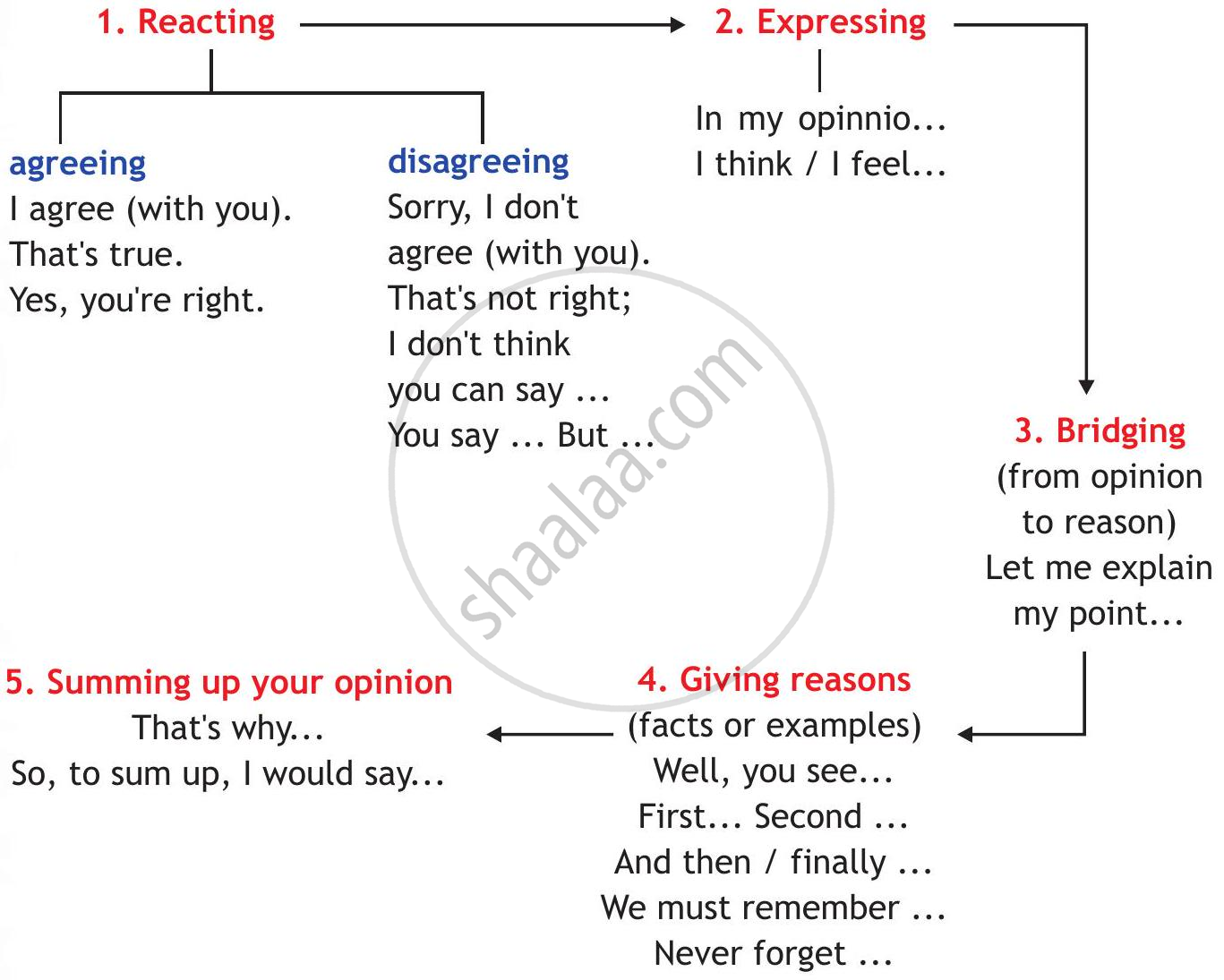
Language Use
- Opening statement/Quotation
- Respected Chairperson, members of the jury, teachers, and my dear friends …
- I strongly support/reject/oppose the motion …
- First reason for/against
- Second reason for/against
- My worthy opponent has just pointed out … but I feel…
- Friends, don’t you agree with me when I say …
- Although my opponent may feel …
- Summing up
Solutions for D: Sounds of English - Review
CBSE solutions for English Language Skills Class 12 chapter D - Sounds of English - Review
Shaalaa.com has the CBSE Mathematics English Language Skills Class 12 CBSE solutions in a manner that help students grasp basic concepts better and faster. The detailed, step-by-step solutions will help you understand the concepts better and clarify any confusion. CBSE solutions for Mathematics English Language Skills Class 12 CBSE D (Sounds of English - Review) include all questions with answers and detailed explanations. This will clear students' doubts about questions and improve their application skills while preparing for board exams.
Further, we at Shaalaa.com provide such solutions so students can prepare for written exams. CBSE textbook solutions can be a core help for self-study and provide excellent self-help guidance for students.
Concepts covered in English Language Skills Class 12 chapter D Sounds of English - Review are .
Using CBSE English Language Skills Class 12 solutions Sounds of English - Review exercise by students is an easy way to prepare for the exams, as they involve solutions arranged chapter-wise and also page-wise. The questions involved in CBSE Solutions are essential questions that can be asked in the final exam. Maximum CBSE English Language Skills Class 12 students prefer CBSE Textbook Solutions to score more in exams.
Get the free view of Chapter D, Sounds of English - Review English Language Skills Class 12 additional questions for Mathematics English Language Skills Class 12 CBSE, and you can use Shaalaa.com to keep it handy for your exam preparation.
