Advertisements
Chapters
1: Interpretation of Topographical Maps
2: Map of India
UNIT 2: GEOGRAPHY OF INDIA
Chapter 3: Location, Extent and Physical Features of India
4: Climate of India
5: Soils in India
6: Natural Vegetation of India
▶ 7: Water Resources
8: Minerals and Energy Resources in India - Part I
9: Mineral and Energy Resources - Part II
10: Agriculture in India - Part 1
11: Agriculture in India Part II - Food Crops
12: Agriculture in India Part III - Cash Crops
13: Industries in India Part I - Agro Based Industries
14: Industries in India Part II - Mineral-Based Industries
15: Transport in India
Chapter 16: Waste Management Part I - Impact of Waste Accumulation
Chapter 17: Waste Management Part II - Need for Waste Management and Methods of Safe Disposal
Chapter 18: Waste Management Part III - Need and Methods for Reducing, Reusing and Recycling Waste
![Austine Vas, Hemant M. Pednekar, Vidhya Malar solutions for Geography Our Earth [English] Class 10 ICSE chapter 7 - Water Resources - Shaalaa.com](/images/geography-english-class-10-icse_6:4d4b3dbbabe34a99b001783cb7b5fbff.jpg "Austine Vas, Hemant M. Pednekar, Vidhya Malar solutions for Geography Our Earth [English] Class 10 ICSE chapter 7 - Water Resources")
Advertisements
Solutions for Chapter 7: Water Resources
Below listed, you can find solutions for Chapter 7 of CISCE Austine Vas, Hemant M. Pednekar, Vidhya Malar for Geography Our Earth [English] Class 10 ICSE.
Austine Vas, Hemant M. Pednekar, Vidhya Malar solutions for Geography Our Earth [English] Class 10 ICSE 7 Water Resources Exercises [Pages 174 - 177]
Most of the fresh water in India is used up by ______.
irrigation
recreation
industries
domestic consumption
Farmers find the ______ wells to be the most reliable wells for irrigation.
Lined
Unlined
Tube
All the three types of wells
The state of ______ is famous for canal irrigation.
Tamil Nadu
Karnataka
Punjab
Rajasthan
______ irrigation makes the most liberal use of water.
Furrow
Sprinkler
Spray
Drip
‘Cheruva’ is the local name for rainwater harvesting in ______ state.
Rajasthan
Maharashtra
Telangana
Tamil Nadu
Which of the following statements is incorrect:
Rainwater harvesting includes the collection and storage of rainwater.
Rainwater harvesting helps in solving the problem of water crisis in rural areas.
Excess rainwater harvesting may cause floods.
Rainwater harvesting helps in recharging the groundwater table.
Pick the odd one out of the following, with reference to canal irrigation.
Uttar Pradesh
Punjab
Haryana
Telangana
Bihar is not much known for ______ irrigation.
Tank
Tube well
Canal
Open well
______ irrigation is known as the most efficient water saving method of irrigation.
Furrow
Sprinkler
Spray
Drip
India needs well-developed irrigation facilities in place because:
- We are largely an agricultural country with a lot of demand for agricultural produce.
- Rainfall is uncertain and unevenly distributed.
- All our export earnings come from the agricultural sector.
- 95% of the working population is directly employed in the agricultural sector.
1 and 2
1 and 3
2 and 4
1 and 4
Explain the following term.
Irrigation
Surface water.
Explain the following term.
Ground water
Explain the following term.
Kuchhawells
Explain the following term.
Tube wells
Explain the following term.
Tank
Explain the following term.
Canal Irrigation
What is a Watershed?
Explain the following term.
Sprinkler irrigation
What is ‘drip irrigation’?
Read the two statements given below and select the option that shows the correct relationship between (A) and (B).
- Reliable means of irrigation is important in India.
- Monsoon rainfall causes floods.
(B) contradicts (A).
(B) is the reason for (A).
(A) is true but (B) is false.
(A) and (B) are independent of each other.
- Tube wells are expensive.
- They need power to operate.
(B) contradicts (A).
(B) is the reason for (A).
(A) is true but (B) is false.
(A) and (B) are independent of each other.
- Drip irrigation is a good method of irrigation.
- It facilitates fertigation.
(B) contradicts (А).
(B) is the reason for (A).
(A) is true but (B) is false.
(A) and (B) are independent of each other.
In the following question, a statement of Assertion (A) is followed by a statement of Reason (R). Choose the correct answer out of the following choices.
Assertion (A): Saline water may cause problem for crops.
Reason (B): Some sensitive crops may suffer leaf scorch because of the salt deposits on the leaf after evaporation of water.
Both (A) and (R) are true and (R) is the correct explanation of (A).
Both (A) and (R) are true but (R) is not the correct explanation of (А).
(A) is true but (R) is false.
(A) is false but (R) is true.
Answer the following questions. (2 Marks)
Explain how nature of soil determines the need for irrigation?
Why do some farmers in India prefer surface well over tube wells?
Why well irrigation is more popular in Northern plains than Peninsular India?
Name two states known for tank irrigation.
Name two states known for well irrigation.
Give a geographical reason for the following:
Inundation canals are being converted to perennial canals.
What are ‘Inundation canals’?
Which is the longest perennial canal in India? What is its length?
What are the major disadvantages of canal irrigation?
Name any four states which are popular for canal irrigation.
What is watershed management?
Name two water harvesting system practised in India.
Explain rain water harvesting.
What is meant by conservation of water?
Mention two traditional ways of extracting water from a well.
Explain two advantages of well irrigation over canal irrigation.
Answer in detail. (three marks each)
What is the role of irrigation in maximizing agricultural production?
What are the two modern means of irrigation practiced in India? Why are they so popular?
What are the three main requirements for the success of well irrigation in an area?
Mention any three advantages of well irrigation in India.
What are the three disadvantages of well irrigation?
What are the three main requirements for the successful construction of tanks in an area?
What are the three advantages of tank irrigation?
What are the three disadvantages of tank irrigation?
What are the three advantages of canal irrigation?
What are the three advantages of drip irrigation?
What are the various methods of recharging ground water aquifers?
What are the advantages of rainwater harvesting?
What is the role of recharge pits in recharging groundwater?
What is the role of recharge trenches in recharging groundwater?
How is rooftop rainwater harvesting done?
Give reasons for the following.
Give three reasons that justify the fact that there is ever growing need for various methods of irrigation in India.
Give reasons for the following.
There is water scarcity in India despite the monsoons.
Give reasons for the following.
Why are tube wells more popular in the Gangetic plain?
Give reasons for the following.
Well irrigation is more common in the alluvial plains.
Give reasons for the following.
Tank irrigation is more popular in the Deccan plateau.
Give reasons for the following.
Canal irrigation is more popular in northern plains.
Give reasons for the following.
Drip irrigation is most suited in arid and semi-arid regions.
Give reasons for the following.
There is an ever growing need for conservation of water resources in our country.
Rainwater harvesting is the most effective method of watershed management in India. Explain.
Give reasons for the following.
Canal irrigation leads to the land around it becoming unproductive.
Give one geographical reason for the following:
A tube well should be installed in a fertile and productive region.
Give one reason for the following:
Although expensive, yet, sprinkler irrigation is gaining popularity in recent times.
Distinguish between the following.
Lined wells and unlined wells.
Distinguish between the following.
Surface well irrigation and tube well irrigation.
Distinguish between Inundation Canals and Perennial Canals.
Distinguish between the following.
Furrow irrigation and drip irrigation.
Austine Vas, Hemant M. Pednekar, Vidhya Malar solutions for Geography Our Earth [English] Class 10 ICSE 7 Water Resources ICSE Board Examination Questions [Pages 178 - 180]
MCQ
Which of the following is a ground water source?
Pond
Lake
Spring
River
Give a reason for the following:
Agriculture sector in India needs the support of irrigation.
Give a reason for the following:
Well irrigation is a popular means of irrigation in Northern India.
Distinguish between Inundation Canals and Perennial Canals.
Where in India is Tank irrigation most widely used?
Give one factor that has led to its popularity in the region mentioned by you.
Mention one advantage of using tank as a means of irrigation.
What is Rainwater Harvesting?
Give two ways in which Rainwater Harvesting is important for India.
MCQ
Which means of irrigation can be developed with minimum expenditure?
Tube well
Canal
Well
Drip irrigation
Mention one advantage of using tank irrigation.
Mention one disadvantage of using tank irrigation.
What is the advantage of using Drip irrigation?
Why is Drip irrigation not practiced on a large scale in India?
Give one reason for the following:
Although expensive, yet, sprinkler irrigation is gaining popularity in recent times.
Give a reason to explain the following:
Tube well irrigation is used in Punjab.
Give a reason to explain the following:
North India has more area under canal irrigation.
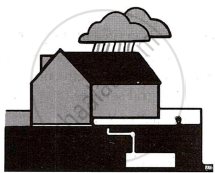
- Name the water conservation practice shown in the above picture.
- How does this system help to reduce floods?
- Why is water conservation necessary? (Any two reasons)
Solutions for 7: Water Resources
Austine Vas, Hemant M. Pednekar, Vidhya Malar solutions for Geography Our Earth [English] Class 10 ICSE chapter 7 - Water Resources
Shaalaa.com has the CISCE Mathematics Geography Our Earth [English] Class 10 ICSE CISCE solutions in a manner that help students grasp basic concepts better and faster. The detailed, step-by-step solutions will help you understand the concepts better and clarify any confusion. Austine Vas, Hemant M. Pednekar, Vidhya Malar solutions for Mathematics Geography Our Earth [English] Class 10 ICSE CISCE 7 (Water Resources) include all questions with answers and detailed explanations. This will clear students' doubts about questions and improve their application skills while preparing for board exams.
Further, we at Shaalaa.com provide such solutions so students can prepare for written exams. Austine Vas, Hemant M. Pednekar, Vidhya Malar textbook solutions can be a core help for self-study and provide excellent self-help guidance for students.
Concepts covered in Geography Our Earth [English] Class 10 ICSE chapter 7 Water Resources are Need for Irrigation, India: A Land of Rivers Yet Water Scarce, Sources of Water, Need to Conserve Water, Water Conservation Practices > Rainwater Harvesting, Irrigation, Means of Irrigation, Well Irrigation, Tank Irrigation, Canal Irrigation, Modern Irrigation Methods, Water Conservation Practices > Watershed Management, Water Conservation Practices > Rooftop Rainwater Harvesting, Water Conservation Practices > Recharging Groundwater Aquifers, Need for Irrigation, India: A Land of Rivers Yet Water Scarce, Sources of Water, Need to Conserve Water, Water Conservation Practices > Rainwater Harvesting, Irrigation, Means of Irrigation, Well Irrigation, Tank Irrigation, Canal Irrigation, Modern Irrigation Methods, Water Conservation Practices > Watershed Management, Water Conservation Practices > Rooftop Rainwater Harvesting, Water Conservation Practices > Recharging Groundwater Aquifers.
Using Austine Vas, Hemant M. Pednekar, Vidhya Malar Geography Our Earth [English] Class 10 ICSE solutions Water Resources exercise by students is an easy way to prepare for the exams, as they involve solutions arranged chapter-wise and also page-wise. The questions involved in Austine Vas, Hemant M. Pednekar, Vidhya Malar Solutions are essential questions that can be asked in the final exam. Maximum CISCE Geography Our Earth [English] Class 10 ICSE students prefer Austine Vas, Hemant M. Pednekar, Vidhya Malar Textbook Solutions to score more in exams.
Get the free view of Chapter 7, Water Resources Geography Our Earth [English] Class 10 ICSE additional questions for Mathematics Geography Our Earth [English] Class 10 ICSE CISCE, and you can use Shaalaa.com to keep it handy for your exam preparation.
