Please select a subject first
Advertisements
Advertisements
In the pair of triangles in the following figure, parts bearing identical marks are congruent. State the test and the correspondence of vertices by the triangle in pairs is congruent.
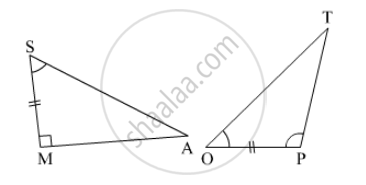
Concept: undefined >> undefined
In the pair of triangles in the following figure, parts bearing identical marks are congruent. State the test and the correspondence of vertices by the triangle in pairs is congruent.
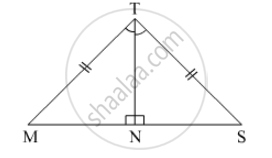
Concept: undefined >> undefined
Advertisements
In the pair of triangles given below, the parts shown by identical marks are congruent. State the test and the one-to-one correspondence of vertices by which the triangles in the pair are congruent, the remaining congruent parts.
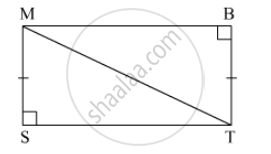
Concept: undefined >> undefined
In the pair of triangles given below, the parts shown by identical marks are congruent. State the test and the one-to-one correspondence of vertices by which the triangles in the pair are congruent, the remaining congruent parts.
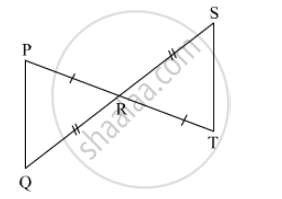
Concept: undefined >> undefined
In the pair of triangles given below, the parts shown by identical marks are congruent. State the test and the one-to-one correspondence of vertices by which the triangles in the pair are congruent, the remaining congruent parts.
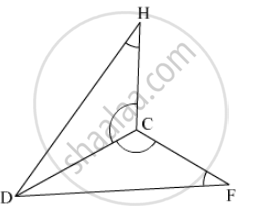
Concept: undefined >> undefined
In the adjacent figure, seg AD ≌ seg EC Which additional information is needed to show that ∆ ABD and ∆ EBC will be congruent by A-A-S test?
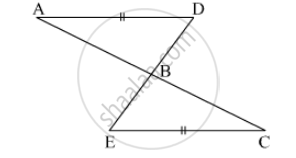
Concept: undefined >> undefined
Construct the following quadrilateral of given measures.
In ☐ MORE, l(MO) = 5.8 cm, l(OR) = 4.4 cm, m∠M = 58°, m∠O = 105°, m∠R = 90°.
Concept: undefined >> undefined
Construct the following quadrilateral of given measures.
Construct ☐ DEFG such that l(DE) = 4.5 cm, l(EF) = 6.5 cm, l(DG) = 5.5 cm, l(DF) = 7.2 cm, l(EG) = 7.8 cm.
Concept: undefined >> undefined
Construct the following quadrilateral of given measures.
In ☐ ABCD l(AB) = 6.4 cm, l(BC) = 4.8 cm, m∠A = 70°, m∠B = 50°, m∠C = 140°.
Concept: undefined >> undefined
Construct the following quadrilateral of given measures.
Construct ☐ LMNO such that l(LM) = l(LO) = 6 cm, l(ON) = l(NM) = 4.5 cm, l(OM) = 7.5 cm.
Concept: undefined >> undefined
Draw a square WXYZ with side 5.2 cm.
Concept: undefined >> undefined
Show the following numbers on a number line. Draw a separate number line for each example.
(1)`3/2 , 5/2 , -3/2`
(2)`7/5 , (-2)/5 , (-4)/5`
(3) `(-5)/8 , 11/8`
(4)`13/10 , (-17)/10`
Concept: undefined >> undefined
Observe the number line and answer the questions.

- Which number is indicated by point B?
- Which point indicates the number `1 3/4`?
- State whether the statement ‘the point D denotes the number `5/2`’ is true or false.
Concept: undefined >> undefined
Show the following numbers on a number line. Draw a separate number line for the example.
`3/2 , 5/2 , -3/2`
Concept: undefined >> undefined
Show the following numbers on a number line. Draw a separate number line for the example.
`7/5 , (-2)/5 , (-4)/5`
Concept: undefined >> undefined
Show the following numbers on a number line. Draw a separate number line for the example.
`(-5)/8 , 11/8`
Concept: undefined >> undefined
Show the following numbers on a number line. Draw a separate number line for the example.
`13/10 , (-17)/10`
Concept: undefined >> undefined
The number `sqrt2` is shown on a number line. Steps are given to show `sqrt3` on the number line using `sqrt2`. Fill in the boxes properly and complete the activity.
Activity :
- The point Q on the number line shows the number ______.
- A line perpendicular to the number line is drawn through the point Q. Point R is at unit distance from Q on the line.
- Right angled ∆ORQ is obtained by drawing seg OR.
`l ("OQ") = sqrt2` , `l("QR") = 1`
`therefore` by Pythagoras theorem,
`[l("OR")]^2 = [l("OQ")]^2 + [l("QR")]^2 `
= `square^2`+ `square^2` = `square` + `square`
= `square`
∴ l(OR) = `square`
Draw an arc with centre O and radius OR. Mark the point of intersection of the line and the arc as C. The point C shows the number `sqrt3`.
Concept: undefined >> undefined
Show the number √5 on the number line.
Concept: undefined >> undefined
Show the number √7 on the number line.
Concept: undefined >> undefined
