Advertisements
Advertisements
Question
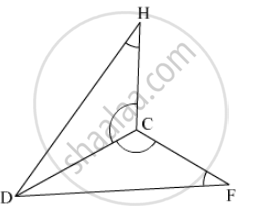
In the pair of triangles given below, the parts shown by identical marks are congruent. State the test and the one-to-one correspondence of vertices by which the triangles in the pair are congruent, the remaining congruent parts.
Advertisements
Solution
In ∆DHC and ∆DFC,
∠DCH ≅ ∠DCF (given)
∠DHC ≅ ∠DFC (given)
side DC is common
∴ By AAS test, ∆DHC ≅ ∆DFC.
∴ side DH ≅ side DF,
side HC ≅ side FC,
∠HDC ≅ ∠FDC.
RELATED QUESTIONS
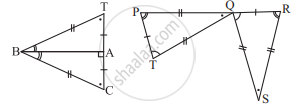
Complete the congruence statement:
ΔBCA ≅?
ΔQRS ≅?
In a ΔABC, if AB = AC and ∠B = 70°, find ∠A.
Observe the information shown in pair of triangle given below. State the test by which the two triangles are congruent. Write the remaining congruent parts of the triangles.
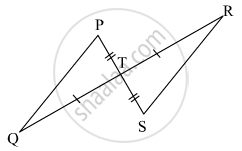
From the information shown in the figure,
in ΔPTQ and ΔSTR
seg PT ≅ seg ST
∠PTQ ≅ ∠STR ...[Vertically opposite angles]
∴ ΔPTQ ≅ ΔSTR ...`square` test
∴ `{:("∠TPQ" ≅ square),("and" square ≅ "∠TRS"):}}` ...corresponding angles of congruent triangles
seg PQ ≅ `square` ...corresponding sides of congruent triangles
In the following figure, OA = OC and AB = BC.
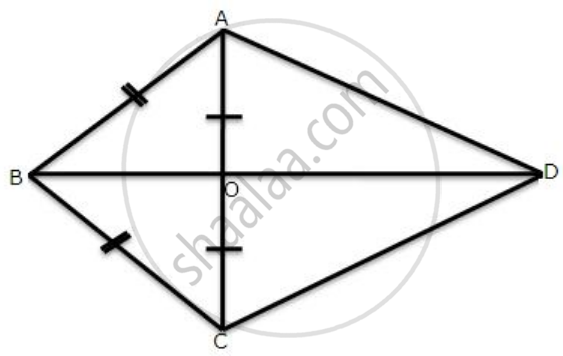
Prove that: AD = CD
In the given figure, prove that: ∆ ABD ≅ ∆ ACD
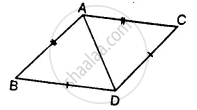
In ΔABC, AB = AC and the bisectors of angles B and C intersect at point O.Prove that BO = CO and the ray AO is the bisector of angle BAC.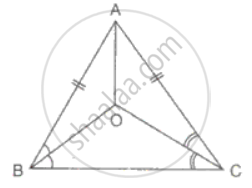
Two right-angled triangles ABC and ADC have the same base AC. If BC = DC, prove that AC bisects ∠BCD.
Given that ∆ABC ≅ ∆DEF List all the corresponding congruent angles
Without drawing the triangles write all six pairs of equal measures in the following pairs of congruent triangles.
∆ABC ≅ ∆LMN
Without drawing the triangles write all six pairs of equal measures in the following pairs of congruent triangles.
∆XYZ ≅ ∆MLN
