Advertisements
Advertisements
Question
Show the number √5 on the number line.
Advertisements
Solution
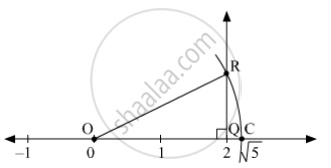
Draw a number line as shown in the figure. Let the point O represent 0 and point Q represent 2. Draw a perpendicular QR at Q on the number line such that QR = 1 unit. Join OR. Now, ∆OQR is a right angled triangle.
By Pythagoras theorem, we have
OR2 = OQ2 + QR2
= (2)2 + (1)2
= 4 + 1
= 5
∴ OR = √5
Taking O as the centre and radius OR = √5, draw an arc cutting the number line at C.
Clearly, OC = OR = √5
Hence, C represents √5 on the number line.
APPEARS IN
RELATED QUESTIONS
Write five rational numbers which are smaller than 2.
Show the following numbers on a number line. Draw a separate number line for each example.
(1)`3/2 , 5/2 , -3/2`
(2)`7/5 , (-2)/5 , (-4)/5`
(3) `(-5)/8 , 11/8`
(4)`13/10 , (-17)/10`
Show the following numbers on a number line. Draw a separate number line for the example.
`13/10 , (-17)/10`
The number `sqrt2` is shown on a number line. Steps are given to show `sqrt3` on the number line using `sqrt2`. Fill in the boxes properly and complete the activity.
Activity :
- The point Q on the number line shows the number ______.
- A line perpendicular to the number line is drawn through the point Q. Point R is at unit distance from Q on the line.
- Right angled ∆ORQ is obtained by drawing seg OR.
`l ("OQ") = sqrt2` , `l("QR") = 1`
`therefore` by Pythagoras theorem,
`[l("OR")]^2 = [l("OQ")]^2 + [l("QR")]^2 `
= `square^2`+ `square^2` = `square` + `square`
= `square`
∴ l(OR) = `square`
Draw an arc with centre O and radius OR. Mark the point of intersection of the line and the arc as C. The point C shows the number `sqrt3`.
Evaluate:
`5/9 + (-7)/6`
Evaluate:
`0 + (-2)/7`
Evaluate:
`4/(-9) + 1`
Find the rational numbers represented by the question marks marked on the following number line
Draw a number line and represent the following rational numbers on it
`(-8)/3`
The rational number `(-3)/4` lies to the right of zero on the number line.
