Advertisements
Advertisements
In ΔABC, AB = 9 cm, BC = 40 cm, AC = 41 cm. State whether ΔABC is a right-angled triangle or not. Write reason.
Concept: undefined >> undefined
Prove that: (sec θ – cos θ) (cot θ + tan θ) = tan θ.sec θ
Proof: L.H.S. = (sec θ – cos θ) (cot θ + tan θ)
= `(1/square - cos θ) (square/square + square/square)` ......`[∵ sec θ = 1/square, cot θ = square/square and tan θ = square/square]`
= `((1 - square)/square) ((square + square)/(square square))`
= `square/square xx 1/(square square)` ......`[(∵ square + square = 1),(∴ square = 1 - square)]`
= `square/(square square)`
= tan θ.sec θ
= R.H.S.
∴ L.H.S. = R.H.S.
∴ (sec θ – cos θ) (cot θ + tan θ) = tan θ.sec θ
Concept: undefined >> undefined
Advertisements
In the given figure, triangle PQR is right-angled at Q. S is the mid-point of side QR. Prove that QR2 = 4(PS2 – PQ2).

Concept: undefined >> undefined
In a right angled triangle, right-angled at B, lengths of sides AB and AC are 5 cm and 13 cm, respectively. What will be the length of side BC?
Concept: undefined >> undefined
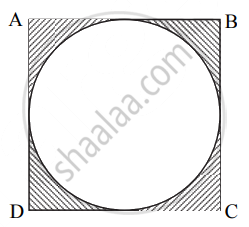
In the figure given above, `square`ABCD is a square and a circle is inscribed in it. All sides of a square touch the circle. If AB = 14 cm, find the area of shaded region.
Solution:
Area of square = `(square)^2` ......(Formula)
= 142
= `square "cm"^2`
Area of circle = `square` ......(Formula)
= `22/7 xx 7 xx 7`
= 154 cm2
(Area of shaded portion) = (Area of square) - (Area of circle)
= 196 − 154
= `square "cm"^2`
Concept: undefined >> undefined
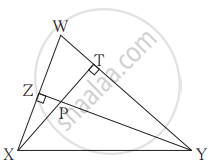
In the given figure, altitudes YZ and XT of ∆WXY intersect at P. Prove that,
- `square`WZPT is cyclic.
- Points X, Z, T, Y are concyclic.
Concept: undefined >> undefined
Find the diagonal of a rectangle whose length is 16 cm and area is 192 sq.cm ?
Concept: undefined >> undefined
In the following figure, O is the centre of the circle. ∠ABC is inscribed in arc ABC and ∠ ABC = 65°. Complete the following activity to find the measure of ∠AOC.

∠ABC = `1/2`m ______ (Inscribed angle theorem)
______ × 2 = m(arc AXC)
m(arc AXC) = _______
∠AOC = m(arc AXC) (Definition of measure of an arc)
∠AOC = ______
Concept: undefined >> undefined
Find the side and perimeter of a square whose diagonal is `13sqrt2` cm.
Concept: undefined >> undefined
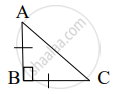
From given figure, In ∆ABC, AB ⊥ BC, AB = BC then m∠A = ?
Concept: undefined >> undefined
From given figure, In ∆ABC, AB ⊥ BC, AB = BC, AC = `2sqrt(2)` then `l` (AB) = ?

Concept: undefined >> undefined
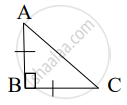
From given figure, In ∆ABC, AB ⊥ BC, AB = BC, AC = `5sqrt(2)`, then what is the height of ∆ABC?
Concept: undefined >> undefined
Find the height of an equilateral triangle having side 4 cm?
Concept: undefined >> undefined
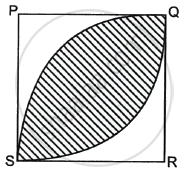
In the figure, PQRS is a square with side 10 cm. The sectors drawn with P and R as centres form the shaded figure. Find the area of the shaded figure. (Use π = 3.14)
Concept: undefined >> undefined
In a ΔABC, ∠CAB is an obtuse angle. P is the circumcentre of ∆ABC. Prove that ∠CAB – ∠PBC = 90°.
Concept: undefined >> undefined

In the above figure, ∠ABC is inscribed in arc ABC.
If ∠ABC = 60°. find m ∠AOC.
Solution:
∠ABC = `1/2` m(arc AXC) ......`square`
60° = `1/2` m(arc AXC)
`square` = m(arc AXC)
But m ∠AOC = \[\boxed{m(arc ....)}\] ......(Property of central angle)
∴ m ∠AOC = `square`
Concept: undefined >> undefined
Adjacent sides of a parallelogram are 11 cm and 17 cm. If the length of one of its diagonal is 26 cm, find the length of the other.
Concept: undefined >> undefined
The radius of a circle is 7 cm. find the circumference of the circle.
Concept: undefined >> undefined
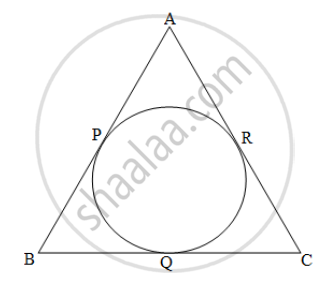
In figure, ΔABC is an isosceles triangle with perimeter 44 cm. The base BC is of length 12 cm. Side AB and side AC are congruent. A circle touches the three sides as shown in the figure below. Find the length of the tangent segment from A to the circle.
Concept: undefined >> undefined
Find the circumferences of a circle whose radius is 7 cm.
Concept: undefined >> undefined
