Please select a subject first
Advertisements
Advertisements
The following diagram in Fig. 10.44 shows a coil X connected to a sensitive centre –zero galvanometer G and a coil P connected to a battery through a switch S.
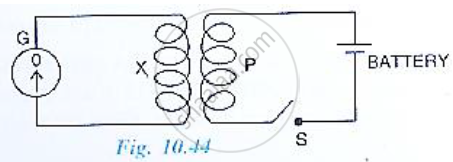
(a) Describe the observation when the switch S is (i) closed suddenly, (ii) then kept closed, (iii) finally opened.
(b) Name and state the law which explains the above observations.
Concept: undefined >> undefined
For what purpose are the transformers used? Can they be used with a direct current source?
Concept: undefined >> undefined
Advertisements
How are the e.m.f in the primary and secondary coils of a transformer related with the number of turns in these coils?
Concept: undefined >> undefined
The secondary windings of a transformer in which the voltage is stepped down are usually made of thicker wire than the primary. Explain why.
Concept: undefined >> undefined
Why is the iron core of a transformer made laminated (thin sheets) instead of being in one solid piece?
Concept: undefined >> undefined
The transformer is used in ______ current circuits.
Concept: undefined >> undefined
In a transformer, the frequency of A.C. voltage ______.
Concept: undefined >> undefined
What is the function of a transformer in an a.c. circuit? How do the input and output powers in a transformer compare?
Concept: undefined >> undefined
Name two kind of energy loss in a transformer. How is it minimized?
Concept: undefined >> undefined
The primary coil of a transformed has 800 urns and the secondary coil has 8 turns. It is connected to a 220 V a.c. supply. What will be the output voltage?
Concept: undefined >> undefined
A transformer is designed to work from a 240 V a.c. mains and to give a supply of 8 V to ring a house bell. The primary coil has 4800 turns. How many turns will be in the secondary coil?
Concept: undefined >> undefined
The input and output voltage of a transformer are 220 V and 44 V respectively. Find: the turns ratio.
Concept: undefined >> undefined
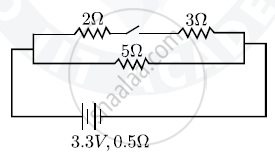
The diagram above shows a circuit with the key k open. Calculate :
(i) the resistance of the circuit when the key k is open.
(ii) the current drawn from the cell when the key k is open.
(iii) the resistance of the circuit when the key k is closed.
(iv) the current drawn from the cell when the key k is closed.
Concept: undefined >> undefined
The diagram below shows a magnetic kept just below the conductor AB which is kept in North South direction.
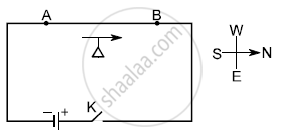
(i) In which direction will the needle deflect when the key is closed ?
(ii) Why is the deflection produced ?
(iii) What will be the change in the deflection if the magnetic needle is taken just above the conductor AB ?
(iv) Name one device which works on this principle.
Concept: undefined >> undefined
Concept: undefined >> undefined
Concept: undefined >> undefined
Concept: undefined >> undefined
Concept: undefined >> undefined
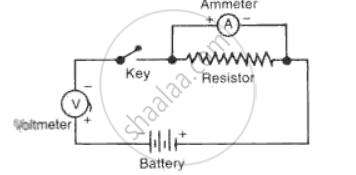
What is wrong with the circuit diagram (Fig. 34)? Carefully check the symbols and assign proper positive and negative signs to them.
Concept: undefined >> undefined
A simple electric circuit has 24 V battery and a resistor of 60 Ω. What will be the current in the circuit? The resistance of the connecting wires is negligible.
Concept: undefined >> undefined
