Advertisements
Advertisements
What do you understand by the term energy? Is energy a scalar or vector? How is the energy possessed by a body measured?
Concept: undefined >> undefined
A man climbs a slope and another walks same distance on level road. Which of the two expends more energy and why?
Concept: undefined >> undefined
Advertisements
Name the material commonly used for the manufacturing of solar cells.
Concept: undefined >> undefined
Name two places in India where electricity is generated from nuclear power plants.
Concept: undefined >> undefined
What should be the characteristic of a source of energy?
Concept: undefined >> undefined
Explain, why submarines are able to dive underwater as well as a sail on the surface of the water?
Concept: undefined >> undefined
Give two examples each of contact and non-contact forces.
Concept: undefined >> undefined
What is the difference between renewable and non-renewable resources?
Concept: undefined >> undefined
What are the advantages and disadvantages of using solar cells for producing electricity?
Concept: undefined >> undefined
A block of mass 30 kg is pulled up a slope, as shown in diagram with a constant speed, by applying a force of 200 N parallel to slope.
A and B are initial and final positions of block.

(i) Calculate the work done by force in moving the block from A to B.
(ii) Calculate P.E. gained by block. [g=10ms-2]
Concept: undefined >> undefined
(i) A 200g ball is thrown vertically upward with an initial velocity of 30 ms-1. Draw a velocity-time graph for the motion of ball.
(ii) How long will the ball take to reach the highest point?
(iii) What will be the kinetic energy of ball, when it returns to the starting point, neglecting the air resistance?
(iv) What will be the potential energy of ball at highest point?
Concept: undefined >> undefined
A truck driver can load oil drums into the back of the truck by pushing them up a sloping plank, or by lifting them directly. Each drum has a mass of 80 kg, the plank is 3 m long, and the back of the truck is 0.8 m above the ground.
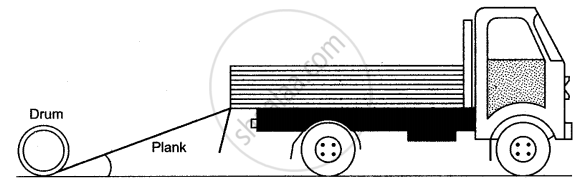
(i) How much force would be needed to lift a drum into the truck directly/without using the plank? (Take g = 10 m/s2)
(ii) How much energy would be required in lifting the drum into the truck without the plank?
(iii) If the force needed to push the drum up the plank is 300 N, why is this less than the answer to part (i)?
(iv) When the truck is loaded, the driver drives off. List the major energy changes that take place in moving the truck.
(v) The driver has to stop at the factory gates. What happens to the kinetic energy of the truck?
Concept: undefined >> undefined
A man can open a nut by applying a force of 150 N by using a lever handle of length 0.4 m. What should be the length of the handle if he is able to open it by applying a force of 60 N?
Concept: undefined >> undefined
Calculate the work done when:
A 5 kg weight is lifted 10 m vertically. (g = 9.8 m/s2)
Concept: undefined >> undefined
A force is applied on a body of mass 20 kg moving with a velocity of 40 ms−1. The body attains a velocity of 50 ms−1 in 2 seconds. Calculate the work done by the body.
Concept: undefined >> undefined
The work done by the heart is 1 Joule per beat. Calculate the power of the heart if it beats 72 times in one.
Concept: undefined >> undefined
How long should an electric motor, of power 2 H.P. operate, so as to pump 5 m3 of water from a depth of 15m. [Take g = 10 N kg−1]
Concept: undefined >> undefined
How do you define force? What are the forces acting on a man standing in a lift? If the lift moves down with an acceleration of 2 ms−2, what is the net force on the man if his mass is 50 kg?
Concept: undefined >> undefined
A coolie is pushing a box weighing 1500 N up an inclined plane 7.5 m long on to a platform, 2.5 m above the ground.
(i) Calculate the mechanical advantage of the inclined plane. (ii) Calculate the effort applied by the coolie.
(iii) In actual practice, the coolie needs to apply more effort than what is calculated. Give one reason why you think the coolie needs to apply more effort.
Concept: undefined >> undefined
