Advertisements
Advertisements
Question
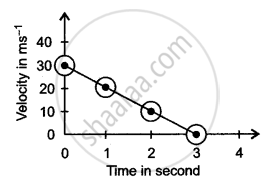
(i) A 200g ball is thrown vertically upward with an initial velocity of 30 ms-1. Draw a velocity-time graph for the motion of ball.
(ii) How long will the ball take to reach the highest point?
(iii) What will be the kinetic energy of ball, when it returns to the starting point, neglecting the air resistance?
(iv) What will be the potential energy of ball at highest point?
Advertisements
Solution
Given : m = 0.200 kg; v = 30 ms−1
(i) Shown in diagram alongside.
(ii) 3 seconds.
(iii) K.E. = `1/2` mv2 = `1/2xx(30)^2` = 90 J.
(iv) P.E. = K.E. = 90 J.
[By the law of conservation of energy]
RELATED QUESTIONS
When do we say that work is done?
Power spent by a body depends on the time for which it does work.
In which of the following cases is work being done:
- A boy pushing a heavy rock
- A boy climbing up the stairs
- A coolie standing with a box on his head
- A girl moving on the road.
A boy weighing 25 kgf climbs up from the first floor at height 3 m above the ground to the third floor at height 9m above the ground. What will be the increase in his gravitational potential energy? (Take g = 10 N kg -1)
Explain degradation of energy by taking two examples of your daily life.
Name the type of energy possessed by a
(i) stretched catapult (ii) hot iron
(iii) wound up clock
Give an example
Chemical energy changes to electrical energy.
Why is less effort needed to lift a load over an inclined plane as compared to lifting the load directly?
A girl of mass 40 kg runs a height of 80 stairs, each 25 cm high with a load of 20 kg on her head in 25 sec. If g is 10 m/s2, find:
(i) Gravitational force acting on the girl.
(ii) Work done by her.
(iii) Useful work done by her.
(iv) Her power in watt.
