Advertisements
Advertisements
प्रश्न
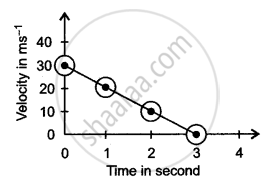
(i) A 200g ball is thrown vertically upward with an initial velocity of 30 ms-1. Draw a velocity-time graph for the motion of ball.
(ii) How long will the ball take to reach the highest point?
(iii) What will be the kinetic energy of ball, when it returns to the starting point, neglecting the air resistance?
(iv) What will be the potential energy of ball at highest point?
Advertisements
उत्तर
Given : m = 0.200 kg; v = 30 ms−1
(i) Shown in diagram alongside.
(ii) 3 seconds.
(iii) K.E. = `1/2` mv2 = `1/2xx(30)^2` = 90 J.
(iv) P.E. = K.E. = 90 J.
[By the law of conservation of energy]
संबंधित प्रश्न
Work done by a boy depends on the time in which he does work.
A body, when acted upon by a force of 10 kgf, moves to a distance 0.5 m in the direction of force. Find the work done by the force. Take 1 kgf = 10 N.
Fill in the blank with suitable word :
The work done on a body moving in a circular path is __________
What do you mean by a kilo joule?
Complete the following sentences:
Joule is the unit of .......
A woman pulls a bucket of water of total mass 5 kg from a well which is 10 s. calculate the power used by her.
An electric motor of power 100 W is used to drive the stirrer in a water bath. If 50% of the energy supplied to the motor is spent in stirring the water. Calculate the work done on the water in one minute.
An electric motor pump is 60% efficient and is rated 2.5 H.P. Calculate the maximum load it can lift through a height of 10m in 8 sec. (1 H.P. = 750 W).
