Advertisements
Advertisements
प्रश्न
(i) A 200g ball is thrown vertically upward with an initial velocity of 30 ms-1. Draw a velocity-time graph for the motion of ball.
(ii) How long will the ball take to reach the highest point?
(iii) What will be the kinetic energy of ball, when it returns to the starting point, neglecting the air resistance?
(iv) What will be the potential energy of ball at highest point?
Advertisements
उत्तर
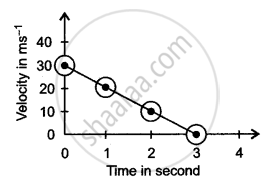
Given : m = 0.200 kg; v = 30 ms−1
(i) Shown in diagram alongside.
(ii) 3 seconds.
(iii) K.E. = `1/2` mv2 = `1/2xx(30)^2` = 90 J.
(iv) P.E. = K.E. = 90 J.
[By the law of conservation of energy]
संबंधित प्रश्न
Give reasons for the following A teacher moving around in the class is doing work but a child standing and reading a book is not doing any work.
When is the work done by a force on a body : (a) positive, (b) negative, and (c) zero?
Choose one or more correct alternatives.
Joule is the unit of ______.
- force
- work
- power
- energy
Why does a spanner have a long handle?
Is work done a scalar or a vector physical quantity?
A girl of mass 50 kg runs up a flight of 40 steps in 20 seconds. If each step in 20 cm high, calculate the power developed by the girl. (g= 10 ms-2).
A block of mass 30 kg is pulled up a slope, as shown in diagram with a constant speed, by applying a force of 200 N parallel to slope.
A and B are initial and final positions of block.

(i) Calculate the work done by force in moving the block from A to B.
(ii) Calculate P.E. gained by block. [g=10ms-2]
A force of F = (5y + 20) `hat"j"` N acts on a particle. The work done by this force when the particle is moved from y = 0 m to y = 10 m is ______ J.
