Advertisements
Advertisements
Question
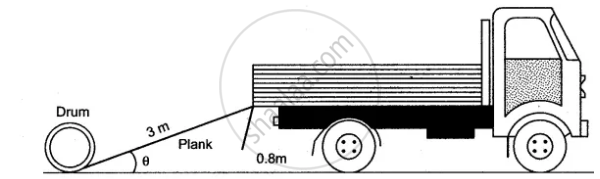
A truck driver can load oil drums into the back of the truck by pushing them up a sloping plank, or by lifting them directly. Each drum has a mass of 80 kg, the plank is 3 m long, and the back of the truck is 0.8 m above the ground.
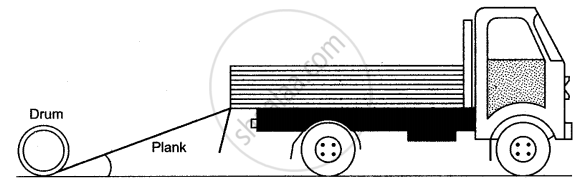
(i) How much force would be needed to lift a drum into the truck directly/without using the plank? (Take g = 10 m/s2)
(ii) How much energy would be required in lifting the drum into the truck without the plank?
(iii) If the force needed to push the drum up the plank is 300 N, why is this less than the answer to part (i)?
(iv) When the truck is loaded, the driver drives off. List the major energy changes that take place in moving the truck.
(v) The driver has to stop at the factory gates. What happens to the kinetic energy of the truck?
Advertisements
Solution
(i) F = mg = 80 × 10 = 800 N.
(ii) Energy = m × g × h = 80 × 10 × 0.8 = 640 J.
(iii) In this case F = mg sin θ = `800xx0.8/3=640/3` = 213.3 N.
It is less than the answer in part (i) as the efforts act through 3 m whereas the weight is lifted up through 0.8 m. The effort needed maybe 300 N instead of 213.3 N owing to loss of energy in overcoming friction and air resistance.
(iv) The energy released owing to the combustion of fuel changes into kinetic energy of the truck and load, and these changes in heat energy of the pebbles on the road and of wheels.
(v) The kinetic energy is dissipated as heat.
RELATED QUESTIONS
It takes 20 s for a person A of mass 50 kg to climb up the stairs, while another person B does the same in 15 s. Compare the work done.
State two advantage of producing hydroelectricity.
Why is the work done on an object moving with uniform circular motion zero?
Nm is the unit of .......
Can two agents, doing the same work, have different power?
Explain, why submarines are able to dive underwater as well as a sail on the surface of the water?
A block of mass 30 kg is pulled up a slope, as shown in diagram with a constant speed, by applying a force of 200 N parallel to slope.
A and B are initial and final positions of block.

(i) Calculate the work done by force in moving the block from A to B.
(ii) Calculate P.E. gained by block. [g=10ms-2]
A car is accelerated on a levelled road and attains a velocity 4 times of its initial velocity. In this process the potential energy of the car
