Advertisements
Advertisements
प्रश्न
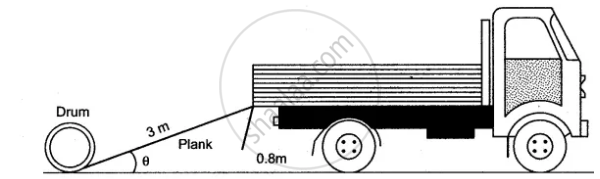
A truck driver can load oil drums into the back of the truck by pushing them up a sloping plank, or by lifting them directly. Each drum has a mass of 80 kg, the plank is 3 m long, and the back of the truck is 0.8 m above the ground.
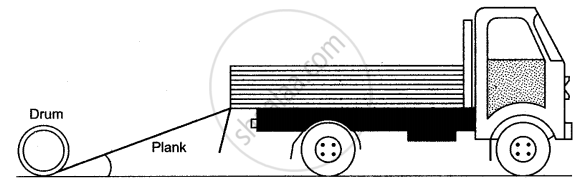
(i) How much force would be needed to lift a drum into the truck directly/without using the plank? (Take g = 10 m/s2)
(ii) How much energy would be required in lifting the drum into the truck without the plank?
(iii) If the force needed to push the drum up the plank is 300 N, why is this less than the answer to part (i)?
(iv) When the truck is loaded, the driver drives off. List the major energy changes that take place in moving the truck.
(v) The driver has to stop at the factory gates. What happens to the kinetic energy of the truck?
Advertisements
उत्तर
(i) F = mg = 80 × 10 = 800 N.
(ii) Energy = m × g × h = 80 × 10 × 0.8 = 640 J.
(iii) In this case F = mg sin θ = `800xx0.8/3=640/3` = 213.3 N.
It is less than the answer in part (i) as the efforts act through 3 m whereas the weight is lifted up through 0.8 m. The effort needed maybe 300 N instead of 213.3 N owing to loss of energy in overcoming friction and air resistance.
(iv) The energy released owing to the combustion of fuel changes into kinetic energy of the truck and load, and these changes in heat energy of the pebbles on the road and of wheels.
(v) The kinetic energy is dissipated as heat.
संबंधित प्रश्न
A force of 7 N acts on an object. The displacement is, say 8 m, in the direction of the force (see the given figure). Let us take it that the force acts on the object through the displacement. What is the work done in this case?

What is the work done by the moon when it revolves around the earth?
Define work.
A machine raises a load of 750 N through a height of 16 m in 5 s. calculate:
- energy spent by machine,
- power at which the machine works.
Each of the following statement describes a force acting. Which force is causing work to be done?
Complete the following sentences:
Kilowatt is the unit of ....... and kWh is the unit of
Fill in the boxe to show the corresponding energy transformation.

How long should an electric motor, of power 2 H.P. operate, so as to pump 5 m3 of water from a depth of 15m. [Take g = 10 N kg−1]
Look at the activity below. Reason out whether or not work is done in the light of your understanding of the term ‘work’.
Suma is swimming in a pond.
A force of F = (5y + 20) `hat"j"` N acts on a particle. The work done by this force when the particle is moved from y = 0 m to y = 10 m is ______ J.
