Advertisements
Advertisements
A substance changes from its solid state to the liquid state when heat is supplied to it. Name the process.
Concept: undefined >> undefined
Advertisements
Which of the following is the radio isotope in pair?
\[\ce {^12_6 C , ^14_6 C}\]
Give reason for your answer.
Concept: undefined >> undefined
Which of the following is the radio isotope in pair?
\[\ce {^30_15 P , ^32_15 P}\]
Give reason for your answer.
Concept: undefined >> undefined
Which of the following is the radio isotope in pair?
\[\ce {^39_19 K , ^40_19 K}\]
Give reason for your answer.
Concept: undefined >> undefined
State the medical use of radioactivity.
Concept: undefined >> undefined
A ray of monochromatic light enters a liquid from the air as shown in the diagram given below:
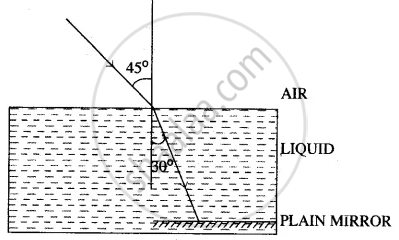
Copy the diagram and show in the diagram the path of the ray of light after it strikes the mirror and re-enters the medium of air.
Concept: undefined >> undefined
A ray of monochromatic light enters a liquid from the air as shown in the diagram given below:
Mark in your diagram the two angles on the surface of separation when the ray of light moves out from the liquid to air.
Concept: undefined >> undefined
After a robbery, if a window has been broken, there will be tiny particles of glass. Some of these will be found at the scene of the crime and some may be caught in the thief’s clothing. If the police can prove that these particles are identical, they have a strong case.
A method of doing this is to suspend the particles of glass in a special liquid. Light of a single colour is thrown through the liquid and the particles viewed through a microscope. The temperature of the liquid is then slowly altered. This alters the speed of light through the liquid (i.e., it alters the refractive index). At one particular temperature, the particles of glass disappear. It this happens at the same temperature for both sets of glass particles, they probably came from the same broken pane of glass.
Complete and copy the diagram to show how light bends when it travels from the liquid to the glass and back to the liquid, If the light speeds up in the glass.
Concept: undefined >> undefined
A lens forms an upright and diminished image of an object, irrespective of its position. What kind of lens is this? Draw an outline ray diagram to show the formation of the image. State the position and one more characteristic of the image.
Concept: undefined >> undefined
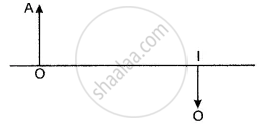
The following diagram shows the object O and the image I formed by a lens. Copy the diagram and on it mark the positions of the lens LL’ and focus (F). Name the lens.
Concept: undefined >> undefined
A stick partly immersed in water appears to be bent. Draw a ray diagram to show the bending of the stick when placed in water and viewed obliquely from above.
Concept: undefined >> undefined
Complete the diagram to show the formation of the image of the object AB.
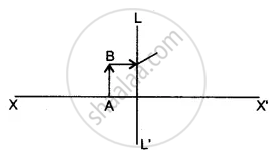
(i) Name the Lens LL’.
(ii) Where is the image of the object AB formed?
(iii) State three characteristics of the image.
Concept: undefined >> undefined
A convex lens is of focal length 20 cm. Find its power.
Concept: undefined >> undefined
If the lens is of focal length 25 cm. Calculate the power of the lens.
Concept: undefined >> undefined
If there is a convex lens of focal length 75 cm and a concave lens of focal length 40 cm, then calculate their combined power and combined focal length.
Concept: undefined >> undefined
Why does it become pleasantly warm when the lakes start freezing?
Concept: undefined >> undefined
The lens of power + 1·0 D is ______.
Concept: undefined >> undefined
The melting point of napthalene is 80°C and the room temperature is 25°. A sample of liquid napthalene at 90° is cooled down to room temperature. Draw a temperature-time graph to represent this cooling. On the graph mark the region which corresponds to the freezing process.
Concept: undefined >> undefined
Give one example of a radio isotope.
Concept: undefined >> undefined
