Please select a subject first
Advertisements
Advertisements
Using the following frequency table.
| Marks (obtained out of 10) | 4 | 5 | 7 | 8 | 9 | 10 |
| Frequency | 5 | 10 | 8 | 6 | 12 | 9 |
9 students got full marks.
Concept: undefined >> undefined
Using the following frequency table.
| Marks (obtained out of 10) | 4 | 5 | 7 | 8 | 9 | 10 |
| Frequency | 5 | 10 | 8 | 6 | 12 | 9 |
The frequency of less than 8 marks is 29.
Concept: undefined >> undefined
Advertisements
Using the following frequency table.
| Marks (obtained out of 10) | 4 | 5 | 7 | 8 | 9 | 10 |
| Frequency | 5 | 10 | 8 | 6 | 12 | 9 |
The frequency of more than 8 marks is 21.
Concept: undefined >> undefined
Using the following frequency table.
| Marks (obtained out of 10) | 4 | 5 | 7 | 8 | 9 | 10 |
| Frequency | 5 | 10 | 8 | 6 | 12 | 9 |
10 marks the highest frequency.
Concept: undefined >> undefined
If the fifth class interval is 60 – 65, fourth class interval is 55 – 60, then the first-class interval is 45 – 50.
Concept: undefined >> undefined
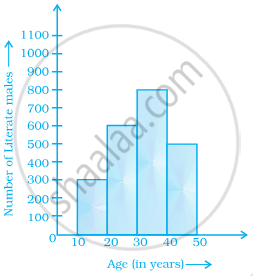
From the histogram given on the right, we can say that 1500 males above the age of 20 are literate.
Concept: undefined >> undefined
The class size of the class interval 60 – 68 is 8.
Concept: undefined >> undefined
The following pictorial representation of data is a histogram.

Concept: undefined >> undefined
Given below is a frequency distribution table. Read it and answer the questions that follow:
| Class Interval | Frequency |
| 10 – 20 | 5 |
| 20 – 30 | 10 |
| 30 – 40 | 4 |
| 40 – 50 | 15 |
| 50 – 60 | 12 |
- What is the lower limit of the second class interval?
- What is the upper limit of the last class interval?
- What is the frequency of the third class?
- Which interval has a frequency of 10?
- Which interval has the lowest frequency?
- What is the class size?
Concept: undefined >> undefined
The top speeds of thirty different land animals have been organised into a frequency table. Draw a histogram for the given data.
| Maximum Speed (km/h) | Frequency |
| 10 – 20 | 5 |
| 20 – 30 | 5 |
| 30 – 40 | 10 |
| 40 – 50 | 8 |
| 50 – 60 | 0 |
| 60 – 70 | 2 |
Concept: undefined >> undefined
Look at the histogram below and answer the questions that follow.

- How many students have height more than or equal to 135 cm but less than 150 cm?
- Which class interval has the least number of students?
- What is the class size?
- How many students have height less than 140 cm?
Concept: undefined >> undefined
Following are the number of members in 25 families of a village:
6, 8, 7, 7, 6, 5, 3, 2, 5, 6, 8, 7, 7, 4, 3, 6, 6, 6, 7, 5, 4, 3, 3, 2, 5.
Prepare a frequency distribution table for the data using class intervals 0 – 2, 2 – 4, etc.
Concept: undefined >> undefined
Draw a histogram to represent the frequency distribution in question 91.
Concept: undefined >> undefined
The marks obtained (out of 20) by 30 students of a class in a test are as follows:
14, 16, 15, 11, 15, 14, 13, 16, 8, 10, 7, 11, 18, 15, 14, 19, 20, 7, 10, 13, 12, 14, 15, 13, 16, 17, 14, 11, 10, 20.
Prepare a frequency distribution table for the above data using class intervals of equal width in which one class interval is 4 – 8 (excluding 8 and including 4).
Concept: undefined >> undefined
Prepare a histogram from the frequency distribution table obtained in question 93.
Concept: undefined >> undefined
The weights (in kg) of 30 students of a class are:
39, 38, 36, 38, 40, 42, 43, 44, 33, 33, 31, 45, 46, 38, 37, 31, 30, 39, 41, 41, 46, 36, 35, 34, 39, 43, 32, 37, 29, 26.
Prepare a frequency distribution table using one class interval as (30 – 35), 35 not included.
- Which class has the least frequency?
- Which class has the maximum frequency?
Concept: undefined >> undefined
Construct a frequency distribution table for the following weights (in grams) of 35 mangoes, using the equal class intervals, one of them is 40 – 45 (45 not included).
30, 40, 45, 32, 43, 50, 55, 62, 70, 70, 61, 62, 53, 52, 50, 42, 35, 37, 53, 55, 65, 70, 73, 74, 45, 46, 58, 59, 60, 62, 74, 34, 35, 70, 68.
- How many classes are there in the frequency distribution table?
- Which weight group has the highest frequency?
Concept: undefined >> undefined
Complete the following table:
| Weights (in kg.) |
Tally Marks | Frequency (Number of persons) |
| 40 – 50 | `\cancel(bb|bb|bb|bb|) \cancel(bb|bb|bb|bb|) bb|bb|` | |
| 50 – 60 | `\cancel(bb|bb|bb|bb|) \cancel(bb|bb|bb|bb|) bb|bb|bb|bb|` | |
| 60 – 70 | `\cancel(bb|bb|bb|bb|) bb|` | |
| 70 – 80 | `bb|bb|` | |
| 80 – 90 | `bb|` |
Find the total number of persons whose weights are given in the above table.
Concept: undefined >> undefined
Draw a histogram for the following data.
| Class interval | 10 – 15 | 15 – 20 | 20 – 25 | 25 – 30 | 30 – 35 | 35 – 40 |
| Frequency | 30 | 98 | 80 | 58 | 29 | 50 |
Concept: undefined >> undefined
The below histogram shows the number of literate females in the age group of 10 to 40 years in a town.

- Write the classes assuming all the classes are of equal width.
- What is the classes width?
- In which age group are literate females the least?
- In which age group is the number of literate females the highest?
Concept: undefined >> undefined
