Please select a subject first
Advertisements
Advertisements
Write the two important factors considered to increase the magnifying power?
Concept: undefined >> undefined
Describe briefly the two main limitations and explain how far these can be minimized in a reflecting telescope ?
Concept: undefined >> undefined
Advertisements
"A telescope resolves whereas a microscope magnifies." Justify this statement ?
Concept: undefined >> undefined
Draw a labelled ray diagram of an astronomical telescope to show the image formation of a distant object. Write the main considerations required in selecting the objective and eyepiece lenses in order to have large magnifying power and high resolution of the telescope.
Concept: undefined >> undefined
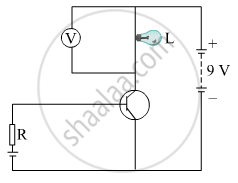
In the given circuit diagram a voltmeter ‘V’ is connected across a lamp ‘L’. Ho would (i) the brightness of the lamp and (ii) voltmeter reading ‘V’ be affected, if the value of resistance ‘R’ is decreased? Justify your answer.
Concept: undefined >> undefined
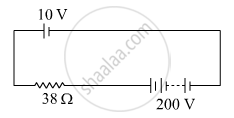
A 10 V battery of negligible internal resistance is connected across a 200 V battery and a resistance of 38Ω as shown in the figure. Find the value of the current in circuit.
Concept: undefined >> undefined
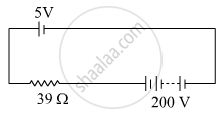
A 5 V battery of negligible internal resistance is connected across a 200 V battery and a resistance of 39Ω as shown in the figure. Find the value of the current in circuit.
Concept: undefined >> undefined
Write two important limitations of a refracting telescope over a reflecting-type telescope.
Concept: undefined >> undefined
Define its magnifying power and write the expression for it?
Concept: undefined >> undefined
Define magnifying power of a telescope. Write its expression.
Concept: undefined >> undefined
A small telescope has an objective lens of focal length 150 cm and an eye piece of focal length 5 cm. If this telescope is used to view a 100 m high tower 3 km away, find the height of the final image when it is formed 25 cm away from the eye piece.
Concept: undefined >> undefined
How is the working of a telescope different from that of a microscope?
Concept: undefined >> undefined
The focal lengths of the objective and eyepiece of a microscope are 1.25 cm and 5 cm respectively. Find the position of the object relative to the objective in order to obtain an angular magnification of 30 in normal adjustment.
Concept: undefined >> undefined
Draw a labeled ray diagram of a reflecting telescope. Mention its two advantages over the refracting telescope.
Concept: undefined >> undefined
A giant refracting telescope at an observatory has an objective lens of focal length 15 m. If an eyepiece lens of focal length 1.0 cm is used, find the angular magnification of the telescope. If this telescope is used to view the moon, what is the diameter of the image of the moon formed by the objective lens? The diameter of the moon is 3.42 × 10⁶ m and the radius of the lunar orbit is 3.8 × 10⁸ m.
Concept: undefined >> undefined
An astronomical telescope is to be designed to have a magnifying power of 50 in normal adjustment. If the length of the tube is 102 cm, find the powers of the objective and the eyepiece.
Concept: undefined >> undefined
The eyepiece of an astronomical telescope has a focal length of 10 cm. The telescope is focussed for normal vision of distant objects when the tube length is 1.0. m. Find the focal length of the objective and the magnifying power of the telescope.
Concept: undefined >> undefined
A Galilean telescope is 27 cm long when focussed to form an image at infinity. If the objective has a focal length of 30 cm, what is the focal length of the eyepiece?
Concept: undefined >> undefined
A lady cannot see objects closer than 40 cm from the left eye and closer than 100 cm from the right eye. While on a mountaineering trip, she is lost from her team. She tries to make an astronomical telescope from her reading glasses to look for her teammates. (a) Which glass should she use as the eyepiece? (b) What magnification can she get with relaxed eye?
Concept: undefined >> undefined
If the above capacitor is connected across a 6⋅0 V battery, find (a) the charge supplied by the battery, (b) the induced charge on the dielectric and (c) the net charge appearing on one of the coated surfaces.
Concept: undefined >> undefined
