Advertisements
Advertisements
The circuit in figure shows two cells connected in opposition to each other. Cell E1 is of emf 6V and internal resistance 2Ω; the cell E2 is of emf 4V and internal resistance 8Ω. Find the potential difference between the points A and B.
Concept: undefined >> undefined
The circuit in figure shows two cells connected in opposition to each other. Cell E1 is of emf 6V and internal resistance 2Ω; the cell E2 is of emf 4V and internal resistance 8Ω. Find the potential difference between the points A and B.
Concept: undefined >> undefined
Advertisements
Two cells of voltage 10V and 2V and internal resistances 10Ω and 5Ω respectively, are connected in parallel with the positive end of 10V battery connected to negative pole of 2V battery (Figure). Find the effective voltage and effective resistance of the combination.

Concept: undefined >> undefined
Two cells of voltage 10V and 2V and internal resistances 10Ω and 5Ω respectively, are connected in parallel with the positive end of 10V battery connected to negative pole of 2V battery (Figure). Find the effective voltage and effective resistance of the combination.
Concept: undefined >> undefined
State the two Kirchhoff’s rules used in the analysis of electric circuits and explain them.
Concept: undefined >> undefined
State the two Kirchhoff’s rules used in the analysis of electric circuits and explain them.
Concept: undefined >> undefined
Derive the equation of the balanced state in a Wheatstone bridge using Kirchhoff’s laws.
Concept: undefined >> undefined
Derive the equation of the balanced state in a Wheatstone bridge using Kirchhoff’s laws.
Concept: undefined >> undefined
An electric dipole of dipole moment 2 × 10⁻⁸ C-m in a uniform electric field experiences a maximum torque of 6 × 10⁻⁴ N-m. The magnitude of the electric field is ______.
Concept: undefined >> undefined
An electric dipole of length 2 cm is placed at an angle of 30° with an electric field 2 × 10⁵ N/C. If the dipole experiences a torque of 8 × 10⁻³ Nm, the magnitude of either charge of the dipole is ______.
Concept: undefined >> undefined
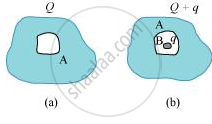
(a) A conductor A with a cavity as shown in Fig (a) is given a charge Q. Show that the entire charge must appear on the outer surface of the conductor.
(b) Another conductor B with charge q is inserted into the cavity keeping B insulated from A. Show that the total charge on the outside surface of A is Q + q [Fig. (b)].
(c) A sensitive instrument is to be shielded from the strong electrostatic fields in its environment. Suggest a possible way.
Concept: undefined >> undefined
A hollow charged conductor has a tiny hole cut into its surface. Show that the electric field in the hole is `(sigma/(2in_0)) hat"n"`. where `hat"n"` is the unit vector in the outward normal direction, and `sigma` is the surface charge density near the hole.
Concept: undefined >> undefined
The number of electrons in an insulator is of the same order as the number of electrons in a conductor. What is then the basic difference between a conductor and an insulator ?
Concept: undefined >> undefined
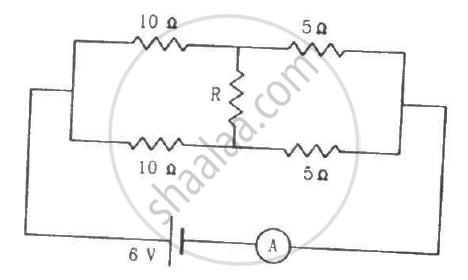
What should be the value of R in the figure for which the current in it is zero?
Concept: undefined >> undefined
Concept: undefined >> undefined
Concept: undefined >> undefined
Concept: undefined >> undefined
Concept: undefined >> undefined
A resistance R is to be measured using a meter bridge. Student chooses the standard resistance S to be 100Ω. He finds the null point at l1 = 2.9 cm. He is told to attempt to improve the accuracy. Which of the following is a useful way?
Concept: undefined >> undefined
The measurement of an unknown resistance R is to be carried out using Wheatstones bridge (figure). Two students perform an experiment in two ways. The first students takes R2 = 10 Ω and R1 = 5 Ω. The other student takes R2 = 1000 Ω and R1 = 500 Ω. In the standard arm, both take R3 = 5 Ω. Both find R = `R_2/R_1 R_3` = 10 Ω within errors.
- The errors of measurement of the two students are the same.
- Errors of measurement do depend on the accuracy with which R2 and R1 can be measured.
- If the student uses large values of R2 and R1, the currents through the arms will be feeble. This will make determination of null point accurately more difficult.
- Wheatstone bridge is a very accurate instrument and has no errors of measurement.
Concept: undefined >> undefined
