Advertisements
Advertisements
Question
The number of electrons in an insulator is of the same order as the number of electrons in a conductor. What is then the basic difference between a conductor and an insulator ?
Advertisements
Solution
The outer electrons of an atom or molecule in a conductor are only weakly bound to it and are free to move throughout the body of the material. On the other hand, in insulators, the electrons are tightly bound to their respective atoms and cannot leave their parent atoms and move through a long distance.
APPEARS IN
RELATED QUESTIONS
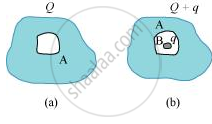
(a) A conductor A with a cavity as shown in Fig (a) is given a charge Q. Show that the entire charge must appear on the outer surface of the conductor.
(b) Another conductor B with charge q is inserted into the cavity keeping B insulated from A. Show that the total charge on the outside surface of A is Q + q [Fig. (b)].
(c) A sensitive instrument is to be shielded from the strong electrostatic fields in its environment. Suggest a possible way.
Which of the following is three-dimensional continuous charge distribution?
Two large, thin metal plates are parallel and close to each other. On their inner faces, the plates have surface charge densities of opposite signs and of magnitude 17.7 × 10⁻²² C/m2. What is electric field intensity E:
- in the outer region of the first plate, and
- between the plates?
There is a uniform spherically symmetric surface charge density at a distance Ro from the origin. The charge distribution is initially at rest and starts expanding because of mutual repulsion. The figure that represents best the speed V (R(t)) of the distribution as a function of its instantaneous radius R(t) is:
Under what condition is a charge distribution treated as continuous rather than discrete?
Which of the following best defines linear charge density?
What is the SI unit of volume charge density?
For a linear charge distribution, if the linear charge density is λ and a small element has length dl, what is the charge element dq?
For a volume charge distribution, if the volume charge density is ρ and a small volume element is dV, what is the charge element dq?
What is the nature (classification) of linear charge density λ?
Which type of charge distribution is represented as one-dimensional (1D)?
Which type of charge distribution is represented as two-dimensional (2D)?
Which type of charge distribution is represented as three-dimensional (3D)?
The electric field due to a continuous charge distribution is derived by extending which fundamental principle?
For a linear charge distribution, what is the integral form of the electric field?
For a volume charge distribution, what is the integral form of the electric field?
What is the defining characteristic of a non-uniform charge distribution?
