Please select a subject first
Advertisements
Advertisements
Monochromatic light of frequency 6.0 × 10¹⁴ Hz is produced by a laser. The power emitted is 2.0 × 10⁻³ W. Estimate the number of photons emitted per second on an average by the source
Concept: undefined >> undefined
'Two independent monochromatic sources of light cannot produce a sustained interference pattern'. Give reason.
Concept: undefined >> undefined
Advertisements
Two monochromatic rays of light are incident normally on the face AB of an isosceles right-angled prism ABC. The refractive indices of the glass prism for the two rays '1' and '2' are respectively 1.3 and 1.5. Trace the path of these rays after entering the prism.
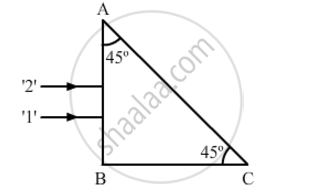
Concept: undefined >> undefined
Deduce the expression for the torque acting on a dipole of dipole moment `vecp` in the presence of a uniform electric field `vecE`
Concept: undefined >> undefined
Two monochromatic rays of light are incident normally on the face AB of an isosceles right-angled prism ABC. The refractive indices of the glass prism for the two rays '1' and '2' are respectively 1.35 and 1.45. Trace the path of these rays after entering the prism.
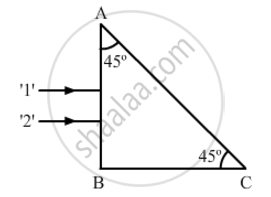
Concept: undefined >> undefined
An electric dipole with dipole moment 4 × 10⁻⁹ C m is aligned at 30° with the direction of a uniform electric field of magnitude 5 × 10⁴ N C−1. Calculate the magnitude of the torque acting on the dipole.
Concept: undefined >> undefined
In a certain region of space, electric field is along the z-direction throughout. The magnitude of electric field is, however, not constant but increases uniformly along the positive z-direction, at the rate of 105 NC−1 per metre. What are the force and torque experienced by a system having a total dipole moment equal to 10−7 Cm in the negative z-direction?
Concept: undefined >> undefined
(a) A conductor A with a cavity as shown in Fig (a) is given a charge Q. Show that the entire charge must appear on the outer surface of the conductor.
(b) Another conductor B with charge q is inserted into the cavity keeping B insulated from A. Show that the total charge on the outside surface of A is Q + q [Fig. (b)].
(c) A sensitive instrument is to be shielded from the strong electrostatic fields in its environment. Suggest a possible way.
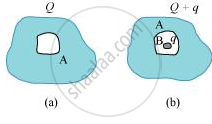
Concept: undefined >> undefined
A hollow charged conductor has a tiny hole cut into its surface. Show that the electric field in the hole is `(sigma/(2in_0)) hat"n"`. where `hat"n"` is the unit vector in the outward normal direction, and `sigma` is the surface charge density near the hole.
Concept: undefined >> undefined
A spherical conductor of radius 12 cm has a charge of 1.6 × 10⁻⁷ C distributed uniformly on its surface. What is the electric field
- inside the sphere
- just outside the sphere
- at a point 18 cm from the centre of the sphere?
Concept: undefined >> undefined
A spherical conducting shell of inner radius r1 and outer radius r2 has a charge Q.
(a) A charge q is placed at the centre of the shell. What is the surface charge density on the inner and outer surfaces of the shell?
(b) Is the electric field inside a cavity (with no charge) zero, even if the shell is not spherical, but has any irregular shape? Explain.
Concept: undefined >> undefined
(a) Show that the normal component of electrostatic field has a discontinuity from one side of a charged surface to another given by
`(vec"E"_2 - vec"E"_1).hat"n" = sigma/in_0`
Where `hat"n"` is a unit vector normal to the surface at a point and σ is the surface charge density at that point. (The direction of `hat"n"` is from side 1 to side 2.) Hence show that just outside a conductor, the electric field is σ `hat"n"/in_0`
(b) Show that the tangential component of electrostatic field is continuous from one side of a charged surface to another.
[Hint: For (a), use Gauss’s law. For, (b) use the fact that work done by electrostatic field on a closed loop is zero.]
Concept: undefined >> undefined
A 4 µF capacitor is charged by a 200 V supply. It is then disconnected from the supply and is connected to another uncharged 2 µF capacitors. How much electrostatic energy of the first capacitor is lost in the form of heat and electromagnetic radiation?
Concept: undefined >> undefined
If Coulomb’s law involved 1/r3 dependence (instead of 1/r2), would Gauss’s law be still true?
Concept: undefined >> undefined
For a transistor amplifier, the voltage gain
(a) remains constant for all frequencies.
(b) is high at high and low frequencies and constant in the middle frequency range.
(c) is low at high and low frequencies and constant at mid frequencies.
(d) None of the above.
Concept: undefined >> undefined
Two amplifiers are connected one after the other in series (cascaded). The first amplifier has a voltage gain of 10 and the second has a voltage gain of 20. If the input signal is 0.01 volt, calculate the output ac signal.
Concept: undefined >> undefined
Which of the following frequencies will be suitable for beyond-the-horizon communication using sky waves?
(a) 10 kHz
(b) 10 MHz
(c) 1 GHz
(d) 1000 GHz
Concept: undefined >> undefined
Frequencies in the UHF range normally propagate by means of:
(a) Ground waves.
(b) Sky waves.
(c) Surface waves.
(d) Space waves.
Concept: undefined >> undefined
Digital signals
(i) Do not provide a continuous set of values,
(ii) Represent values as discrete steps,
(iii) Can utilize binary system, and
(iv) Can utilize decimal as well as binary systems.
Which of the above statements are true?
(a) (i) and (ii) only
(b) (ii) and (iii) only
(c) (i), (ii) and (iii) but not (iv)
(d) All of (i), (ii), (iii) and (iv).
Concept: undefined >> undefined
The ground state energy of hydrogen atom is – 13∙6 eV. If an electron makes a transition from an energy level – 1∙51 eV to – 3∙4 eV, calculate the wavelength of the spectral line emitted and name the series of hydrogen spectrum to which it belongs.
Concept: undefined >> undefined
