English

Trace the Path of the Two Rays '1' and '2' Are Respectively 1.35 and 1.45 After Entering the Prism. - Physics

Advertisements
Advertisements

Question

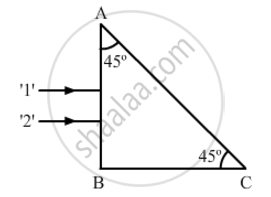
Two monochromatic rays of light are incident normally on the face AB of an isosceles right-angled prism ABC. The refractive indices of the glass prism for the two rays '1' and '2' are respectively 1.35 and 1.45. Trace the path of these rays after entering the prism.
Advertisements

Solution

Critical angle of ray 1:

`sin(c_1)=1/mu_1=1/1.35`

`=>c_1=sin^(-1)(1/1.35)=47.73^@`

Similarly, critical angle of ray 2:

`sin(c_2)=1/mu_1=1/1.45`

`=>c_2=sin^(-1)(1/1.45)=43.6^@`

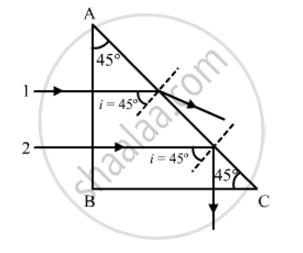
Both the rays will fall on the side AC with angle of incidence (i) equal to 45°. Critical angle of ray 1 is greater than that of i. Hence, it will emerge from the prism, as shown in the figure. Critical angle of ray 2 is less than that of i. Hence, it will be internally reflected, as shown in the figure.
shaalaa.com
Refraction of Monochromatic Light
  Is there an error in this question or solution?
2013-2014 (March) All India Set 1

RELATED QUESTIONS

Two monochromatic rays of light are incident normally on the face AB of an isosceles right-angled prism ABC. The refractive indices of the glass prism for the two rays '1' and '2' are respectively 1.3 and 1.5. Trace the path of these rays after entering the prism.


When light travels from a rarer to a denser medium, the speed decreases. Does this decrease in speed imply a reduction in the energy carried by the wave?


In the wave picture of light, the intensity of light is determined by the square of the amplitude of the wave. What determines the intensity in the photon picture of light?


A monochromatic ray of light falls on a regular prism. What is the relation between the angle of incidence and angle of emergence in the case of minimum deviation?


Which of the following sources provides the best monochromatic light?


Monochromatic fight of wavelength 198 nm is incident on the surface of a metallic cathode whose work function is 2.5 eV How much potential difference must be applied between the cathode and the anode of a photocell to just stop the photocurrent from flowing? 


Answer the following question.
In the diffraction due to a single slit experiment, the aperture of the slit is 3 mm. If monochromatic light of wavelength 620 nm is incident normally on the slit, calculate the separation between the first order minima and the 3rd order maxima on one side of the screen. The distance between the slit and the screen is 1.5 m.


For constructive interference to take place between two monochromatic light waves of wavelength λ, the path difference should be ______.


Assertion(A): The photoelectrons produced by a monochromatic light beam incident on a metal surface have a spread in their kinetic energies.

Reason(R): The energy of electrons emitted from inside the metal surface, is lost in collision with the other atoms in the metal.


The Figure below shows a ray of monochromatic light LM incident on the first surface AB of a regular (equilateral) glass prism ABC. The emergent ray grazes the adjacent surface AC. Calculate the angle of incidence. (Refractive Index of glass = 1.5)


Share
Notifications

Englishहिंदीमराठी


      Forgot password?
Use app×