Advertisements
Advertisements
प्रश्न
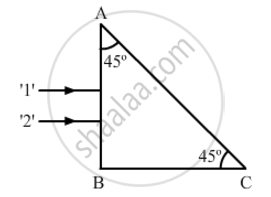
Two monochromatic rays of light are incident normally on the face AB of an isosceles right-angled prism ABC. The refractive indices of the glass prism for the two rays '1' and '2' are respectively 1.35 and 1.45. Trace the path of these rays after entering the prism.
Advertisements
उत्तर
Critical angle of ray 1:
`sin(c_1)=1/mu_1=1/1.35`
`=>c_1=sin^(-1)(1/1.35)=47.73^@`
Similarly, critical angle of ray 2:
`sin(c_2)=1/mu_1=1/1.45`
`=>c_2=sin^(-1)(1/1.45)=43.6^@`
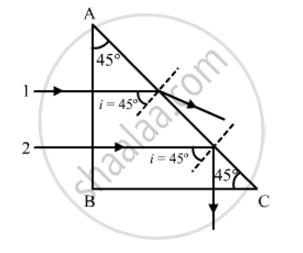
Both the rays will fall on the side AC with angle of incidence (i) equal to 45°. Critical angle of ray 1 is greater than that of i. Hence, it will emerge from the prism, as shown in the figure. Critical angle of ray 2 is less than that of i. Hence, it will be internally reflected, as shown in the figure.
APPEARS IN
संबंधित प्रश्न
When monochromatic light is incident on a surface separating two media, the reflected and refracted light both have the same frequency as the incident frequency.
When monochromatic light travels from a rarer to a denser medium, explain the following, giving reasons:
(i) Is the frequency of reflected and refracted light same as the frequency of incident light?
(ii) Does the decrease in speed imply a reduction in the energy carried by light wave?
State Huygen’s principle. Using this principle explain how a diffraction pattern is obtained on a screen due to a narrow slit on which a narrow beam coming from a `=> n = (vlamda)/(vlamda_omega)`monochromatic source of light is incident normally.
Which of the following sources provides the best monochromatic light?
Consider the situation shown in the figure. The two slits S1 and S2 placed symmetrically around the central line are illuminated by a monochromatic light of wavelength λ. The separation between the slits is d. The light transmitted by the slits falls on a screen ∑1placed at a distance D from the slits. The slit S3 is at the central line and the slit S4 is at a distance z from S3. Another screen ∑2 is placed a further distance D away from ∑1.Find the ratio of the maximum to minimum intensity observed on ∑2 if z is equal to

(a) \[z = \frac{\lambda D}{2d}\]
(b) \[\frac{\lambda D}{d}\]
(c) \[\frac{\lambda D}{4d}\]
Can the interference pattern be produced by two independent monochromatic sources of light? Explain.
State with reason, how the linear width of the central maximum will be affected if
(i) monochromatic yellow light is replaced with red light, and
(ii) distance between the slit and the screen is increased.
Find the angle of incidence at which a ray of monochromatic light should be incident on the first surface AB of a regular glass prism ABC so that the emergent ray grazes the adjacent surface AC. (Refractive Index of glass = 1 .56)
Monochromatic fight of wavelength 198 nm is incident on the surface of a metallic cathode whose work function is 2.5 eV How much potential difference must be applied between the cathode and the anode of a photocell to just stop the photocurrent from flowing?
Monochromatic light of wavelength 600 nm is incident from the air on a water surface. The refractive index of water is 1.33. Find the
- wavelength,
- frequency and
- speed, of reflected and refracted light.
