हिंदी

Trace the Path of the Two Rays '1' and '2' Are Respectively 1.35 and 1.45 After Entering the Prism. - Physics

Advertisements
Advertisements

प्रश्न

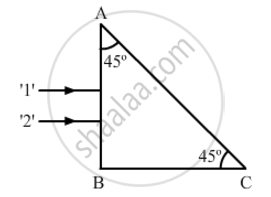
Two monochromatic rays of light are incident normally on the face AB of an isosceles right-angled prism ABC. The refractive indices of the glass prism for the two rays '1' and '2' are respectively 1.35 and 1.45. Trace the path of these rays after entering the prism.
Advertisements

उत्तर

Critical angle of ray 1:

`sin(c_1)=1/mu_1=1/1.35`

`=>c_1=sin^(-1)(1/1.35)=47.73^@`

Similarly, critical angle of ray 2:

`sin(c_2)=1/mu_1=1/1.45`

`=>c_2=sin^(-1)(1/1.45)=43.6^@`

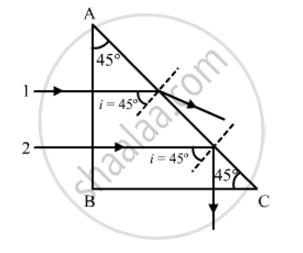
Both the rays will fall on the side AC with angle of incidence (i) equal to 45°. Critical angle of ray 1 is greater than that of i. Hence, it will emerge from the prism, as shown in the figure. Critical angle of ray 2 is less than that of i. Hence, it will be internally reflected, as shown in the figure.
shaalaa.com
Refraction of Monochromatic Light
  क्या इस प्रश्न या उत्तर में कोई त्रुटि है?
2013-2014 (March) All India Set 1

संबंधित प्रश्न

'Two independent monochromatic sources of light cannot produce a sustained interference pattern'. Give reason.


The following figure shows three equidistant slits being illuminated by a monochromatic parallel beam of light. Let \[B P_0  - A P_0  = \lambda/3\text{ and }D >  > \lambda.\] (a) Show that in this case \[d = \sqrt{2\lambda D/3}.\] (b) Show that the intensity at P0 is three times the intensity due to any of the three slits individually.


Consider the situation shown in the figure. The two slits S1 and S2 placed symmetrically around the central line are illuminated by a monochromatic light of wavelength λ. The separation between the slits is d. The light transmitted by the slits falls on a screen ∑1placed at a distance D from the slits. The slit S3 is at the central line and the slit S4 is at a distance z from S3. Another screen ∑2 is placed a further distance D away from ∑1.Find the ratio of the maximum to minimum intensity observed on ∑2 if z is equal to


(a) \[z = \frac{\lambda D}{2d}\]

(b) \[\frac{\lambda D}{d}\]

(c) \[\frac{\lambda D}{4d}\]


State with reason, how the linear width of the central maximum will be affected if
(i) monochromatic yellow  light is replaced with red light, and
(ii) distance between the slit and the screen is increased.


Monochromatic light of wavelength 650 nm falls normally on a slit of width 1 : 3 × 10⁻⁴ cm and the resulting Fraunhofer diffraction is obtained on a screen. Find the angular width of the central maxima.


Answer the following question.
In the diffraction due to a single slit experiment, the aperture of the slit is 3 mm. If monochromatic light of wavelength 620 nm is incident normally on the slit, calculate the separation between the first order minima and the 3rd order maxima on one side of the screen. The distance between the slit and the screen is 1.5 m.


Using the monochromatic light of the wavelength in the experimental set-up of the diffraction pattern as well as in the interference pattern where the slit separation is 1 mm, 10 interference fringes are found to be within the central maximum of the diffraction pattern. Determine the width of the single slit, if the screen is kept at the same distance from the slit in the two cases.


For constructive interference to take place between two monochromatic light waves of wavelength λ, the path difference should be ______.


Monochromatic light of wavelength 396 nm is incident on the surface of a metal whose work function is 1.125 eV. Calculate:

  1. the energy of an incident photon in eV.
  2. the maximum kinetic energy of photoelectrons in eV.

The Figure below shows a ray of monochromatic light LM incident on the first surface AB of a regular (equilateral) glass prism ABC. The emergent ray grazes the adjacent surface AC. Calculate the angle of incidence. (Refractive Index of glass = 1.5)


Share
Notifications

Englishहिंदीमराठी


      Forgot password?
Use app×