English

Science (English Medium) Class 11 - CBSE Question Bank Solutions for Chemistry

Advertisements
[object Object]
[object Object]
Subjects
Popular subjects
Topics
Advertisements
Advertisements
Chemistry
< prev  161 to 180 of 1673  next > 

Write the drawbacks in Mendeleev’s periodic table that led to its modification.

[3] Classification of Elements and Periodicity in Properties
Chapter: [3] Classification of Elements and Periodicity in Properties
Concept: undefined >> undefined

In what manner is the long form of periodic table better than Mendeleev’s periodic table? Explain with examples.

[3] Classification of Elements and Periodicity in Properties
Chapter: [3] Classification of Elements and Periodicity in Properties
Concept: undefined >> undefined

Advertisements

The interaction energy of London force is inversely proportional to sixth power of the distance between two interacting particles but their magnitude depends upon

[5] States of Matter:- Gases and Liquids
Chapter: [5] States of Matter:- Gases and Liquids
Concept: undefined >> undefined

Use the information and data given below:

• Stronger intermolecular forces result in higher boiling point.

Which type of intermolecular forces are present in the molecules \[\ce{HF, HCl, HBr and HI}\]?

[5] States of Matter:- Gases and Liquids
Chapter: [5] States of Matter:- Gases and Liquids
Concept: undefined >> undefined

Use the information and data given below:

• Strength of London forces increases with the number of electrons in the molecule.

Looking at the trend of boiling points of \[\ce{HCl, HBr and HI}\], explain out of dipole-dipole interaction and London interaction, which one is predominant here.

[5] States of Matter:- Gases and Liquids
Chapter: [5] States of Matter:- Gases and Liquids
Concept: undefined >> undefined

At a particular temperature and atmospheric pressure, the solid and liquid phases of a pure substance can exist in equilibrium. Which of the following term defines this temperature?

(i) Normal melting point

(ii) Equilibrium temperature

(iii) Boiling point

(iv) Freezing point

[6] Equilibrium
Chapter: [6] Equilibrium
Concept: undefined >> undefined

Match the following equilibria with the corresponding condition:

Column I Column II
(i) Liquid ⇌ Vapour (a) Saturated solution
(ii) Solid ⇌ Liquid (b) Boiling point
(iii) Solid ⇌ Vapour (c) Sublimation point
(iv) Solute (s) ⇌ Solute (solution) (d) Melting point Unsaturated solution
[6] Equilibrium
Chapter: [6] Equilibrium
Concept: undefined >> undefined

Explain redox reactions on the basis of electron transfer. Give suitable examples.

[7] Redox Reactions
Chapter: [7] Redox Reactions
Concept: undefined >> undefined

Hydrogen resembles halogens in many respects for which several factors are responsible. Of the following factors which one is most important in this respect?

[9] Hydrogen
Chapter: [9] Hydrogen
Concept: undefined >> undefined

Radioactive elements emit α, β and γ rays and are characterised by their half-lives. The radioactive isotope of hydrogen is ______.

[9] Hydrogen
Chapter: [9] Hydrogen
Concept: undefined >> undefined

Dihydrogen reacts with dioxygen \[\ce{(O2)}\] to form water. Write the name and formula of the product when the isotope of hydrogen which has one proton and one neutron in its nucleus is treated with oxygen. Will the reactivity of both the isotopes be the same towards oxygen? Justify your answer.

[9] Hydrogen
Chapter: [9] Hydrogen
Concept: undefined >> undefined

Metal carbonates decompose on heating to give metal oxide and carbon dioxide. Which of the metal carbonates is most stable thermally?

[10] S-block Elements (Alkali and Alkaline Earth Metals)
Chapter: [10] S-block Elements (Alkali and Alkaline Earth Metals)
Concept: undefined >> undefined

The s-block elements are characterised by their larger atomic sizes, lower ionisation enthalpies, invariable +1 oxidation state and solubilities of their oxosalts. In the light of these features describe the nature of their oxides, halides and oxosalts.

[10] S-block Elements (Alkali and Alkaline Earth Metals)
Chapter: [10] S-block Elements (Alkali and Alkaline Earth Metals)
Concept: undefined >> undefined

The geometry of a complex species can be understood from the knowledge of type of hybridisation of orbitals of central atom. The hybridisation of orbitals of central atom in [Be(OH)4] and the geometry of the complex are respectively.

[11] Some P-block Elements
Chapter: [11] Some P-block Elements
Concept: undefined >> undefined

Which of the following oxides is acidic in nature?

[11] Some P-block Elements
Chapter: [11] Some P-block Elements
Concept: undefined >> undefined

The exhibition of highest co-ordination number depends on the availability of vacant orbitals in the central atom. Which of the following elements is not likely to act as central atom in \[\ce{MF^{3-}6}\]?

[11] Some P-block Elements
Chapter: [11] Some P-block Elements
Concept: undefined >> undefined

Ionisation enthalpy (∆iH1kJ mol–1) for the elements of Group 13 follows the order.

[11] Some P-block Elements
Chapter: [11] Some P-block Elements
Concept: undefined >> undefined

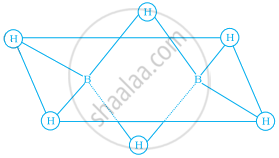
In the structure of diborane ______.

[11] Some P-block Elements
Chapter: [11] Some P-block Elements
Concept: undefined >> undefined

A compound X, of boron reacts with NH3 on heating to give another compound Y which is called inorganic benzene. The compound X can be prepared by treating BF3 with Lithium aluminium hydride. The compounds X and Y are represented by the formulas.

[11] Some P-block Elements
Chapter: [11] Some P-block Elements
Concept: undefined >> undefined

The most commonly used reducing agent is ______.

[11] Some P-block Elements
Chapter: [11] Some P-block Elements
Concept: undefined >> undefined
< prev  161 to 180 of 1673  next > 
Advertisements
Advertisements
CBSE Science (English Medium) Class 11 Question Bank Solutions
Question Bank Solutions for CBSE Science (English Medium) Class 11 Biology
Question Bank Solutions for CBSE Science (English Medium) Class 11 Chemistry
Question Bank Solutions for CBSE Science (English Medium) Class 11 Computer Science (C++)
Question Bank Solutions for CBSE Science (English Medium) Class 11 Computer Science (Python)
Question Bank Solutions for CBSE Science (English Medium) Class 11 English Core
Question Bank Solutions for CBSE Science (English Medium) Class 11 English Elective - NCERT
Question Bank Solutions for CBSE Science (English Medium) Class 11 Entrepreneurship
Question Bank Solutions for CBSE Science (English Medium) Class 11 Geography
Question Bank Solutions for CBSE Science (English Medium) Class 11 Hindi (Core)
Question Bank Solutions for CBSE Science (English Medium) Class 11 Hindi (Elective)
Question Bank Solutions for CBSE Science (English Medium) Class 11 History
Question Bank Solutions for CBSE Science (English Medium) Class 11 Mathematics
Question Bank Solutions for CBSE Science (English Medium) Class 11 Physics
Question Bank Solutions for CBSE Science (English Medium) Class 11 Political Science
Question Bank Solutions for CBSE Science (English Medium) Class 11 Psychology
Question Bank Solutions for CBSE Science (English Medium) Class 11 Sanskrit (Core)
Question Bank Solutions for CBSE Science (English Medium) Class 11 Sanskrit (Elective)
Question Bank Solutions for CBSE Science (English Medium) Class 11 Sociology
Share
Notifications

Englishहिंदीमराठी


      Forgot password?
Use app×