Advertisements
Advertisements
In the following diagram the correctly marked angles are :

(a) ∠A and ∠e
(b) ∠i, ∠A and ∠D
(c) ∠A ∠r and ∠e
(b) ∠A ∠r and ∠D
Concept: undefined >> undefined
Study the following ray diagram:
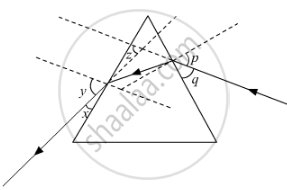
In this diagram, the angle of incidence, the angle of emergence and the angle of deviation respectively have been represented by
(A) y, p, z
(B) x, q, z
(C) p, y, z
(D) p, z, y
Concept: undefined >> undefined
Advertisements
Define the term dispersion of white light.
Concept: undefined >> undefined
Draw a ray diagram to show the dispersion of white light.
Concept: undefined >> undefined
State the cause of dispersion of white light
Concept: undefined >> undefined
Explain the term “corrosion” with an example. Write a chemical equation to show the process of corrosion of iron.
Concept: undefined >> undefined
What special name is given to the corrosion of iron?
Concept: undefined >> undefined
What type of chemical reaction is involved in the corrosion of iron?
Concept: undefined >> undefined
Name any three objects (or structures) which are gradually damaged by the corrosion of iron and steel.
Concept: undefined >> undefined
The chemical reaction involved in the corrosion of iron metal is that of ______.
Concept: undefined >> undefined
- A ray of white light breaks up into its components while passing through a glass prism. Draw a ray diagram to show the path of rays.
- Mark the least deviated colour in your diagram.
- Why do different coloured rays deviate differently in a prism?
Concept: undefined >> undefined
As light rays pass from air into a glass prism, are they refracted towards or away from the normal?
Concept: undefined >> undefined
As light rays emerge from a glass prism into air, are they refracted towards or away from the normal?
Concept: undefined >> undefined
In the formation of spectrum of white light by a prism:
- which colour is deviated least?
- which colour is deviated most?
Concept: undefined >> undefined
In the formation of spectrum of white light by a prism:
which colour is deviated most?
Concept: undefined >> undefined
When a ray of light enters a prism, it bends ______ the normal; as it leaves the prism, it bends ______ the normal.
Concept: undefined >> undefined
What happens when a ray of ordinary light is passed through a triangular glass prism?
Concept: undefined >> undefined
What will happen if another similar glass prism is placed upside down behind the first prism?
Concept: undefined >> undefined
When a beam of white light is passed through a prism, it splits to form lights of seven colours. Is it possible to recombine the lights of seven colours to obtain the white light again? Explain your answer.
Concept: undefined >> undefined
What is spectrum?
Concept: undefined >> undefined
