Advertisements
Advertisements
When a 12 V battery is connected across an unknown resistor, there is a current of 2.5 mA in the circuit. Find the value of the resistance of the resistor.
Concept: undefined >> undefined
A student suffering from myopia is not able to see distinctly the objects placed beyond 5 m. List two possible reasons due to which this defect of vision may have arisen. With the help of ray diagrams, explain
(i) why the student is unable to see distinctly the objects placed beyond 5 m from his eyes.
(ii) the type of the corrective lens used to restore proper vision and how this defect is corrected by the use of this lens.
(b) If, in this case, the numerical value of the focal length of the corrective lens is 5 m, find the power of the lens as per the new Cartesian sign convention
Concept: undefined >> undefined
Advertisements
Decomposition reactions require energy either in the form of heat or light or electricity for breaking down the reactants. Write one equation each for decomposition reactions where energy is supplied in the form of heat, light and electricity
Concept: undefined >> undefined
A student is unable to see clearly the words written on the black board placed at a distance of approximately 3 m from him. Name the defect of vision the boy is suffering from. State the possible causes of this defect and explain the method of correcting it.
Concept: undefined >> undefined
Name the unit of electrical resistance and give its symbol.
Concept: undefined >> undefined
Name the physical quantity whose unit is "ohm".
Concept: undefined >> undefined
When a 12 V battery is connected across an unknown resistor, there is a current of 2.5 mA in the circuit. Calculate the value of the resistance of the resistor.
Concept: undefined >> undefined
Name the law which is illustrated by the above V−I graph.
Concept: undefined >> undefined
Ohm's law gives a relationship between:
(a) current and resistance
(b) resistance and potential difference
(c) potential difference and electric charge
(d) current and potential difference
Concept: undefined >> undefined
The unit of electrical resistance is:
(a) ampere
(b) volt
(c) coulomb
(d) ohm
Concept: undefined >> undefined
Keeping the p.d. constant, the resistance of a circuit is halved. The current will become:
(a) one-fourth
(b) four time
(c) half
(d) double
Concept: undefined >> undefined
The graph between V and I for a conductor is a straight line passing through the origin.
- Which law is illustrated by such a graph?
- What should remain constant in a statement of this law?
Concept: undefined >> undefined
The graph between V and I for a conductor is a straight line passing through the origin.
What should remain constant in a statement of this law?
Concept: undefined >> undefined
Fill in the following blank with suitable words:
Resistance is measured in .............. The resistance of a wire increases as the length ..............; as the temperature ..............; and as the cross-sectional area .............. .
Concept: undefined >> undefined
How should the two resistances of 2 ohms each be connected so as to produce an equivalent resistance of 1 ohm?
Concept: undefined >> undefined
The resistors R1, R2, R3 and R4 in the figure given below are all equal in value.
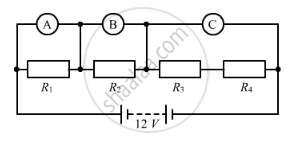
What would you expect the voltmeter A, B and C to read assuming that the connecting wires in the circuit have negligible resistance?
Concept: undefined >> undefined
Four resistances of 16 ohms each are connected in parallel. Four such combinations are connected in series. What is the total resistance?
Concept: undefined >> undefined
How much energy is consumed when a current of 5 amperes flows through the filament (or element) of a heater having resistance of 100 ohms for two hours? Express it in joules.
Concept: undefined >> undefined
A resistance of 40 ohms and one of 60 ohms are arranged in series across 220 volt supply. Find the heat in joules produced by this combination of resistances in half a minute.
Concept: undefined >> undefined
A solid substance P which is very hard is used in the construction of many buildings, especially flooring. When substance P is heated strongly, it decomposes to form another solid Q and a gas R is given out. Solid Q reacts with water with the release of a lot of heat to form a substance S. When gas R is passed into a clear solution of substance S, then a white precipitate of substance T is formed. The substance T has the same chemical composition as starting substance P.
- What is substance P? Write its common name as well as chemical formula.
- What is substance Q?
- What is gas R?
- What is substance S? What is its clear solution known as?
- What is substance T? Name any two natural forms in which substance T occurs in nature.
Concept: undefined >> undefined
