Advertisements
Advertisements
Question
What is the atomic number of carbon. Write its electronic configuration.
Advertisements
Solution
The atomic number of carbon is 6.
Its electronic configuration is K L.
2 4
APPEARS IN
RELATED QUESTIONS
Elements forming ionic compounds attain noble gas configuration by either gaining or losing electrons from their outermost shells. Give reason to explain why carbon cannot attain noble gas configuration in this manner to form its compounds.
State the reason why carbon can neither form C4+ cations nor C4− anions but forms covalent compounds.
Explain the nature of the covalent bond using the bond formation in CH3Cl.
State the type of bonding in the following molecule.
Water
Choose the most appropriate answer from the following list of oxides which fit the description.
A covalent oxide of a metalloid.
What type of bond exist in CCl4?
How buckminsterfullerene is it related to diamond and graphite?
Which inert gas does the H atom in HCl resemble in electron arrangement?
Explain why, diamond is hard while graphite is soft (though both are made of carbon atoms).
A covalent molecule having a double bond between its atoms is:
(a) Hydrogen
(b) Oxygen
(c) water
(d) ammonia
One of the following contains a double bond as well as single bonds. This is:
(a) CO2
(b) O2
(c) C2H4
(d) C2H2
State the type of bonding in the following molecule.
Methane
Which element exhibits the property of catenation to maximum extent and why?
Molecular formula of Propane is C3H8 , write the structural formula of propane.
Explain the following briefly.
Pure water does not conduct electricity, but on adding sodium chloride to it, it starts conducting electricity.
Choose the correct answer from the options given below
Condition favorable for formation of a covalent bond is
State the type of bond formed when the combining atom has zero E.N. difference.
Answer the following question.
What is methane? Draw its electron dot structure. Name the type of bonds formed in this compound. Why are such compounds:
(i) poor conductors of electricity? and
(ii) have low melting and boiling points? What happens when this compound burns in oxygen?
Write the molecular formula of the given compound.
Propylene
Complete the following activity.
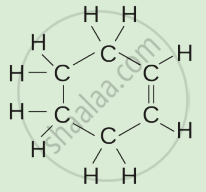
Write the names of the hydrocarbons for the following structural formula.
(isobutylene, cyclohexane, propene, cyclohexene, cyclopentane, benzene, propyne, isobutane, propane)
 |
