Please select a subject first
Advertisements
Advertisements
Light passes through a rectangular glass slab and through a triangular glass prism. In what way does the direction of the two emergent beams differ and why?
Concept: Refraction of Light Through a Rectangular Glass Block
Why is the ratio of the velocities of light of wavelengths 4000Å and 8000Å in vacuum 1: 1?
Concept: Refraction of Light Through a Rectangular Glass Block
Which of the above wavelengths has a higher frequency?
Concept: Refraction of Light Through a Rectangular Glass Block
State the relation between the critical angle and the absolute refractive index of a medium.
Concept: Total Internal Reflection
Which colour of light has a higher critical angle? Red light or green light.
Concept: Total Internal Reflection
The following diagram shows a 60°, 30°, 90° glass prism of critical angle 42°, Copy the diagram and complete the path of incident ray AB emerging out of the prism marking the angle of incidence on each surface.
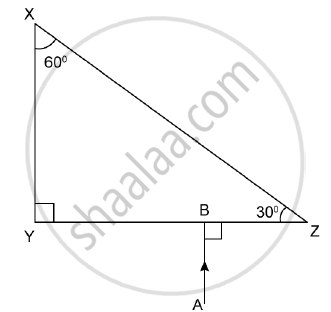
Concept: Refraction of Light Through a Rectangular Glass Block
A ray of light XY passes through a right-angled isosceles prism as shown below
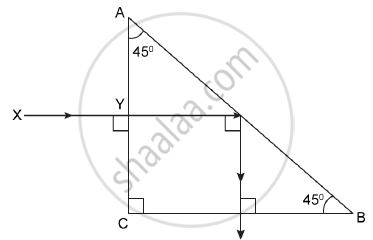
- What is the angle through which the incident ray deviates and emerges out of the prism?
- Name the instrument where this action of the prism is put into use.
- Which prism surface will behave as a mirror?
Concept: Total Internal Reflection in a Prism
Draw the diagram of a right-angled isosceles prism which is used to make an invented image erect.
Concept: Total Internal Reflection
How does the angle of deviation produced by a prism change with increase in the angle of incidence. Draw a curve showing the variation in the angle of deviation with the angle of incidence at a prism surface.
Concept: Refraction of Light Through a Rectangular Glass Block
(i) Define critical angle.
(ii) State one important factor which affects the critical angle of a given medium.
Concept: Total Internal Reflection
(i) What is the relation between the refractive index of water with respect to air `("_aμ_\text(w))` and the refractive index of air with respect to water `("_\text(w)μ_ a)` .
(ii) If the refractive index of water with respect to air `("_aμ_\text(w))` is`5/3`. Calculate the refractive index of air with respect to water `("_\text(w)μ_ a)` .
Concept: Refraction of Light Through a Rectangular Glass Block
The diagram below shows a light source P embedded in a rectangular glass block ABCD of critical angle 42°. Complete the path of the ray PQ till it emerges out of the block. [Write necessary angles].

Concept: Total Internal Reflection
When a ray of light travels normal to the given surface, then the angle of refraction is ______.
Concept: Refraction of Light
Small air bubbles rising up a fish tank appear silvery when viewed from some particular angle is due to the ______.
Concept: Total Internal Reflection
The diagram below shows two parallel rays A (Orange) & B (Blue) incident from air, on air-glass boundary.

- Copy and complete the path of the rays A and B.
- How do the speeds of these rays differ in glass?
- Are the two refracted rays in glass parallel? Give a reason.
Concept: Refraction of Light Through a Rectangular Glass Block
A coin kept inside water [µ = 4/3] when viewed from air in a vertical direction appears to be raised by 3.0 mm. Find the depth of the coin in water.
Concept: Real and Apparent Depth
Light travels a distance of '10x' units in time 't1' in vacuum and it travels a distance of 'x' units in time 't2' in a denser medium. Using this information answer the question that follows:
'Light covers a distance of '20x' units in time 't1' in diamond'. State true or false.
Concept: Speed of Light in Different Media
An endoscope uses optic fiber to transmit high resolution images of internal organs without loss of information. The principle of light that is used by the optic fiber is based on ______.
Concept: Total Internal Reflection
State two differences between normal reflection and total internal reflection.
Concept: Total Internal Reflection
O is a luminescent particle trapped inside a glass block. A student traces the path of rays coming out of it and reflecting over a plane mirror as shown in the diagram below.

Complete the table, using the labels from the figure. The first label is done for you.
| Sr. No. | Description | Label |
| a. | An angle of reflection on the mirror | a |
| b. | A partially reflected ray in the glass slab | |
| c. | A critical angle | |
| d. | A refracted ray | |
| e. | An angle of refraction of the ray R |
Concept: Multiple Images in a Thick Mirror
