Please select a subject first
Advertisements
Advertisements
Name the waves used for echo depth sounding.
Concept: Echo >> Use of Echoes
Two sound waves X and Y have the same amplitude and the same wave pattern but their frequencies are 60 Hz and 120 Hz respectively, then ______.
Concept: Sound Waves
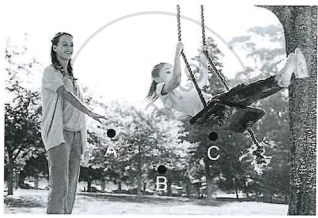
The above picture shows a mother pushing her daughter sitting on a swing. The swing is going through the positions A, B, C where A and C are extreme positions and B is the mean position.
- Which is the right position i.e. at A, B or C, for the mother to give a constant periodic push to the swing every time in the forward direction to increase the amplitude of the swing? (1)
- Name the phenomenon involved in this. (1)
- Explain with this example how this phenomenon helps to increase the amplitude of the swing. (2)
Concept: Resonance (a special case of forced vibrations) >> Examples of Resonance
Which particles are responsible for current in conductors?
Concept: Electrical Power
Concept: Resistance of a System of Resistors >> Resistors in Series
The diagram below shows a cardboard on which iron filings are kept. A wire bent in the form of a loop is seen passing through the cardboard. When current flows through it, the iron filings arrange themselves as shown below.

- State the polarities of the battery at A and B.
- State the effect on the magnetic field if an iron rod is held along the axis of the coil.
- State one way to:
- Change the polarity of the coil.
- Decrease the strength of the magnetic field around the coil.
Concept: Terminal Voltage of a Cell
The circuit depicted in the figure is employed for studying Ohm’s Law. Instead of using a standard resistor, a student opts for a glass tube filled with mercury (tube 1), connected to the circuit through two electrodes, E1 and E2. He records the readings of the ammeter and voltmeter, thereby calculating the resistance. The student repeats the experiment by substituting tube 1 with tube 2, where the same amount of mercury fills tube 2.
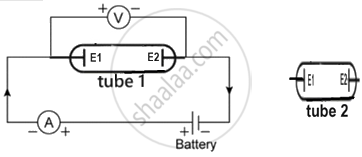
Neglecting internal resistance of the cell use (> or < or =) to compare:
- the resistance in both the cases.
- the voltmeter readings in both the cases.
- the specific resistance in both the cases.
Concept: Ohm's Law
To which wire of a cable in a power circuit should the metal case of the geyser be connected?
Concept: Earthing
To which wire should the fuse be connected?
Concept: Fuse
According to the old convention, the colour of the earth wire is ______.
Concept: Colour Coding of Wires in a Cable
When does the nucleus of an atom tend to become radioactive?
Concept: Radioactivity
Name the following:
The organelle that forms the aster during cell division.
Concept: Cell Organelles >> Centrosome and Centrioles
Why are RBCs efficient in their functions though they lack nucleus and mitochondria?
Concept: Cell Organelles >> Mitochondria - “Power House of the Cell”
Name the following.
The exchange of chromatid parts between the maternal and the paternal chromatids of a pair of homologous chromosomes during meiosis.
Concept: Significance of Mitosis
The diagram given below represents a certain stage of mitosis:
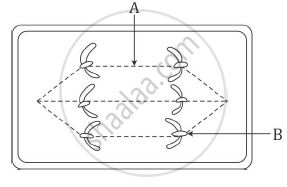
- Identify the stage of cell division.
- Name the parts labelled A and B.
- What is the unique feature observed in this stage?
- How many daughter cells are formed from this type of cell division?
Concept: Mitosis > Karyokinesis (Division of Nucleus)
The diagram given below represents a certain stage of mitosis:
- Identify the stage of cell division.
- Name the parts labelled A and B.
- What is the unique feature observed in this stage?
- How many daughter cells are formed from this type of cell division?
Concept: Mitosis > Karyokinesis (Division of Nucleus)
Correct the following statement by changing the underlined word:
Nitrogen bonds are present between the complementary nitrogenous bases of DNA.
Concept: Deoxyribonucleic Acid (DNA)
The diagram given below represents a stage during cell division.
Study the same and answer the questions that follow:

- Identify whether it is a plant cell or an animal cell. Give a reason in support of your answer.
- Name the stage depicted in the diagram. What is the unique feature observed in this stage?
- Name the type of cell division that occurs during:
- Replacement of old leaves by new ones
- Formation of gametes
- What is the stage that comes before the stage shown in the diagram?
- Draw a neat, labelled diagram of the stage mentioned in (iv) above keeping the chromosome number constant.
Concept: Mitosis > Karyokinesis (Division of Nucleus)
The diagram given below represents a stage during cell division.
Study the same and answer the questions that follow:
- Identify whether it is a plant cell or an animal cell. Give a reason in support of your answer.
- Name the stage depicted in the diagram. What is the unique feature observed in this stage?
- Name the type of cell division that occurs during:
- Replacement of old leaves by new ones
- Formation of gametes
- What is the stage that comes before the stage shown in the diagram?
- Draw a neat, labelled diagram of the stage mentioned in (iv) above keeping the chromosome number constant.
Concept: Mitosis > Karyokinesis (Division of Nucleus)
Name the three components of a nucleotide.
Concept: Chromatin
