English

(English Medium) ICSE Class 10 - CISCE Important Questions

Advertisements
[object Object]
[object Object]
Subjects
Popular subjects
Topics

Please select a subject first

Advertisements
Advertisements
< prev  381 to 400 of 4320  next > 

According to the old convention, the colour of the earth wire is ______.

Appears in 2 question papers
Chapter: [9] Household Circuits
Concept: Colour Coding of Wires in a Cable

When does the nucleus of an atom tend to become radioactive?

Appears in 2 question papers
Chapter: [12] Radioactivity
Concept: Radioactivity

Name the following:

The organelle that forms the aster during cell division.

Appears in 1 question paper
Chapter: [1] Cell - The Structural and Functional Unit of Life [For Revision Only]
Concept: Cell Organelles >> Centrosome and Centrioles

Why are RBCs efficient in their functions though they lack nucleus and mitochondria?

Appears in 1 question paper
Chapter: [1] Cell - The Structural and Functional Unit of Life [For Revision Only]
Concept: Cell Organelles >> Mitochondria - “Power House of the Cell”

The exchange of chromatid parts between the maternal and the paternal chromatids of a pair of homologous chromosomes during meiosis.

Appears in 1 question paper
Chapter: [2] Structure of Chromosomes, Cell Cycle and Cell Division
Concept: Significance of Mitosis

The diagram given below represents a certain stage of mitosis: 

  1. Identify the stage of cell division.
  2. Name the parts labelled A and B.
  3. What is the unique feature observed in this stage?
  4. How many daughter cells are formed from this type of cell division?
Appears in 1 question paper
Chapter: [2] Structure of Chromosomes, Cell Cycle and Cell Division
Concept: Mitosis > Karyokinesis (Division of Nucleus)

The diagram given below represents a certain stage of mitosis: 

  1. Identify the stage of cell division.
  2. Name the parts labelled A and B.
  3. What is the unique feature observed in this stage?
  4. How many daughter cells are formed from this type of cell division?
Appears in 1 question paper
Chapter: [2] Structure of Chromosomes, Cell Cycle and Cell Division
Concept: Mitosis > Karyokinesis (Division of Nucleus)

Correct the following statement by changing the underlined word:

Nitrogen bonds are present between the complementary nitrogenous bases of DNA.

Appears in 1 question paper
Chapter: [2] Structure of Chromosomes, Cell Cycle and Cell Division
Concept: Deoxyribonucleic Acid (DNA)

The diagram given below represents a stage during cell division.

Study the same and answer the questions that follow:

  1. Identify whether it is a plant cell or an animal cell. Give a reason in support of your answer.
  2. Name the stage depicted in the diagram. What is the unique feature observed in this stage?
  3. Name the type of cell division that occurs during:
    1. Replacement of old leaves by new ones
    2. Formation of gametes
  4. What is the stage that comes before the stage shown in the diagram?
  5. Draw a neat, labelled diagram of the stage mentioned in (iv) above keeping the chromosome number constant.
Appears in 1 question paper
Chapter: [2] Structure of Chromosomes, Cell Cycle and Cell Division
Concept: Mitosis > Karyokinesis (Division of Nucleus)

The diagram given below represents a stage during cell division.

Study the same and answer the questions that follow:

  1. Identify whether it is a plant cell or an animal cell. Give a reason in support of your answer.
  2. Name the stage depicted in the diagram. What is the unique feature observed in this stage?
  3. Name the type of cell division that occurs during:
    1. Replacement of old leaves by new ones
    2. Formation of gametes
  4. What is the stage that comes before the stage shown in the diagram?
  5. Draw a neat, labelled diagram of the stage mentioned in (iv) above keeping the chromosome number constant.
Appears in 1 question paper
Chapter: [2] Structure of Chromosomes, Cell Cycle and Cell Division
Concept: Mitosis > Karyokinesis (Division of Nucleus)

Synthesis phase in the cell cycle is called so for the synthesis of more of ______.

Appears in 1 question paper
Chapter: [2] Structure of Chromosomes, Cell Cycle and Cell Division
Concept: Cell Cycle - "Divide, Grow and Redivide"

Given below is a diagram representing a stage during the mitotic cell division. Study thediagram  and answer the following questions:
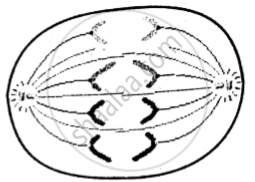
 Identify the stage by giving a suitable reason.

Appears in 1 question paper
Chapter: [2] Structure of Chromosomes, Cell Cycle and Cell Division
Concept: Significance of Mitosis

 Given below is a diagram representing a stage during the mitotic cell division. Study  thediagram  and answer the following questions:
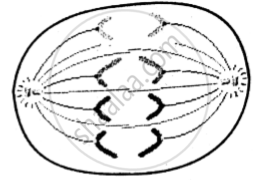
 Is it a plant or an animal cell? Give a reason to support your answer. 

Appears in 1 question paper
Chapter: [2] Structure of Chromosomes, Cell Cycle and Cell Division
Concept: Significance of Mitosis

 Given below is a diagram representing a stage during the mitotic cell division. Study  thediagram  and answer the following questions:
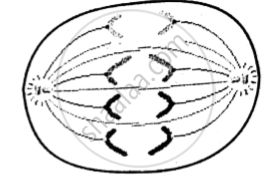
Draw a neat, labelled diagram of the stage which follows the one shown in the diagram.

Appears in 1 question paper
Chapter: [2] Structure of Chromosomes, Cell Cycle and Cell Division
Concept: Significance of Mitosis

How many chromosomes will each daughter cell have after the completion of the above division? 
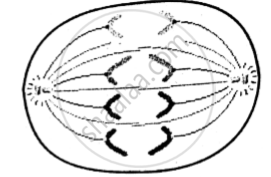
How many chromosomes will each daughter cell have after the completion of the above division? 

Appears in 1 question paper
Chapter: [2] Structure of Chromosomes, Cell Cycle and Cell Division
Concept: Significance of Mitosis
Mention three differences between DNA and RNA.
Appears in 1 question paper
Chapter: [2] Structure of Chromosomes, Cell Cycle and Cell Division
Concept: Deoxyribonucleic Acid (DNA)

Differentiate between Cytokinesis and Karyokinesis.

Appears in 1 question paper
Chapter: [2] Structure of Chromosomes, Cell Cycle and Cell Division
Concept: Cell Division: an Essential Life Process

Differentiate between genotype and phenotype.

Appears in 1 question paper
Chapter: [2] Structure of Chromosomes, Cell Cycle and Cell Division
Concept: Genes and Genetic

Haploid number of chromosomes are found in ______.

Appears in 1 question paper
Chapter: [2] Structure of Chromosomes, Cell Cycle and Cell Division
Concept: Cell Division: an Essential Life Process

Expand the abbreviation - DNA.

Appears in 1 question paper
Chapter: [2] Structure of Chromosomes, Cell Cycle and Cell Division
Concept: Deoxyribonucleic Acid (DNA)
< prev  381 to 400 of 4320  next > 
Advertisements
Share
Notifications

Englishहिंदीमराठी


      Forgot password?
Use app×