CBSE Science (English Medium) Class 12 Important Questions for Physics - Electrostatic Potential and Capacitance
Advertisements
Advertisements
Chapter wise important questions with answers and solutions for Physics in CBSE Science (English Medium) Class 12.
Which of the following is NOT the property of equipotential surface?
Chapter: [2] Electrostatic Potential and Capacitance
- Assertion (A): An electron has a high potential energy when it is at a location associated with a more negative value of potential, and a low potential energy when at a location associated with a more positive potential.
- Reason (R): Electrons move from a region of higher potential to region of lower potential.
Select the most appropriate answer from the options given below:
Chapter: [2] Electrostatic Potential and Capacitance
Draw equipotential surfaces for (i) an electric dipole and (ii) two identical positive charges placed near each other.
Chapter: [2] Electrostatic Potential and Capacitance
A point P lies at a distance x from the midpoint of an electric dipole on its axis. The electric potential at point P is proportional to ______.
Chapter: [2] Electrostatic Potential and Capacitance
A parallel plate capacitor (A) of capacitance C is charged by a battery to voltage V. The battery is disconnected and an uncharged capacitor (B) of capacitance 2C is connected across A. Find the ratio of final charges on A and B.
Chapter: [2] Electrostatic Potential and Capacitance
A parallel plate capacitor (A) of capacitance C is charged by a battery to voltage V. The battery is disconnected and an uncharged capacitor (B) of capacitance 2C is connected across A. Find the ratio of total electrostatic energy stored in A and B finally and that stored in A initially.
Chapter: [2] Electrostatic Potential and Capacitance
Depict the orientation of an electric dipole in (a) stable and (b) unstable equilibrium in an external uniform electric field. Write the potential energy of the dipole in each case.
Chapter: [2] Electrostatic Potential and Capacitance
Charges (+q) and (–q) are placed at points A and B respectively which are a distance 2L apart. C is the midpoint between A and B. What is the work done in moving a charge +Q along the semicircle CRD?

Chapter: [2] Electrostatic Potential and Capacitance
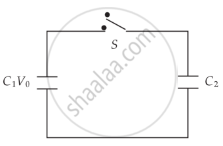
A capacitor of capacity C1 is charged to the potential of V0. On disconnecting with the battery, it is connected with an uncharged capacitor of capacity C2 as shown in the adjoining figure. Find the ratio of energies before and after the connection of switch S.
Chapter: [2] Electrostatic Potential and Capacitance
Obtain the equivalent capacitance of the network shown in the figure. For a 300 V supply, determine the charge on each capacitor.

