Advertisements
Advertisements
A horizontal straight wire 10 m long extending from east to west is falling with a speed of 5.0 m s−1, at right angles to the horizontal component of the earth’s magnetic field, 0.30 × 10⁻⁴ Wb m−2.
- What is the instantaneous value of the emf induced in the wire?
- What is the direction of the emf?
- Which end of the wire is at the higher electrical potential?
Concept: Introduction to Electromagnetic Induction
A circular coil of cross-sectional area 200 cm2 and 20 turns is rotated about the vertical diameter with angular speed of 50 rad s−1 in a uniform magnetic field of magnitude 3.0 × 10⁻²T. Calculate the maximum value of the current in the coil.
Concept: Introduction to Electromagnetic Induction
When Puja, a student of 10th class, watched her mother washing clothes in the open, she observed coloured soap bubbles and was curious to know why the soap bubbles appear coloured. In the evening when her father, an engineer by profession, came home, she asked him this question. Her father explained to her the basic phenomenon of physics due to which the soap bubbles appear coloured.
(a) What according to you are the values displayed by Puja and her father?
(b) State the phenomenon of light involved in the formation of coloured soap bubbles.
Concept: Introduction to Electromagnetic Induction
A bar magnet is moved in the direction indicated by the arrow between two coils PQ and CD. Predict the directions of induced current in each coil.

Concept: Lenz’s Law and Conservation of Energy
Answer the following question.
When an inductor is connected to a 200 V dc voltage, a current at 1A flows through it. When the same inductor is connected to a 200 V, 50 Hz ac source, only 0.5 A current flows. Explain, why? Also, calculate the self-inductance of the inductor.
Concept: Inductance >> Self Inductance
Define 'quality factor' of resonance in a series LCR circuit. What is its SI unit?
Concept: AC Voltage Applied to a Series LCR Circuit
Write the function of a transformer.
Concept: Transformers
A device 'X' is connected to an ac source V = V0 sin ωt. The variation of voltage, current and power in one cycle is shown in the following graph:
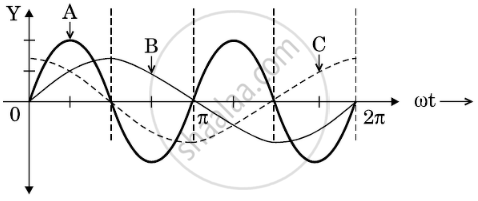
(a) Identify the device 'X'.
(b) Which of the curves A, B and C represent the voltage , current and the power consumed in the circuit? Justify your answer.
(c) How does its impedance vary with frequency of the ac source? Show graphically.
(d) Obtain an expression for the current in the circuit and its phase relation with ac voltage.
Concept: AC Voltage Applied to a Resistor
State the principle of transformer working with the help of a diagram
Concept: Transformers
Mention various energy losses in transformer device
Concept: Transformers
The primary coil of an ideal step-up transformer has 100 turns and the transformation ratio is also 100. The input voltage and power are 220 V and 1100 W, respectively. Calculate the
(a) number of turns in secondary
(b) current in the primary
(c) a voltage across secondary
(d) current in secondary
(e) power in secondary
Concept: Transformers
Show that the current leads the voltage in phase by π/2 in an AC circuit containing an ideal capacitor ?
Concept: AC Voltage Applied to a Capacitor
Mention the two characteristic properties of the material suitable for making core of a transformer.
Concept: Transformers
State the underlying principle of a transformer. How is the large scale transmission of electric energy over long distances done with the use of transformers?
Concept: Transformers
A series LCR circuit is connected to an ac source. Using the phasor diagram, derive the expression for the impedance of the circuit. Plot a graph to show the variation of current with frequency of the source, explaining the nature of its variation.
Concept: AC Voltage Applied to a Series LCR Circuit
State the principle of a step-up transformer. Explain, with the help of a labeled diagram, its working ?
Concept: Transformers
Describe briefly and two energy losses, giving the reasons for their occurrence in actual transformers ?
Concept: Transformers
Answer the following question.
In a series LCR circuit connected across an ac source of variable frequency, obtain the expression for its impedance and draw a plot showing its variation with frequency of the ac source.
Concept: AC Voltage Applied to a Series LCR Circuit
Answer the following question.
What is the phase difference between the voltages across the inductor and the capacitor at resonance in the LCR circuit?
Concept: AC Voltage Applied to a Series LCR Circuit
Answer the following question.
Draw the diagram of a device that is used to decrease high ac voltage into a low ac voltage and state its working principle. Write four sources of energy loss in this device.
Concept: AC Voltage Applied to a Series LCR Circuit
