Advertisements
Advertisements
Question
In the study of Geiger-Marsdon experiment on scattering of α particles by a thin foil of gold, draw the trajectory of α-particles in the coulomb field of target nucleus. Explain briefly how one gets the information on the size of the nucleus from this study.
From the relation R = R0 A1/3, where R0 is constant and A is the mass number of the nucleus, show that nuclear matter density is independent of A
Advertisements
Solution
Trajectory of α Particles in Coulomb Field of Target Nucleus
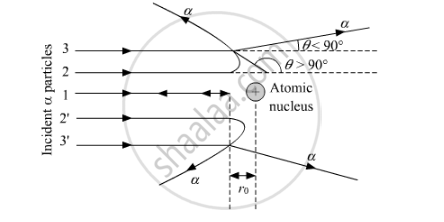
From this experiment, the following is observed:
1. Most of the alpha particles pass straight through the gold foil. It means that they do not suffer any collision with gold atoms.
2. About one alpha particle in every 8000 alpha particles deflects by more than 90°
As most of the alpha particles go undeflected and only a few get deflected, this shows that most of the space in an atom is empty and at the centre of the atom, there exists a nucleus. By the number of the alpha particles deflected, the information regarding size of the nucleus can be known.
If m is the average mass of a nucleon and R is the nuclear radius, then mass of nucleus = mA, where A is the mass number of the element.
Volume of the nucleus, `V=4/3piR^3`
`=>V=4/3pi(R_0A^"1/3")^3`
`=>V=4/3piR_0^3A`
Density of nuclear matter, `rho=(mA)/V`
`=>rho=(mA)/(4/3R_0^3A)`
`=>rho=(3m)/(4piR_0^3`
This shows that the nuclear density is independent of A
APPEARS IN
RELATED QUESTIONS
Name a material which is used in making control rods in a nuclear reactor.
If neutrons exert only attractive force, why don't we have a nucleus containing neutrons alone?
Potassium-40 can decay in three modes. It can decay by β−-emission, B*-emission of electron capture. (a) Write the equations showing the end products. (b) Find the Q-values in each of the three cases. Atomic masses of `""_18^40Ar` , `""_19^40K` and `""_20^40Ca` are 39.9624 u, 39.9640 u and 39.9626 u respectively.
(Use Mass of proton mp = 1.007276 u, Mass of `""_1^1"H"` atom = 1.007825 u, Mass of neutron mn = 1.008665 u, Mass of electron = 0.0005486 u ≈ 511 keV/c2,1 u = 931 MeV/c2.)
Nuclear species or nuclides are shown by the notation ________ where X is the chemical symbol of the species.
Nuclides with same neutron number N but different atomic number Z are called ______.
A nucleus yYx emits one α and two β particles. The resulting nucleus is ______.
A nuclide 1 is said to be the mirror isobar of nuclide 2 if Z1 = N2 and Z2 = N1. (a) What nuclide is a mirror isobar of 1123 Na? (b) Which nuclide out of the two mirror isobars have greater binding energy and why?
What conclusion is drawn from Rutherford’s scattering experiment of α-particles?
The volume occupied by an atom is greater than the volume of the nucleus by a factor of about:
The value of one atomic mass unit (1 u) is:
