Definitions [10]
The position of a point in a plane is expressed by a pair of numbers, one concerning the x-axis and the other concerning the y-axis. called co-ordinates.
-
x → distance from y-axis (abscissa)
-
y → distance from x-axis (ordinate)
The two mutually perpendicular number lines intersecting each other at their zeroes are called rectangular axes or coordinate axes, or axes of reference.
If α, β and γ are the direction angles of a vector, then the cosines of these angles, i.e.
l = cosα, m = cosβ, n = cosγ
are called the direction cosines of the vector.
If \[ P(x,y,z) \] is a point and \[ \vec{OP} \] is its position vector, then
\[ r = |\vec{OP}| = \sqrt{x^{2} + y^{2} + z^{2}} \]
and
\[ \boxed{\,\cos\alpha = \frac{x}{r}, \qquad \cos\beta = \frac{y}{r}, \qquad \cos\gamma = \frac{z}{r}\,} \]
The angles made by a vector with the positive directions of the X-axis, Y-axis and Z-axis are called direction angles of the vector, denoted by α, β, and γ.
\[ l = \cos\alpha, \quad m = \cos\beta, \quad n = \cos\gamma, \]
\[ \boxed{\,\cos^{2}\alpha + \cos^{2}\beta + \cos^{2}\gamma = 1\,} \]
If l, m, n are direction cosines of a line and if a, b, c are real numbers such that \[\frac{\mathrm{a}}{l}=\frac{\mathrm{b}}{\mathrm{m}}=\frac{\mathrm{c}}{\mathrm{n}}=\lambda,\] then a, b, c are called direction ratios of that line.
\[ \boxed{\,\frac{a}{\sqrt{a^{2} + b^{2} + c^{2}}}, \qquad \frac{b}{\sqrt{a^{2} + b^{2} + c^{2}}}, \qquad \frac{c}{\sqrt{a^{2} + b^{2} + c^{2}}}\,} \]
The cosines of these angles are called the direction cosines of the line.
So, the direction cosines are written as (l, m, n).
\[ \boxed{\,l^{2} + m^{2} + n^{2} = 1\,} \]
If a directed line makes angles \[\alpha\], \[\beta\], and \[\gamma\] with the positive x-, y-, and z-axes respectively, then these are called the direction angles of the line.
Any three numbers proportional to the direction cosines of a line are called the direction ratios of the line.
If (a, b, c) are direction ratios, then:
An equation of the form ax + by + c = 0 represents a straight line and is known as a linear equation.
The slope m of a line is m = tanθ
where θ is the inclination of the line with the positive x-axis.
Formulae [18]
| Sr. No. | Name | Condition | Formula |
|---|---|---|---|
| i. | Distance Formula | Two points P(x₁, y₁), Q(x₂, y₂) | \[\mathrm{d(PQ)}=\sqrt{\left(x_{2}-x_{1}\right)^{2}+\left(y_{2}-y_{1}\right)^{2}}\] |
| a. | Internal Division | P divides AB in the ratio m: n | \[\mathrm{P\equiv\left(\frac{mx_{2}+nx_{1}}{m+n},\frac{my_{2}+ny_{1}}{m+n}\right)}\] |
| b. | Midpoint Formula | P is the midpoint of AB | \[\mathrm{P}\equiv\left(\frac{x_{1}+x_{2}}{2},\frac{y_{1}+y_{2}}{2}\right)\] |
| c. | External Division | P divides AB externally in m: n | \[\mathrm{P\equiv\left(\frac{mx_{2}-nx_{1}}{m-n},\frac{my_{2}-ny_{1}}{m-n}\right)}\] |
| iii. | Centroid Formula | Triangle with vertices A, B, C | \[\left(\frac{x_1+x_2+x_3}{3},\frac{y_1+y_2+y_3}{3}\right)\] |
\[P\left(\frac{m_1x_2+m_2x_1}{m_1+m_2},\frac{m_1y_2+m_2y_1}{m_1+m_2}\right)\]
If slopes are m1 and m2:
\[\tan\theta=\left|\frac{m_1-m_2}{1+m_1m_2}\right|\]
If lines are a₁x + b₁y + c₁ = 0 and a₂x + b₂y + c₂ = 0,
\[\tan\theta=\left|\frac{a_1b_2-a_2b_1}{a_1a_2+b_1b_2}\right|\]
Conditions for Parallel, Perpendicular and Identical Lines:
Parallel Lines:
Slope: m₁ = m₂
In general form: \[\frac{a_1}{a_2}=\frac{b_1}{b_2}\neq\frac{c_1}{c_2}\]
Perpendicular Lines:
Slope: m₁m₂ = −1
In general form: a₁a₂ + b₁b₂ = 0
Identical Lines:
\[\frac{a_1}{a_2}=\frac{b_1}{b_2}=\frac{c_1}{c_2}\]
For a₁x + b₁y + c₁ = 0 and a₂x + b₂y + c₂ = 0,
\[(x,y)=\left(\frac{b_1c_2-b_2c_1}{a_1b_2-a_2b_1},\frac{c_1a_2-c_2a_1}{a_1b_2-a_2b_1}\right)\]
\[SD=\left|\frac{\left(a_{2}-a_{1}\right)\times b}{\left|b\right|}\right|\]
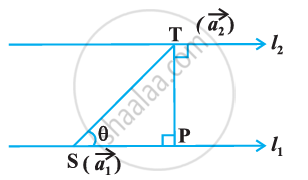
If the lines are \[ \vec{r} = \vec{a}_{1} + \lambda\vec{b}_{1} \] and \[ \vec{r} = \vec{a}_{2} + \mu\vec{b}_{2}, \]
then \[ \vec{a}_{1}, \vec{a}_{2} \] are position vectors of points on the lines and \[ \vec{b}_{1}, \vec{b}_{2} \] are their direction vectors.
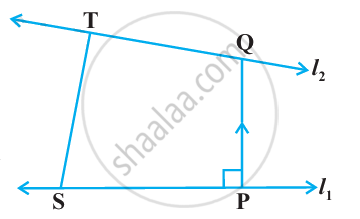
Vector Form:
\[\mathbf{d}=\left|\frac{(\overline{\mathbf{b}}_{1}\times\overline{\mathbf{b}}_{2}).(\overline{\mathbf{a}}_{2}-\overline{\mathbf{a}}_{1})}{\left|\overline{\mathbf{b}}_{1}\times\overline{\mathbf{b}}_{2}\right|}\right|\]
Cartesian Form:
\[\mathbf{d}=\left|\frac{ \begin{vmatrix} x_2-x_1 & y_2-y_1 & z_2-z_1 \\ \mathbf{a}_1 & \mathbf{b}_1 & \mathbf{c}_1 \\ \mathbf{a}_2 & \mathbf{b}_2 & \mathbf{c}_2 \end{vmatrix}}{\sqrt{\left(\mathbf{a}_1\mathbf{b}_2-\mathbf{a}_2\mathbf{b}_1\right)^2+\left(\mathbf{a}_1\mathbf{c}_2-\mathbf{a}_2\mathbf{c}_1\right)^2+\left(\mathbf{b}_1\mathbf{c}_2-\mathbf{b}_2\mathbf{c}_1\right)^2}}\right|\]
From general form:
- Slope (m) = −a / b
- Y-intercept = −c / b
If the direction ratios are \[(a_1, b_1, c_1)\] and \[(a_2, b_2, c_2)\], then:
If the direction cosines of the two lines are
\[(l_1, m_1, n_1)\] and \[(l_2, m_2, n_2)\], then:
If the direction ratios of two lines are:
First line: \[(a_1, b_1, c_1)\]
Second line: \[(a_2, b_2, c_2)\]
then the cosine of the angle \[\theta\] between them is:
\[m=\frac{y_2-y_1}{x_2-x_1}\]
For point (x₁, y₁) and line ax + by + c = 0,
\[p=\frac{|ax_1+by_1+c|}{\sqrt{a^2+b^2}}\]
For lines ax + by + c₁ = 0 and ax + by + c₂ = 0,
P = \[\left|\frac{c_{1}-c_{2}}{\sqrt{a^{2}+b^{2}}}\right|\]
If ax² + 2hxy + by² + 2gx + 2fy + c = 0 represents a pair of parallel straight lines, then the distance between them is given by
\[2\sqrt{\frac{g^{2}-ac}{a(a+b)}}\mathrm{or}2\sqrt{\frac{f^{2}-bc}{b(a+b)}}\]
\[SD=\left|\frac{\left(a_{2}-a_{1}\right)\times b}{\left|b\right|}\right|\]
If the lines are \[ \vec{r} = \vec{a}_{1} + \lambda\vec{b}_{1} \] and \[ \vec{r} = \vec{a}_{2} + \mu\vec{b}_{2}, \]
then \[ \vec{a}_{1}, \vec{a}_{2} \] are position vectors of points on the lines and \[ \vec{b}_{1}, \vec{b}_{2} \] are their direction vectors.
Vector Form:
\[\mathbf{d}=\left|\frac{(\overline{\mathbf{b}}_{1}\times\overline{\mathbf{b}}_{2}).(\overline{\mathbf{a}}_{2}-\overline{\mathbf{a}}_{1})}{\left|\overline{\mathbf{b}}_{1}\times\overline{\mathbf{b}}_{2}\right|}\right|\]
Cartesian Form:
\[\mathbf{d}=\left|\frac{ \begin{vmatrix} x_2-x_1 & y_2-y_1 & z_2-z_1 \\ \mathbf{a}_1 & \mathbf{b}_1 & \mathbf{c}_1 \\ \mathbf{a}_2 & \mathbf{b}_2 & \mathbf{c}_2 \end{vmatrix}}{\sqrt{\left(\mathbf{a}_1\mathbf{b}_2-\mathbf{a}_2\mathbf{b}_1\right)^2+\left(\mathbf{a}_1\mathbf{c}_2-\mathbf{a}_2\mathbf{c}_1\right)^2+\left(\mathbf{b}_1\mathbf{c}_2-\mathbf{b}_2\mathbf{c}_1\right)^2}}\right|\]
Vector Form:
\[\sin\theta=\left|\frac{\overline{\mathbf{b}}.\overline{\mathbf{n}}}{\left|\overline{\mathbf{b}}\right|.\left|\overline{\mathbf{n}}\right|}\right|\]
Cartesian Form:
\[\mathrm{sin}\theta=\frac{\mathrm{aa}_{1}+\mathrm{bb}_{1}+\mathrm{cc}_{1}}{\sqrt{\mathrm{a}^{2}+\mathrm{b}^{2}+\mathrm{c}^{2}}\sqrt{\mathrm{a}_{1}^{2}+\mathrm{b}_{1}^{2}+\mathrm{c}_{1}^{2}}}\]
Vector Form:
\[\cos\theta=\left|\frac{\overline{\mathbf{n₁}}.\overline{\mathbf{n₂}}}{\left|\overline{\mathbf{n₁}}\right|.\left|\overline{\mathbf{n₂}}\right|}\right|\]
Cartesian Form:
\[\cos\theta=\left|\frac{\mathrm{a}_{1}\mathrm{a}_{2}+\mathrm{b}_{1}\mathrm{b}_{2}+\mathrm{c}_{1}\mathrm{c}_{2}}{\sqrt{\mathrm{a}_{1}^{2}+\mathrm{b}_{1}^{2}+\mathrm{c}_{1}^{2}}\sqrt{\mathrm{a}_{2}^{2}+\mathrm{b}_{2}^{2}+\mathrm{c}_{2}^{2}}}\right|\]
Theorems and Laws [4]
Let `A(bara)` and `B(barb)` be any two points in the space and `R(barr)` be the third point on the line AB dividing the segment AB externally in the ratio m : n, then prove that `barr = (mbarb - nbara)/(m - n)`.
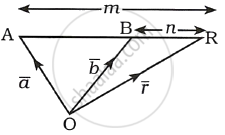
As the point R divides the line segment AB externally, we have either A-B-R or R-A-B.
Assume that A-B-R and `bar(AR) : bar(BR)` = m : n
∴ `(AR)/(BR) = m/n` so n(AR) = m(BR)
As `n(bar(AR))` and `m(bar(BR))` have same magnitude and direction,
∴ `n(bar(AR)) = m(bar(BR))`
∴ `n(barr - bara) = m(barr - barb)`
∴ `nbarr - nbara = mbarr - mbarb`
∴ `mbarr - nbarr = mbarb - nbara`
∴ `(m - n)barr = mbarb - nbara`
∴ `barr = (mbarb - nbara)/(m - n)`
Hence proved.
Let `A(bara)` and `B(barb)` are any two points in the space and `R(barr)` be a point on the line segment AB dividing it internally in the ratio m : n, then prove that `barr = (mbarb + nbara)/(m + n)`.
R is a point on the line segment AB(A – R – B) and `bar(AR)` and `bar(RB)` are in the same direction.
Point R divides AB internally in the ratio m : n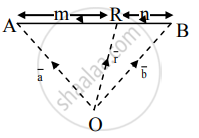
∴ `(AR)/(RB) = m/n`
∴ n(AR) = m(RB)
As `n(bar(AR))` and `m(bar(RB))` have same direction and magnitude,
`n(bar(AR)) = m(bar(RB))`
∴ `n(bar(OR) - bar(OA)) = m(bar(OB) - bar(OR))`
∴ `n(vecr - veca) = m(vecb - vecr)`
∴ `nvecr - nveca = mvecb - mvecr`
∴ `mvecr + nvecr = mvecb + nveca`
∴ `(m + n)vecr = mvecb + nveca`
∴ `vecr = (mvecb + nveca)/(m + n)`
By vector method prove that the medians of a triangle are concurrent.

Let A, B and C be vertices of a triangle.
Let D, E and F be the mid-points of the sides BC, AC and AB respectively.
Let `bara, barb, barc, bard, bare` and `barf` be position vectors of points A, B, C, D, E and F respectively.
Therefore, by mid-point formula,
∴ `bard = (barb + barc)/2, bare = (bara + barc)/2` and `barf = (bara + barb)/2`
∴ `2bard = barb + barc, 2bare = bara + barc` and `2barf = bara + barb`
∴ `2bard + bara = bara + barb + barc`, similarly `2bare + barb = 2barf + barc = bara + barb + barc`
∴ `(2bard + bara)/3 = (2bare + barb)/3 = (2barf + barc)/3 = (bara + barb + barc)/3 = barg` ...(Say)
Then we have `barg = (bara + barb + barc)/3 = ((2)bard + (1)bara)/(2 + 1) = ((2)bare + (1)barb)/(2 + 1) = ((2)barf + (1)barc)/(2 + 1)`
If G is the point whose position vector is `barg`, then from the above equation it is clear that the point G lies on the medians AD, BE, CF and it divides each of the medians AD, BE, CF internally in the ratio 2 : 1.
Therefore, three medians are concurrent.
If D, E, F are the midpoints of the sides BC, CA, AB of a triangle ABC, prove that `bar(AD) + bar(BE) + bar(CF) = bar0`.
Let `bara, barb, barc, bard, bare, barf` be the position vectors of the points A, B, C, D, E, F respectively.
Since D, E, F are the midpoints of BC, CA, AB respectively, by the midpoint formula
`bard = (barb + barc)/2, bare = (barc + bara)/2, barf = (bara + barb)/2`
∴ `bar(AD) + bar(BE) + bar(CF) = (bard - bara) + (bare - barb) + (barf - barc)`
= `((barb + barc)/2 - bara) + ((barc + bara)/2 - barb) + ((bara + barb)/2 - barc)`
= `1/2barb + 1/2barc - bara + 1/2barc + 1/2bara - barb + 1/2bara + 1/2barb - barc`
= `1/2(barb + barc - 2bara + bar c + bara - 2barb + bara + barb - 2barc)`
= `(bara + barb + barc) - (bara + barb + barc) = bar0`.
Key Points
Sign Convention
-
Right of y-axis → +x
-
Left of y-axis → −x
-
Above x-axis → +y
-
Below x-axis → −y
Standard Line Results
-
x = 0 → y-axis
-
y = 0 → x-axis
-
x = a → line parallel to the y-axis
-
y = b → line parallel to the x-axis
Quadrant Reminder
| Quadrant | Sign of (x, y) |
|---|---|
| I | (+, +) |
| II | (−, +) |
| III | (−, −) |
| IV | (+, −) |
-
Direction angles are the angles a line makes with the positive coordinate axes.
-
Direction cosines are \[\cos \alpha\], \[\cos \beta\], and \[\cos \gamma\].
-
If direction cosines are (l, m, n), then \[l^2 + m^2 + n^2 = 1\].
-
Direction ratios are any numbers proportional to direction cosines.
-
If direction ratios are (a, b, c), then corresponding direction cosines are:
-
For points \[A(x_1, y_1, z_1)\], \[B(x_2, y_2, z_2)\], direction ratios of AB are \[(x_2 - x_1, y_2 - y_1, z_2 - z_1)\].
-
Angle between two lines can be found using either direction cosines or direction ratios.
-
Direction Cosines (DCs) of a line: \[(l, m, n) = (\cos \alpha, \cos \beta, \cos \gamma)\].
-
Main identity: \[l^2 + m^2 + n^2 = 1\].
-
Direction Ratios (DRs): Are proportional to DCs.
-
Relation between DRs and DCs: If DRs are (a, b, c), then DCs are proportional to (a, b, c) divided by \[\sqrt{a^2 + b^2 + c^2}\].
-
DRs for two points: For points \[P(x_1, y_1, z_1)\] and \[Q(x_2, y_2, z_2)\], DRs are \[(x_2 - x_1, y_2 - y_1, z_2 - z_1)\].
-
Intersecting lines: SD = 0
-
Parallel lines: \[SD = \frac{|(\vec{a}_2 - \vec{a}_1) \times \vec{b}|}{|\vec{b}|}\]
-
Skew lines: \[SD = \frac{|(\vec{a}_2 - \vec{a}_1) \cdot (\vec{b}_1 \times \vec{b}_2)|}{|\vec{b}_1 \times \vec{b}_2|}\]
| Form | Formula |
|---|---|
| X-axis | y = 0 |
| Y-axis | x = 0 |
| Parallel to the X-axis | y = b or y = -b |
| Parallel to the Y-axis | x = a or x = -a |
| Slope-point form | y − y₁ = m(x − x₁) |
| Two-point form | \[\frac{y-y_{1}}{y_{1}-y_{2}}=\frac{x-x_{1}}{x_{1}-x_{2}}\] |
| Slope-intercept form | y = mx + c |
| Intercept form | \[\frac{x}{\mathrm{a}}+\frac{y}{\mathrm{b}}=1\] |
| Normal form | x cosα + y sinα = p |
| Parametric form | \[\frac{x-x_{1}}{\cos\theta}=\frac{y-y_{1}}{\sin\theta}=r\] |
Position of a Point:
For line: ax₁ + by₁ + c
- If ax₁ + by₁ + c = 0 → Point lies on the line
- If ax₁ + by₁ + c < 0 → Point lies on one side (origin side)
- If ax₁ + by₁ + c > 0 → Point lies on other side
Vector Form:
Condition for coplanarity of two lines:
Two lines r = a₁ + λb₁ and r = a₂ + μb₂ are coplanar if
(a₁ − a₂) · (b₁ × b₂) = 0
Equation of the plane containing both lines:
\[\left(\overline{\mathbf{r}}-\overline{\mathbf{a}_1}\right).\left(\overline{\mathbf{b}_1}\times\overline{\mathbf{b}_2}\right)=\mathbf{0}\] or \[\left(\overline{\mathbf{r}}-\overline{\mathbf{a}_2}\right).\left(\overline{\mathbf{b}_1}\times\overline{\mathbf{b}_2}\right)=\mathbf{0}\]
Cartesian Form:
\[\begin{vmatrix} x_2-x_1 & y_2-y_1 & z_2-z_1 \\ \mathbf{a}_1 & \mathbf{b}_1 & \mathbf{c}_1 \\ \mathbf{a}_2 & \mathbf{b}_2 & \mathbf{c}_2 \end{vmatrix}=0\]
-
The angle between two lines depends only on their directions.
-
If lines do not pass through the origin, imagine parallel lines through the origin.
-
The dot-product formula is the main method for solving these questions.
-
In symmetric form, denominators give direction ratios.
-
Zero dot product means perpendicular lines.
-
Proportional direction ratios mean parallel lines.
-
The required angle is generally the acute angle.
Nature of Slope
-
m > 0 → rising line
-
m < 0 → falling line
-
m = 0 → horizontal line
-
m = ∞→ vertical line
Parallel Lines
Two lines are parallel ⇔ , their slopes are equal, m1 = m2
Perpendicular Lines
Two lines are perpendicular ⇔
Collinearity of Three Points
Points A, B, and C are collinear
Method 1: Distance method
AB + BC = AC
Method 2: Slope method
Slope of AB = Slope of BC
-
Intersecting lines: SD = 0
-
Parallel lines: \[SD = \frac{|(\vec{a}_2 - \vec{a}_1) \times \vec{b}|}{|\vec{b}|}\]
-
Skew lines: \[SD = \frac{|(\vec{a}_2 - \vec{a}_1) \cdot (\vec{b}_1 \times \vec{b}_2)|}{|\vec{b}_1 \times \vec{b}_2|}\]
| Case | Vector Form | Cartesian Form |
|---|---|---|
| 1. Normal form (given normal vector) | \[\overline{\mathbf{r}}.\hat{\mathbf{n}}=\mathbf{p}\] | ax + by + cz + d = 0 |
| 2. Through a point (x₁, y₁, z₁) | \[\begin{bmatrix} \mathbf{\overline{r}}-\mathbf{\overline{a}} \end{bmatrix}.\mathbf{\overline{n}}=\mathbf{0}\] | a(x−x₁) + b(y−y₁) + c(z−z₁) = 0 |
| 3. Through point + parallel to two vectors | \[\begin{bmatrix} \overline{\mathbf{r}}\overline{\mathbf{b}}\overline{\mathbf{c}} \end{bmatrix}= \begin{bmatrix} \overline{\mathbf{a}}\overline{\mathbf{b}}\overline{\mathbf{c}} \end{bmatrix}\] | \[\begin{vmatrix} x-x_1 & y-y_1 & z-z_1 \\ \mathbf{b}_1 & \mathbf{b}_2 & \mathbf{b}_3 \\ \mathbf{c}_1 & \mathbf{c}_2 & \mathbf{c}_3 \end{vmatrix}=0\] |
| 4. Through three non-collinear points | \[(\mathbf{r-a})\cdot[(\mathbf{b-a})\times(\mathbf{c-a})]=0\] | \[\begin{vmatrix} x-x_1 & y-y_1 & z-z_1 \\ x_2-x_1 & y_2-y_1 & z_2-z_1 \\ x_3-x_1 & y_3-y_1 & z_3-z_1 \end{vmatrix}=0\] |
| 5. Through the intersection of two planes | \[\left(\overline{\mathbf{r}}.\overline{\mathbf{n}}_1-\mathbf{d}_1\right)+\lambda\left(\overline{\mathbf{r}}.\overline{\mathbf{n}}_2-\mathbf{d}_2\right)=0\] | (a₁x + b₁y + c₁z + d₁) + λ(a₂x + b₂y + c₂z + d₂) = 0 |
Equation of a Plane in Intercept form:
\[\frac{x}{a}+\frac{y}{b}+\frac{z}{c}=1\]
Distance of the Plane from Origin is
\[d=\frac{1}{\sqrt{\frac{1}{a^{2}}+\frac{1}{b^{2}}+\frac{1}{c^{2}}}}\]
Condition for Perpendicularity:
\[\overline{\mathbf{b}}=\lambda\overline{\mathbf{n}}\], λ is a parameter
\[\frac{\mathbf{a}_{1}}{\mathbf{a}}=\frac{\mathbf{b}_{1}}{\mathbf{b}}=\frac{\mathbf{c}_{1}}{\mathbf{c}}\]
Condition for Parallelism:
The line is parallel to the plane, if
\[\overline{\mathbf{b}}.\overline{\mathbf{n}}=0\]
aa₁ + bb₁ + cc₁ = 0
Concepts [25]
- Foundation of Coordinate Geometry
- Coordinates of a Point in Space
- Distance Between Two Points
- Section Formula in Coordinate Geometry
- Direction Ratios, Direction Cosine & Direction Angles in Vector
- Direction Cosines and Direction Ratios of a Line
- The Angle Between Two Intersecting Lines
- Skew Lines
- Shortest Distance Between Two Lines
- Equations of Line in Different Forms
- Intersection of the Line and Plane
- Coplanarity of Two Lines
- Angle Between Two Lines
- Projection of a Point on a Line
- Projection of a Line Segment Joining Two Points
- Equation of a Straight Line in Cartesian and Vector Form
- Concept of Slope (or, gradient)
- Distance in Lines (Point & Parallel Lines)
- Shortest Distance Between Two Lines
- Different Forms of Equation of a Plane
- Angle Between Two Planes
- Angle Between Line and a Plane
- Distance Between Two Parallel Planes
- Position of Point and Line wrt a Plane
- Projection of a Line on a Plane
