- A concave mirror has an inward-curved reflecting surface, while a convex mirror has an outward-curved reflecting surface.
- Important parts of a spherical mirror: Pole (P), Centre of Curvature (C), Principal Axis, and Principal Focus (F).
- For spherical mirrors, the relation is R = 2f, where R is the radius of curvature and f is the focal length.
- In concave mirrors, parallel rays converge at the focus; in convex mirrors, they appear to diverge from the focus behind the mirror.
Definitions [94]
Definition: Principal Axis
The line joining the pole and the centre of curvature of the spherical mirror is called the principal axis.
Definition: Pole
The geometric centre of a spherical mirror is called its pole.
Definition: Normal
For a spherical mirror, the normal at the point of incidence is along the radius, that is, the line joining the centre of curvature of the mirror to the point of incidence, called the normal.
Definition: Refracted Ray
The ray that enters the second medium after crossing the boundary is called the refracted ray.
Definition: Normal
A normal is an imaginary line drawn perpendicular to the boundary at the point of incidence.
Define the principal focus of a concave mirror.
Light rays that are parallel to the principal axis of a concave mirror converge at a specific point on its principal axis after reflecting from the mirror. This point is known as the principal focus of the concave mirror.
Definition: Refraction
The change in the direction of the path of light when it passes from one transparent medium to another transparent medium is called refraction. The refraction of light is essentially a surface phenomenon.
or
When light passes from one transparent medium to another, its speed and direction change. This is called refraction.
Definition: Refraction of Light
When travelling obliquely from one medium to another, the direction of propagation of light in the second medium changes. This phenomenon is known as refraction of light.
OR
Light changes its direction when going from one transparent medium to another transparent medium. This is called the refraction of light.
OR
The bending of the light ray from its path in passing from one medium to the other medium is called 'refraction' of light.
OR
When a ray of light impinges on a polished, smooth, shiny surface, the rebounding of light within the same medium is called reflection of light.
Define the following terms used in the study of reflection of light by drawing a labelled ray-diagram:
- Incident ray
- Point of incidence
- Normal
- Reflected ray
- Angle of incidence
- Angle of reflection
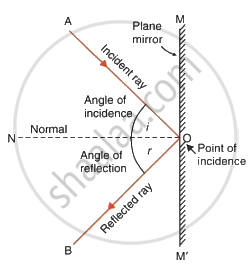
- Incident ray: The ray of light which falls on the mirror surface is called the incident ray.
- Point of incidence: The point at which the incident ray falls on the mirror is called the point of incidence.
- Normal: The normal is a line at right angles to the mirror surface at the point of incidence.
- Reflected ray: The ray of light which is sent back by the mirror is called the reflected ray.
- Angle of incidence: The angle of incidence is the angle made by the incident ray with the normal at the point of incidence.
- Angle of reflection: The angle of reflection is the angle made by the reflected ray with the normal at the point of incidence.
Definition: Refracted Light
Refracted light is the part of light enters into the other medium and travels in a straight path but in a direction different from its initial direction and is called the refracted light.
Definition: Critical Angle
The critical angle is the angle of incidence in the denser medium for which the angle of refraction in the rarer medium is 90 degrees.
Define critical angle for a given medium.
When a ray of light propagates from a denser medium to a rarer medium, the angle of incidence for which the angle of refraction is 90° is called the critical angle.
Definition: Total Internal Reflection
Total internal reflection is the complete reflection of light back into an optically denser medium when light travels from a denser medium to a rarer medium and the angle of incidence exceeds the critical angle.
Definition: Spherical Aberration (Lens)
The aberration caused by the spherical shape of the lens, where light rays at the edges focus at a different point than those near the centre, leading to a blurred image, is called spherical aberration.
Definition: Chromatic Aberration
The aberration that occurs due to the lens refracting different wavelengths of light at different angles, resulting in an image consisting of different colours without a single focussed image, is called chromatic aberration.
Define the term ‘focal length of a mirror’.
When rays of light parallel to the principal axis of a mirror are incident on it, the rays after reflection either converge at a point or appear to diverge from a point. The distance of that point from the pole of the mirror is known as the focal length of the mirror.
Definition: Principal Focus
The point on the principal axis where rays parallel to the principal axis actually meet after refraction, or appear to diverge after refraction, is called the principal focus.
Definition: Magnification
The ratio of the height of the image to the height of the object is called magnification.
Definition: Focal Length
The distance between the optical centre and the principal focus is called the focal length.
Definition: Optic Centre
The point near the centre of a thin lens through which a ray of light passes without appreciable deviation is called the optical centre.
Definition: Principal Axis
The straight line passing through the optical centre and the centres of curvature of the lens surfaces is called the principal axis.
Definition: Lens
A transparent refracting medium bounded by two surfaces, of which at least one is spherical, is called a lens.
Definition: Secondary Rainbow
An arc of seven colours with red on the inner edge and violet on the outer edge, caused by double total internal reflection inside water droplets, is called a secondary rainbow.
Definition: Primary Rainbow
An arc of seven colours formed in the sky with red on the outer edge and violet on the inner edge, caused by single total internal reflection inside water droplets, is called a primary rainbow.
Definition: Mirage
The optical illusion of water or distant objects caused by refraction of light due to temperature differences in air layers is called a mirage.
Definition: Angular Magnification or Magnifying Power
Angular magnification or magnifying power of an optical instrument is defined as the ratio of the visual angle made by the image formed by that optical instrument (β) to the visual angle subtended by the object when kept at the least distance of distinct vision (α).
Definition: Least Distance of Distinct Vision
For a normal, unaided human eye, D = 25 cm. If an object is brought closer than this, we cannot see it clearly. The minimum distance from the eye at which an object can be seen clearly is called the least distance of distinct vision.
OR
Due to the limitation of focusing the eye lens, it is not possible to take an object closer than a certain distance. This distance is called the least distance of distinct vision.
Definition: Simple Microscope
An optical instrument that uses a single convex lens to magnify small objects is called a simple microscope.
Definition: Compound Microscope
An optical instrument that uses objective and eye piece lenses to magnify tiny objects in detail is called a compound microscope.
Definition: Telescope
An optical instrument that uses objective and eye piece lenses to magnify distant terrestrial or celestial objects is called a telescope.
Define the term ‘resolving power of a telescope’.
The resolving power of an astronomical telescope is defined as the reciprocal of the smallest angular separation between two point objects whose images can just be resolved by the telescope.
R.P = `(1.22 lambda)/D`
Resolving power is the ability of the telescope to distinguish clearly between two points whose angular separation is less than the smallest angle that the observer’s eye can resolve.
Definition: Wavefront
A wavefront is a surface of constant phase.
Definition: Spherical Wave
If a point source emits waves uniformly in all directions, the locus of points which have the same amplitude and vibrate in the same phase is a sphere. This is known as a spherical wave.
Definition: Plane Wave
At a large distance from the source, a small portion of the spherical wave can be considered as a plane. This is known as a plane wave.
Definition: Total Internal Reflection
Total internal reflection is the complete reflection of light back into the denser medium when light travels from a denser to a rarer medium, and the angle of incidence becomes greater than the critical angle.
Definition: Critical Angle
The critical angle is the angle of incidence in the denser medium for which the angle of refraction in the rarer medium becomes 90 degrees.
If i = ic, then the refracted ray travels along the boundary surface.
Definition: Rarer Medium
A rarer medium is a medium in which light travels faster and whose refractive index is lower compared with the denser medium.
Answer briefly.
What is Doppler effect?
The apparent change in the frequency of sound heard by a listener, due to relative motion between the source of sound and the listener is called Doppler effect in sound.
When the source and the observer are in relative motion with respect to each other and to the medium in which sound propagates, the frequency of the sound wave observed is different from the frequency of the source. This phenomenon is called Doppler Effect.
Definition: Doppler Effect
The apparent change in frequency of sound heard by a listener due to relative motion between the source and the listener is called the Doppler effect.
Definition: Destructive Interference
When two waves meet in opposite phase, the resultant amplitude decreases, and the intensity becomes minimum.
Definition: Superposition Principle
When two or more waves travel through the same medium at the same time, the resultant displacement is the sum of the displacements due to the individual waves.
Definition: Interference
The redistribution of intensity that occurs when two light waves superpose is called interference.
Definition: Coherent Sources
Sources that emit waves of the same frequency and maintain a constant phase difference are called coherent sources.
Definition: Incoherent Sources
Sources for which the phase difference changes randomly with time are called incoherent sources.
Definition: Constructive Interference
When two waves meet in the same phase, the resultant amplitude increases and the intensity becomes maximum.
Definition: Interference of Light
Interference is the phenomenon in which light intensity is modified due to the superposition of two or more light waves.
Definition: Fringe
A fringe is a bright or dark band formed on the screen due to constructive or destructive interference.
Definition: Fringe Width
Fringe width is the distance between two consecutive bright fringes or two consecutive dark fringes.
Definition: Diffraction
Diffraction is the phenomenon of bending of light (or any wave) around the corners or edges of an obstacle or aperture, causing it to spread into the geometrical shadow region and produce alternate dark and bright regions.
Definition: Electric Polarisation
Electric Polarisation is the phenomenon in which an external electric field induces or aligns molecular dipoles within a dielectric, producing equal and opposite bound surface charges on its faces.
Definition: Dielectric Strength
Dielectric Strength is the maximum electric field a dielectric can withstand without electrical breakdown (i.e., before it starts conducting).
Definition: Dielectric Constant (K)
Dielectric Constant (K) is the ratio of the applied field to the net field inside the dielectric, indicating how much the material reduces the electric field.
Definition: Object Distance
In a spherical mirror, the distance of the object from its pole is called the object distance (u).
Definition: Image Distance
The distance of the image from the pole of the mirror is called the image distance (v).
Definition: Focal Length
The distance of the principal focus from the pole is called the focal length (f).
Define the term dispersion of light.
The phenomenon of the splitting of white light by a prism into its constituent colours is known as dispersion of light.
When a beam of white light or composite light is refracted through any transparent media such as glass or water, it is split into its component colours. This phenomenon is called ‘dispersion of light’.
Definition: Spectrum
On passing white light through a prism, the band of colours seen on a screen is called the spectrum.
or
The band of the coloured components of a light beam is called its spectrum.
Definition: Angular Dispersion
The angular separation between the two extreme rays of a dispersed beam of light is called angular dispersion.
Definition: Dispersion
The phenomenon of splitting of white light by a prism into its constituent colours is known as dispersion.
OR
The splitting of light into its component colours is called dispersion.
OR
The process of separation of light into its component colours while passing through a medium is called the dispersion of light.
OR
The phenomenon in which white light splits into its constituent colours when it passes through a prism or another medium is called dispersion of light.
Define the term Normal.
Normal to the surface of a mirror at any point is the straight line at the right angle to the tangent drawn at that point.
Define the term Focus of a concave mirror.
The focus of a concave mirror is a point on the principal axis of the mirror, where all the rays travelling parallel to the principal axis and close to it after reflection from the mirror converge to that point.
Define the following term in relation to concave mirror.
Focal length
The linear distance between the pole and the principal focus is called focal length.
Define the following term in relation to concave mirror.
Radius of curvature
The linear distance between the pole and the center of curvature is called the radius of curvature.
Define the following term in relation to concave mirror.
Principal focus
It is a point on the principal axis, where a beam of light, parallel to the principal axis, after reflection actually meet.
Define the following term in relation to concave mirror.
Principal axis
An imaginary line passing through the pole and the centre of curvature of a spherical mirror is called principal axis.
Define the following term in relation to concave mirror.
Center of curvature
The centre of a hollow sphere of which the mirror forms a part is called the centre of curvature.
Define the following term in relation to concave mirror.
Pole
Pole “is the mid-point of the mirror”.
Define the following term:
concave mirror
“A mirror made by silvering the outer or the bulging surface such that the reflection takes place from the concave surface.” Centre of curvature is towards the reflecting surface.
Define the following term:
convex mirror
“A mirror made by silvering the inner surface such that reflection takes place from the bulging surface” is called Convex Mirror.
The Centre of curvature is towards the silvered surface.
Define the following term:
spherical mirror
“A mirror which is made from a part of a hollow sphere is called Spherical Mirror.
Define the term Pole.
Pole is the centre of the reflecting surface, in this case, a spherical mirror.
Definition: Spherical Mirrors
Mirrors whose reflecting surfaces are spherical are called spherical mirrors.
OR
A spherical mirror is a part of a hollow sphere, whose one side is silvered and coated with red oxide and the other side is the reflecting surface.
OR
A spherical mirror is a piece cut out of a spherical surface, which can be concave or convex.
Definition: Concave Mirror
A spherical mirror, whose reflecting surface is curved inwards, that is, faces towards the centre of the sphere, is called a concave mirror.
OR
A concave mirror is one whose reflecting surface is towards the centre of the sphere of which the mirror is a part.
OR
The reflecting surface is on the inner side of the sphere (converging mirror).
Definition: Convex Mirror
A spherical mirror whose reflecting surface is curved outwards, is called a convex mirror.
OR
A convex mirror is one whose reflecting surface is away from the centre of the sphere of which the mirror is a part.
OR
The reflecting surface is on the outer side of the sphere (diverging mirror).
Definition: Radius of Curvature
The radius of the sphere of which the reflecting surface of a spherical mirror forms a part is called the radius of curvature of the mirror. It is represented by the letter R.
OR
The radius of the sphere of which the mirror forms a part, is called the 'radius of curvature' of the mirror.
Definition: Principal Axis
A straight line passing through the pole and the centre of curvature of a spherical mirror. This line is called the principal axis.
OR
The straight line joining the pole and the centre of curvature of the mirror and extended on both sides is called the 'principal axis' of the mirror.
Definition: Pole
The centre of the reflecting surface of a spherical mirror is a point called the pole. The pole is usually represented by the letter P.
OR
The central point of the reflecting surface of the mirror is called the 'pole' of the mirror.
Definition: Centre of Curvature
The reflecting surface of a spherical mirror forms a part of a sphere. This sphere has a centre. This point is called the centre of curvature of the spherical mirror. It is represented by the letter C.
OR
The centre of the sphere of which the mirror forms a part, is called the ‘centre of curvature' of the mirror.
Define the term Aperture.
Aperture is the distance between the extreme points on the periphery of the mirror.
Define the term Principle focus.
Principal focus of a spherical mirror is a point on the principal axis of the mirror, where all the rays travelling parallel to the principal axis and close to it after reflection from the mirror, converge to or appear to diverge from.
Define focal length.
The distance between the pole and the principal focus is called the focal length (f) of a spherical mirror.
Define the term Centre of curvature.
Centre of curvature is the centre of the imaginary sphere to which the mirror belongs.
Define the term Principle axis.
The principal axis is the straight line passing through the pole and the centre of curvature.
Definition: Reflection of Light
The phenomenon of bouncing back of light rays in the same medium on striking a surface is called reflection of light.
Define Regular reflection.
The phenomenon due to which a parallel beam of light traveling through a certain medium, on striking some polished surface, bounces off from it, as a parallel beam, in some other direction, is called regular reflection.
Define reflection.
The bouncing of light by any smooth or polished surface is called.
Definition: Power of a Lens
The deviation of the incident light rays produced by a lens on refraction through it, is a measure of its power.
or
The power of a lens is defined as the reciprocal of its focal length. It is represented by the letter P.
OR
The power (P) of a thin lens is equal to the reciprocal of its focal length (f) measured in metres.
Define the power of a lens.
Power of a lens is defined as the ability of a lens to bend the rays of light. It is given by the reciprocal of focal length in metre.
The power of a lens is a measure of the deviation produced by it in the path of rays refracted through it.
Definition: Unit of Power
The SI unit of power of a lens is the dioptre.
One dioptre is the power of a lens whose focal length is 1 metre.
1D = 1m−1
Definition: Limit of Resolution
The minimum distance of separation between two objects when they can be observed as separate by an optical instrument is called the limit of resolution of that instrument.
Definition: Resolving Power (Mathematical)
The reciprocal of the limit of resolution is called its resolving power.
Definition: Resolving Power of Telescope
The reciprocal of the least angular separation between the objects that are just resolved is called the resolving power of the telescope.
Definition: Numerical Aperture (N.A.)
The quantity μ sin θ, where μμ is the refractive index of the medium between the object and the objective, is called the numerical aperture (N.A.) of the objective of the microscope.
Definition: Resolving Power of an Optical Instrument
The ability of an optical instrument to produce distinctly separate images of two objects very close to each other is called the resolving power of the instrument.
Formulae [28]
Formula: Critical Angle
For light travelling from medium 1 to medium 2, where medium 1 is denser than medium 2:
sin C = \[\frac {n_1}{n_2}\]
where:
- C = critical angle
- n1 = refractive index of the denser medium
- n2 = refractive index of rarer medium
For a denser medium to air:
sin C = \[\frac {1}{μ}\]
where μ is the refractive index of the denser medium with respect to air.
Formula: Refractive Index
n = \[\frac {\text {sin i}}{\text {sin r}}\] = \[\frac {c}{v}\] = \[\frac {\text {Real depth}}{\text {Apparent depth}}\]
Formula: Apparent Depth (Glass Slab)
d = t - \[\frac {t}{μ}\] = t\[\left(1-\frac{1}{\mu}\right)\]
Formula: Refraction at a Spherical Surface
For refraction at a spherical surface, the relation is:
\[\frac{n_2}{v}-\frac{n_1}{u}=\frac{n_2-n_1}{R}\]
Formula: Lens Maker’s Formula
\[\frac{1}{f}=(\mu-1)\left(\frac{1}{R_1}-\frac{1}{R_2}\right)\]
Where:
- f = focal length of the lens.
- μ = refractive index of the material of the lens with respect to air.
- R1 = radius of curvature of the first surface.
- R2 = radius of curvature of the second surface.
Formula: Magnification
\[m=\frac{h_i}{h_o}=\frac{v}{u}\]
Where:
- m = magnification.
- hi = height of image.
- ho = height of object.
- v = image distance.
- u = object distance.
Formula: Thin Lens Formula
\[\frac{1}{v}-\frac{1}{u}=\frac{1}{f}\]
Where:
- u = object distance.
- v = image distance.
- f = focal length of the lens.
Formula: Magnifying Power of Simple Microscope
- MMax = 1 + \[\frac {D}{f}\]
- MMin = \[\frac {D}{f}\]
Formula: Magnifying Power of Compound Microscopе
M = mo × Me
Formula: Magnifying Power of Telescope
- \[\mathrm{M_{D.D.V}=\frac{f_{o}}{f_{e}}\left(1+\frac{f_{e}}{D}\right)}\]
- M = \[\frac{\mathrm{f}_{0}}{\mathrm{f}_{0}}\]
Formula: Resultant Intensity
For two waves of equal intensity I0, the resultant intensity is:
I = \[4I_0\cos^2\left(\frac{\phi}{2}\right)\]
Formula: Angular fringe width (α)
\[\alpha=\frac{\beta}{D}=\frac{\lambda}{d}\]
Formula: Position of m-th dark fringe
\[\begin{array} {cc} & x_m=\frac{(2m-1)\lambda D}{2d} \end{array}\]
Formula: Position of n-th bright fringe
\[\begin{array} {c}x_n=\frac{n\lambda D}{d}=n\beta \end{array}\]
Formula: Fringe Width (β)
\[\beta=\frac{\lambda D}{d}\]
Formula: Distance between n-th bright and m-th dark
\[x_n-x_m=\left[n-\frac{(2m-1)}{2}\right]\beta\]
Formula: Dielectric Strength
Eds = \[\frac {V_{max}}{d}\]
SI unit: V/m
Formula: Dielectric Constant
K = \[\frac {E_0}{E}\]
K = \[\frac {\sigma}{\sigma-\sigma_i}\]
where σ = surface charge density on plates, σi = induced (bound) charge density.
Formula: Magnification
Magnification (m) = \[\frac{\text{Height of the image (}h'\text{)}}{\text{Height of the object (}h\text{)}}\] = \[\frac {h'}{h}\]
Magnification in terms of object and image distances:
Magnification (m) = \[\frac {h'}{h}\] = -\[\frac {v}{u}\]
Formula: Mirror Formula
\[\frac {1}{v}\] + \[\frac {1}{u}\] = \[\frac {1}{f}\]
Formula: Lens Magnification
Magnification (m) = \[\frac{\text{Height of the Image}}{\text{Height of the object}}=\frac{h^{\prime}}{h}\]
Magnification in terms of object and image distances:
Magnification (m ) = \[\frac {h'}{h}\] = \[\frac {v}{u}\]
Formula: Lens Formula
\[\frac {1}{v}\] - \[\frac {1}{u}\] = \[\frac {1}{f}\]
Write the formula for a lens connecting image distance (v), object distance (u) and the focal length (f). How does the lens formula differ from the mirror formula?
Lens formula is:
`1/v-1/u=1/f`
Now, the mirror formula is given by:
`1/v+1/u=1/f`
In both the formulas,
u = Object distance
v = Image distance
f = Focal length
In the mirror formula, a positive sign is present between the reciprocals of the image distance and object distance.
In lens formula, a negative sign is present between the reciprocals of image distance and object distance.
Formula: Number of Images in Inclined Mirrors
n = \[\frac {360°}{θ}\]
- If n is even → N = n − 1
- If n is odd → N = n (object not on bisector); N = n − 1 (object on bisector)
- If n is a fraction → N = integral part of n
Formula: Power of a Lens
Power of lens (in D) = \[\frac{1}{\text{focal length (in metre)}}\]
or
P = \[\frac {1}{f}\]
or
P = \[\frac {1}{f (m)}\]
Power of a Lens in a Medium:
P = (n2 - n1)\[\left(\frac{1}{R_{1}}-\frac{1}{R_{2}}\right)\] = \[\frac {n_1}{f}\]
Formula: Resolving Power of Microscope
R.P. = \[\frac {1}{d}\] = \[\frac{2\mu\sin\theta}{\lambda}\]
where μ sin θ is the Numerical Aperture (N.A.) of the objective.
Formula: Resolving Power of Telescope
R.P. = \[\frac{1}{d\theta}=\frac{D}{1.22\lambda}\]
Formula: Resolving Power
R.P. = \[\frac {1}{\text {Limit of resolution}}\]
Theorems and Laws [5]
Law: Laws of Reflection
- The angle of reflection is equal to the angle of incidence.
- The angle of reflection is the angle between the reflected ray and the normal to the reflecting surface or mirror.
- The angle of incidence is the angle between the incident ray and the normal.
- The incident ray, reflected ray, and the normal to the reflecting surface at the point of incidence lie in the same plane.
Important: These laws are valid at each point on any reflecting surface, whether plane or curved.
Law: Laws of Refraction
The laws of refraction are fundamental for board examinations and objective tests.
First law
The incident ray, the refracted ray, and the normal at the point of incidence all lie in the same plane.
Second law
For a given pair of media, the ratio of the sine of the angle of incidence to the sine of the angle of refraction remains constant.
\[\frac {\text {sin i}}{\text {sin r}}\] = constant
This constant is called the refractive index of the second medium with respect to the first medium.
With the help of a diagram, show how a plane wave is reflected from a surface. Hence, verify the law of reflection.
According to the laws of reflection:
- At the point of incidence, the incident rays, reflected rays, and normal to the reflecting surface all lie in the same plane.
- On opposing sides of the normal are the incident and reflected rays.
- The angle of incidence and the angle of reflection are the same. i.e., ∠i = ∠r.
Explanation:
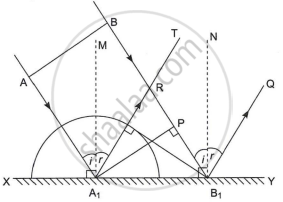
Reflection of light
XY: Plane reflecting surface
AB: Plane wavefront
RB1: Reflecting wavefront
A1M, B1N: Normal to the plane
∠AA1M = ∠BB1N = ∠i = Angle of incidence
∠TA1M = ∠QB1N = ∠r = Angle of reflection
A plane wavefront AB is advancing obliquely towards the plane reflecting surface XY. The AA1 and BB1 are incident rays.
When ‘A’ reaches XY at A1, then the ray at ‘B’ reaches point ‘P’, and it has to cover the distance PB1 to reach the reflecting surface XY.
Let ‘t’ be the time required to cover the distance PB1. During this time interval, secondary wavelets are emitted from A1 and will spread over a hemisphere of radius A1R, in the same medium. The distance covered by secondary wavelets to reach from A1 to R in time t is the same as the distance covered by primary waves to reach from P to B1. Thus, A1R = PB1 = ct.
All other rays between AA1 and BB1 will reach XY after A1 and before B1. Hence, they will also emit secondary wavelets of decreasing radii.
The surface touching all such hemispheres is RB1 which is the reflected wavefront, bounded by reflected rays A1R and B1Q.
Draw A1M ⊥ XY and B1N ⊥ XY.
Thus, the angle of incidence is ∠AA1M = ∠BB1N = i, and the angle of reflection is ∠MA1R = ∠NB1Q = r.
∠RA1B1 = 90 − r
∠PB1A1 = 90 − i
In ΔA1RB1 and ΔA1PB1
∠A1RB1 = ∠A1PB1
A1R = PB1 ...(Reflected waves travel an equal distance in the same medium in equal time.)
A1B1 = A1B1 ....(Common side)
∴ ΔA1RB1 ≅ ΔA1PB1
∴ ∠RA1B1 = ∠PB1A1
∴ 90 − r = 90 − i
∴ i = r
Also from the figure, it is clear that incident rays, reflected rays, and normal lie in the same plane.
This explains the laws of reflection of light from a plane reflecting surface on the basis of Huygen’s wave theory.
Frequency, wavelength, and speed of light do not change after reflection. If reflection takes place from a denser medium, then the phase changes by π radians.
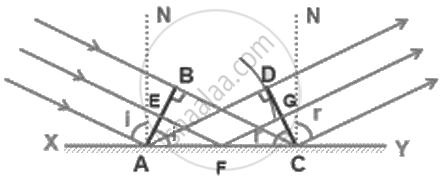
AB = Incident wavefront
CD = Reflected wavefront
XY = Reflecting surface
If c be the speed of light and t be the time taken by light to go from B to C or A to D or E to G through F, then
t = `(EF)/C + (FG)/C`
= `(AF sin i)/C + (FC sin r)/C`
= `(AC sin r + AF(sin i - sin r))/C`
For rays of light from different parts of the incident wavefront, the values of AF are different. But light from different points of the incident wavefront should take the same time to reach the corresponding points on the reflected wavefront.
So, ‘t’ should not depend upon AF.
This is possible only if sin i – sin r = 0.
i.e., sin i = sin r
⇒ i = r
Hence proved.
Law: Brewster's Law
Statement:
When unpolarised light is incident at polarising angle iB on an interface separating air from a medium of refractive index μ, then the reflected light is plane polarised (perpendicular to the plane of incidence), provided:
μ = tan iB
Additional condition at polarising angle:
iB + r = \[\frac {π}{2}\]
i.e., the reflected plane polarised light is at right angles to the refracted light.
OR
Statement:
- When the angle of incidence equals the polarising angle (θB), the reflected and refracted rays are perpendicular to each other.
- "The refractive index of a medium is equal to the tangent of the polarising angle θB."
μ = tan θp
From Brewster's law: \[\mu=\frac{\sin\theta_p}{\sin r}=\frac{\sin\theta_p}{\sin(90°-\theta_p)}=\frac{\sin\theta_p}{\cos\theta_p}=\tan\theta_p\]
Law: Laws of Reflection
- The angle of incidence ∠i = angle of reflection ∠r.
- The incident ray, reflected ray, and normal lie in one plane; both rays are on either side of the normal.
Key Points
Key Points: Reflection of Light by Spherical Mirrors
- The laws of reflection apply to both plane and curved reflecting surfaces.
- In spherical mirrors, the normal is taken at the point of incidence.
- The normal is along the radius joining the centre of curvature to the point of incidence.
- The geometric centre of a spherical mirror is called the pole.
- The line joining the pole and the centre of curvature is the principal axis.
Key Points: Refraction by a Lens
- A lens forms images by refraction at its two spherical surfaces.
- A transparent refracting medium bounded by two surfaces, of which at least one is spherical, is called a lens.
- The new Cartesian sign convention is used in lens problems.
- The focal length of a convex lens is positive, and the focal length of a concave lens is negative.
- The lens formula is: \[\frac {1}{v}−\frac {1}{u}=\frac {1}{f}\]
- The lens maker’s formula is: \[\frac {1}{f}\] = (μ − 1)(\[\frac {1}{R_1}−\frac {1}{R_2}\])
- Magnification is given by: m = \[\frac {h_i}{h_o}\] = \[\frac {v}{u}\]
- A ray through the optical centre passes without appreciable deviation.
- A lens disappears in a liquid if the refractive index of the liquid is the same as that of the lens.
Key Points: Thin Lenses and Their Combination
Lens Formula:
\[\frac{1}{v}-\frac{1}{u}=\frac{1}{f}\]
Magnification:
\[m=\frac{h_i}{h_o}=\frac{v}{u}=\frac{f}{f+u}=\frac{f-v}{f}\]
Combination of Thin Lenses in Contact:
- Effective focal length: \[\frac{1}{F}=\frac{1}{f_1}+\frac{1}{f_2}+\frac{1}{f_3}+...\]
- Total power: P = P1 + P2 + P3 + ...
- When one lens is concave and other convex: \[F=\frac{f_1f_2}{f_2-f_1}\]
For Separated Lenses (distance d apart):
\[\frac{1}{F}=\frac{1}{f_1}+\frac{1}{f_2}-\frac{d}{f_1f_2}\]
Key Points: Some Natural Phenomena Due to Sunlight
- A rainbow forms due to refraction, dispersion, and internal reflection inside a single raindrop.
- Primary rainbow → 2 refractions + 1 internal reflection; red outer, violet inner (θR = 43°, θV = 41°).
- Secondary rainbow → 2 refractions + 2 internal reflections; red inner, violet outer (θR = 51°, θV = 54°).
- Mirage is an optical illusion of water on a hot day caused by upward bending of light due to temperature differences in air layers.
Key Points: Reflection and Refraction of Plane Wave at Plane Surface Using Huygens' Principle
Reflection Using Huygens' Principle:
- Reflection is a sudden change in direction of propagation of a wave that strikes a boundary between two different media.
- If incoming rays are plane waves with infinite parallel planes, the wave AB falls on a reflecting surface and is incident perpendicular to the incident ray at angle i.
- AA₁ = BE (equal distances), triangles are congruent → ∠i = ∠r (angle of incidence = angle of reflection). ✓
- First Law of Reflection: ∠i = ∠r
- Second Law: Incident wavefront, reflected wavefront, and normal all lie in same plane perpendicular to reflecting surface.
Refraction Using Huygens' Principle:
- Refraction is the change in velocity of light as it passes from one medium to another.
- If a plane wavefront AB is incident on a surface, v₁ and v₂ are velocities in medium 1 and 2 respectively (v₁ > v₂).
- From Huygens' principle, A and C form the source of secondary spherical wavelets; time = t.
△ADC gives: \[\frac{\sin i}{\sin r}=\frac{\left(\frac{BC}{AC}\right)}{\left(\frac{AD}{AC}\right)}=\frac{BC}{AD}=\frac{v_{1}t}{v_{2}t}=\frac{v_{1}}{v_{2}}=\mu,\]
This proves Snell's Law of Refraction: \[\frac{\sin i}{\sin r}=\frac{v_{1}}{v_{2}}=n\mathrm{(constant)}\].
Key Points: Doppler Effect
- Doppler effect is the apparent change in frequency of sound due to relative motion between the source and listener.
- If the velocity of the source and observer are not along the same line, their respective components along the line joining them must be used for the longitudinal Doppler effect.
- As the speed of light is absolute, for light waves only the relative velocity between the observer and source matters.
Key Points: Dispersion of Light
- Dispersion is the splitting of white light into seven colours (VIBGYOR) when it passes through a prism or similar transparent medium.
- Human eyes can detect light with wavelengths ranging from 400 nm (violet) to 700 nm (red).
- Different colours travel at different speeds in a medium like glass, so each colour has a different refractive index.
- Violet light bends the most, and red light bends the least, as it passes through a prism, producing a spectrum.
- A rainbow is formed due to dispersion, refraction, and internal reflection of sunlight by raindrops acting as tiny prisms.
Key Points: Spherical Mirrors
Key Points: Reflection of Light
- Reflection occurs when light bounces off a smooth surface like a mirror, following fixed laws.
- Plane mirrors always form virtual, erect, and same-sized images that are laterally inverted.
- Curved surfaces (like a spoon) act as spherical mirrors, changing the image size and orientation depending on the object's position.
Concepts [39]
- Reflection of Light by Spherical Mirrors
- Refraction of Light
- Total Internal Reflection
- Refraction at a Spherical Surface and Lenses
- Refraction at a Spherical Surfaces
- Refraction by a Lens
- Thin Lenses and Their Combination
- Refraction of Light through a Prism
- Some Natural Phenomena Due to Sunlight
- Introduction to Optical Instruments
- Simple Microscope or a Reading Glass
- Compound Microscope
- Telescope
- Huygens Principle
- Reflection and Refraction of Plane Wave at Plane Surface Using Huygens' Principle
- Refraction of a Plane Wave
- Refraction at a Rarer Medium
- Reflection of a Plane Wave by a Plane Surface
- Doppler Effect
- Coherent and Incoherent Addition of Waves
- Interference of Light Waves and Young’s Experiment
- Diffraction of Light
- Fraunhofer's Diffraction Due to a Single-slit
- Electric Polarisation of Dielectrics
- Ray Optics - Mirror Formula
- Dispersion of Light Through a Prism
- Young's Double Slit Experiment and Expression for Fringe Width
- No Interference by Two Independent Light-Sources : Coherent Sources
- Resolving Power of Microscope and Astronomical Telescope
- Width of Central Maximum
- Lens Formula and Magnification
- Magnification
- Brewster's Law
- Polaroids
- Plane Mirror
- Spherical Mirrors
- Reflection of Light
- Power of a Lens
- Resolving Power of Optical Instruments
