Definitions [1]
Parallel lines are straight lines that never intersect and remain at a constant distance from each other.
They are denoted by the symbol “∥”, meaning ‘is parallel to’.
Examples: Railroad tracks, Zebra crossings, Staircase steps
Theorems and Laws [1]
Angle Sum Property of a Triangle:
Theorem: The sum of the angles of a triangle is 180°.
Construction: Draw a line XPY parallel to QR through the opposite vertex P.
Proof:
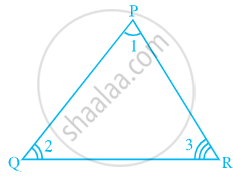
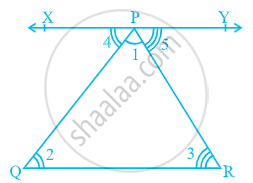
In △ PQR,
Sum of all angles of a triangle is 180°.
∠PQR + ∠PRQ + ∠QPR = 180°......(1)
Since XY is a straight line, it can be concluded that:
Therefore, ∠XPY + ∠QRP + ∠RPY = 180°.
But XPY || QR and PQ, PR are transversals.
So,
∠XPY = ∠PQR.....(Pairs of alternate angles)
∠RPY = ∠PRQ.....(Pairs of alternate angles)
Substituting ∠XPY and ∠RPY in (1), we get
∠PQR + ∠PRQ + ∠QPR = 180°
Thus, The sum of the angles of a triangle is 180°.
Concepts [7]
- Introduction to Lines and Angles
- Basic Terms and Definitions
- Intersecting Lines and Non-intersecting Lines
- Parallel Lines
- Concept of Pairs of Angles
- Concept of Transversal Lines
- Basic Properties of a Triangle
