HSC Commerce (English Medium)
HSC Science (General)
HSC Arts (English Medium)
HSC Science (Electronics)
HSC Science (Computer Science)
HSC Commerce: Marketing and Salesmanship
Academic Year: 2024-2025
Date & Time: 9th July 2025, 11:00 am
Duration: 3h
Advertisements
- All questions are compulsory.
- Draw neat tables/diagrams wherever necessary.
- Figures to the right indicate full marks.
- Write answers to all main questions on new pages.
The method adopted in microeconomic analysis:
- Lumping method
- Aggregative method
- Slicing method
- Inclusive method
a, c and d
a, b and d
Only c
Only a
b, c and d
a, b, c, and d
Chapter:
Under perfect competition, sellers are:
- Price makers
- Price takers
- Price discriminators
- None of these
a, b and c
only b
only c
a and c
Chapter:
Statements that are correct in relation to Index Numbers:
- Index numbers are a geographical tool.
- Index numbers measure changes in the air pressure.
- Index numbers measure relative changes in an economic variable.
- Index numbers are specialised averages.
c and d
a and b
b and c
a and d
Chapter:
Obligatory functions of the government:
- Protection from external attacks
- Maintaining internal law and order
- Welfare measures
- Exporting goods and services
c and d
a and b
Only b
a, c, and d
Chapter:
Types of foreign trade are as follows:
- Import trade
- Export trade
- Entrepot trade
- Internal trade
a and b
a, b, and c
a, b, c, and d
None of these
Chapter:
Give an economic term:
A desire which is backed by willingness to purchase and ability to pay.
Chapter:
Give an economic term:
Net addition made to the total cost by producing one more unit of output.
Chapter:
Give an economic term:
The market where there are few sellers.
Chapter:
Give an economic term:
The gross market value of all final goods and services produced within the domestic territory of a country during a period of a year.
Chapter: [7] National Income
Give an economic term:
Buying and selling of goods and services within the boundaries of a nation.
Chapter:
Microeconomics is also known as ______.
Price Theory
Income Theory
Growth Theory
Development Theory
Chapter:
When total utility is maximum, then marginal utility is ______.
Positive
Negative
Zero
One
Chapter:
The demand curve is parallel to the X-axis in the case of ______.
perfectly elastic demand
perfectly inelastic demand
relatively elastic demand
relatively inelastic demand
Chapter:
In India, National Income is estimated by the Central Statistical Organization (CSO) using a ______.
Output method
Income method
Expenditure method
Combination of Output and Income method
Chapter:
A market for lending and borrowing of short-term funds is known as the ______.
Money market
Capital market
Labour market
Product market
Chapter:
Find the odd word:
Types of utility:
Form utility, Place utility, Marginal utility, Service utility
Chapter:
Advertisements
Find the odd word:
Determinants of demand:
Price, Income, Prices of substitute goods, Giffen’s paradox
Chapter:
Find the odd word:
Methods of measuring price elasticity of demand:
Income method, Percentage method, Total Expenditure method, Point method/Geometric method.
Chapter:
Find the odd word:
Exceptions to the law of supply:
Supply of labour, Agricultural goods, Prestige goods, Perishable goods
Chapter:
Find the odd word:
Non-Tax Revenue Sources:
Fees, Customs duty, Special assessment, Fines and penalties
Chapter:
Identify and explain the following concept:
Raju collected the information about the total consumption, total savings, and total investment of the Indian economy.
Chapter:
Identify and explain the following concept:
A rise in price by 20% of a commodity ‘X’ leads to a fall in the demand of the same commodity ‘X’ by 20%.
Chapter:
Identify and explain the following concept:
Swara receives a monthly pension of ₹ 8,000 from the State Government of Maharashtra.
Chapter:
Identify and explain the following concept:
Tushar deposited a lump sum amount of ₹ 1,00,000 in the bank for a period of three years.
Chapter:
Identify and explain the following concept:
Sharad was able to supply less paper to the market due to technical problems in the paper-making factory, although the price of paper remained constant.
Chapter:
Distinguish between the slicing method and the lumping method.
Chapter:
Distinguish between expansion in demand and increase in demand.
Chapter: [1.03] Analysis of Demand and Elasticity of Demand [3.1] Demand Analysis
Distinguish between simple index numbers and weighted index numbers.
Chapter:
Distinguish between the following concepts:
Public Finance and Private Finance
Chapter: [8] Public Finance in India
Advertisements
Explain any four features of perfect competition.
Chapter: [1.05] Types of Market and Price Determination Under Perfect Competition
Explain the functions of RBI.
Chapter: [9] Money Market and Capital Market in India [9] Money Market and Capital Market in India
Explain the two-sector model of the circular flow of National Income.
Chapter: [7] National Income
Explain the types of index numbers.
Chapter: [6] Index Numbers
State with reasons whether you agree or disagree with the following statement:
There are no real exceptions to the law of Diminishing Marginal Utility.
Chapter:
State with reasons whether you agree or disagree with the following statement:
There are many features of monopolistic competition.
Chapter:
State with reasons whether you agree or disagree with the following statement:
There are no limitations of Index Number.
Chapter:
State with reasons whether you agree or disagree with the following statement:
Money market plays an important role in India.
Chapter: [9] Money Market and Capital Market in India
State with reasons whether you agree or disagree with the following statement:
There is no difference between Balance of Payment and Balance of Trade.
Chapter:
Observe the given label and answer the questions:
| Unit of commodity | Total Utility | Marginal Utility |
| 1 | 10 | `square` |
| 2 | 18 | 8 |
| 3 | `square` | 6 |
| 4 | 28 | 4 |
| 5 | 30 | `square` |
| 6 | 30 | 0 |
| 7 | `square` | −2 |
Questions:
- Complete the above table. [2]
- When total utility increases at a diminishing rate, then marginal utility goes on ______. [1]
- After consuming six units of the commodity, MU becomes ______. [1]
Chapter:
Observe the following diagrams and answer the questions given below:
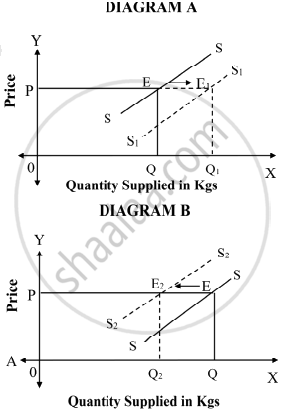
Questions:
- Diagram ‘A’ represent a ______ in supply. (1)
- Diagram ‘B’ represents a ______ in supply. (1)
- In diagram ‘A’, the supply curve shifts to the ______ side of the original supply curve. (1)
- In diagram ‘B’, the supply curve shifts to the ______ side of the original supply curve. (1)
Chapter:
Read the given passage and answer the questions:
|
The Government of India and various agencies continuously monitor and calculate the National Income using different methods, such as output, income, and expenditure methods, etc. These methods help in providing a comprehensive picture of India’s economic performance. From 2001 to 2021, India’s GDP grew at an average annual rate of around 6 to 7%. The country saw a significant shift from primarily agriculture-based to a more diverse economy, with services and industrial sectors playing a more prominent role in GDP composition. However, it is important to note that there were fluctuations and challenges along the way, including the global financial crisis in 2008 and the COVID-19 pandemic in 2020, which temporarily disrupted growth trends. In recent years, India has aimed for sustainable economic development, focusing on information technology. The initiatives such as “Make in India” and “Digital India” have been launched to boost economic activities and create employment opportunities, which in turn impact the National Income positively. |
Questions:
- What is the average annual growth rate of India for the period from 2001 to 2021? [1]
- Which factors disrupted the growth trends of India’s National Income? [1]
- Express your opinion about the given passage. [2]
Chapter:
State and explain the law of demand.
Chapter: [1.03] Analysis of Demand and Elasticity of Demand [3.1] Demand Analysis
State and explain the factors influencing the elasticity of demand.
Chapter: [3.2] Elasticity of Demand
Explain various reasons for the growth of public expenditure.
Chapter: [8] Public Finance in India
Other Solutions
Submit Question Paper
Help us maintain new question papers on Shaalaa.com, so we can continue to help studentsonly jpg, png and pdf files
Maharashtra State Board previous year question papers 12th Standard Board Exam Economics with solutions 2024 - 2025
Previous year Question paper for Maharashtra State Board 12th Standard Board Exam Eco-2025 is solved by experts. Solved question papers gives you the chance to check yourself after your mock test.
By referring the question paper Solutions for Economics, you can scale your preparation level and work on your weak areas. It will also help the candidates in developing the time-management skills. Practice makes perfect, and there is no better way to practice than to attempt previous year question paper solutions of Maharashtra State Board 12th Standard Board Exam.
How Maharashtra State Board 12th Standard Board Exam Question Paper solutions Help Students ?
• Question paper solutions for Economics will helps students to prepare for exam.
• Question paper with answer will boost students confidence in exam time and also give you an idea About the important questions and topics to be prepared for the board exam.
• For finding solution of question papers no need to refer so multiple sources like textbook or guides.
