Advertisements
Advertisements
Question
X is a normally distributed variable with mean µ = 30 and standard deviation σ = 4. Find P(30 < X < 35)
Advertisements
Solution
Given X ~ N(µ, σ2)
µ = 30
σ = 4
P(30 < X < 35) = ?
When x = 30
z = `(35 - 30)/4 = 5/4` = 1.25
P(30 < x < 35) = P(0 < z < 1.25)
= 0.3944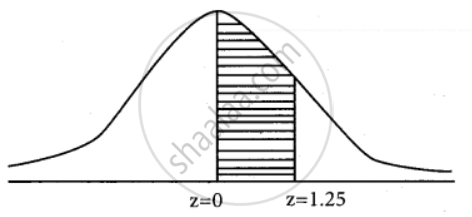
APPEARS IN
RELATED QUESTIONS
In a particular university 40% of the students are having newspaper reading habit. Nine university students are selected to find their views on reading habit. Find the probability that none of those selected have newspaper reading habit
In a particular university 40% of the students are having newspaper reading habit. Nine university students are selected to find their views on reading habit. Find the probability that all those selected have newspaper reading habit
Write any 2 examples for Poisson distribution
Write the conditions for which the poisson distribution is a limiting case of binomial distribution
The distribution of the number of road accidents per day in a city is poisson with mean 4. Find the number of days out of 100 days when there will be atleast 2 accidents
The distribution of the number of road accidents per day in a city is poisson with mean 4. Find the number of days out of 100 days when there will be at most 3 accidents
Choose the correct alternative:
If Z is a standard normal variate, the proportion of items lying between Z = – 0.5 and Z = – 3.0 is
Choose the correct alternative:
Which of the following cannot generate a Poisson distribution?
Choose the correct alternative:
If P(Z > z) = 0.8508 what is the value of z (z has a standard normal distribution)?
Hospital records show that of patients suffering from a certain disease 75% die of it. What is the probability that of 6 randomly selected patients, 4 will recover?
